Deep within the verdant expanses of Guatemala’s Maya rainforest, an unprecedented study spearheaded by Washington State University researchers has illuminated a promising narrative of coexistence. Utilizing an intricate network of camera traps, scientists documented a thriving community of medium-to-large mammals and birds living in a forest managed by local residents. This remarkable discovery challenges the prevailing notion that human use of tropical forests inevitably leads to biodiversity loss and environmental degradation.
The study, published in the journal Conservation Biology, undertakes a rigorous comparison between strictly protected areas and community-managed forests within the Maya Biosphere Reserve. Here, the Uaxactun community legally harvests timber and hunts for subsistence, tightly regulating these activities to minimize ecological impact. The findings reveal that species richness and animal occupancy rates in this managed forest mirror those found within adjacent national parks and wildlife preserves, suggesting that sustainable human use need not come at the expense of biodiversity conservation.
To achieve this comprehensive insight, the research team deployed a sophisticated grid of camera traps covering approximately 1,500 square kilometers. Their meticulous methodology involved targeting ecologically significant sites such as waterholes and forest trails — locations that serve as critical hubs for animal activity. The collaboration with local hunters and bird watchers was pivotal, as their intimate knowledge of animal behavior and terrain enhanced the precision and efficacy of monitoring efforts.
Despite the optimistic overall results, the study also uncovers subtle yet profound effects of human presence on certain vulnerable species. White-lipped peccaries, Baird’s tapirs, and great curassows exhibited aversion to areas with high human activity, retreating into more remote forest sections. Such cryptic disturbances underscore how anthropogenic pressures can cascade through ecosystems in non-obvious ways, resulting in “empty forest” conditions beneath a seemingly intact canopy.
Associate Professor Daniel Thornton, senior author of the study, underscores this complexity, emphasizing that remote sensing tools like satellite imagery—while useful for assessing canopy cover—fall short in revealing the nuanced realities of wildlife presence. The “empty forest” phenomenon can mask the silent erosion of animal populations, threatening the ecological functions they sustain. Large mammals, for instance, are essential for seed dispersal, maintaining plant diversity, and enhancing carbon sequestration—all vital processes for both local and global environmental stability.
This pioneering research also highlights the intricate balance achieved by the Uaxactun community’s stewardship. Their forest management, certified by the Forest Stewardship Council, exemplifies a model where regulated harvesting and subsistence hunting coexist with robust wildlife populations. The study’s detailed spatial data confirm that, although certain species avoid human-dense zones, overall biodiversity remains comparable to that in protected reserves, validating the multifaceted benefits of community-based conservation.
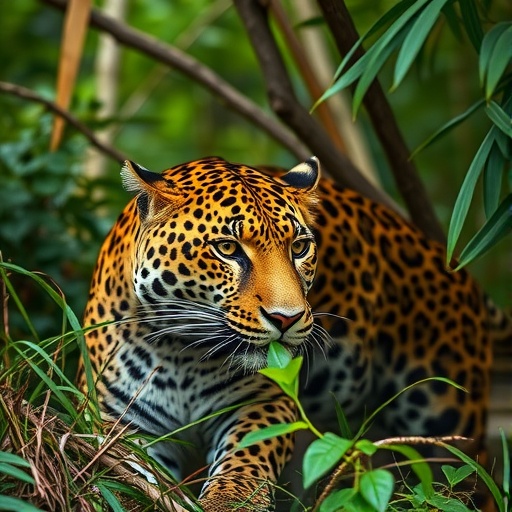
An extraordinary moment captured by the camera traps underscores the richness of the ecosystem. Researchers documented a jaguar hunting an ocelot at a secluded waterhole—an event rarely recorded and likely the first photographic evidence of such predation. This dramatic snapshot not only showcases the complex predator-prey dynamics but also reflects the hidden life stirring beneath the forest canopy, invisible to the casual observer yet crucial for ecosystem resilience.
The team’s findings carry profound implications for conservation policy worldwide. In contexts where outright exclusion of humans is neither feasible nor desirable, the Uaxactun case offers compelling evidence that thoughtful, community-led forest management can sustain both livelihoods and biodiversity. The area’s proximity to national parks provides an ecological buffer, but it is the community’s cultural traditions, political engagement, and active defense against external exploitation that fortify its success.
Integral to Uaxactun’s resilience is its affiliation with the Association of Forest Communities of Peten (ACOFOP), which empowers local groups through political advocacy and facilitates access to governmental resources. These institutional supports are as critical as ecological factors in enabling sustainable stewardship, demonstrating that conservation in tropical forests demands holistic approaches that intertwine social and environmental dimensions.
Moreover, this research punctuates the necessity for ground-based biodiversity monitoring to complement remote sensing technologies. While satellites can map broad forest trends, only in-situ observations reveal how animal communities respond to human activities and environmental pressures. Such detailed monitoring enables adaptive management strategies and informs policymakers, ensuring that conservation interventions remain effective under shifting ecological and social landscapes.
Ultimately, the study signals a hopeful paradigm shift—moving beyond simplistic binaries of protection versus exploitation toward nuanced strategies that embrace coexistence. It argues persuasively that tropical forests, despite their breathtaking beauty and ecological complexity, require vigilant stewardship informed by robust scientific inquiry. Balancing human needs with wildlife persistence is not merely an aspirational ideal but an achievable goal, as evidenced by the successes unfolding in Guatemala’s Maya rainforest.
As Lucy Perera-Romero, the study’s lead author, poignantly states, the forest’s canopy may conceal a fragile world beneath. Enhancing our understanding of the “understory” is indispensable for conserving these ecosystems. This research not only deepens our appreciation for tropical biodiversity but also equips conservationists and communities with the knowledge to protect these irreplaceable landscapes for future generations of people and jaguars alike.
Subject of Research: Biodiversity outcomes and species responses to anthropogenic disturbances in tropical forests within community-managed and protected areas of Guatemala’s Maya Biosphere Reserve.
Article Title: Use of species’ responses to cryptic anthropogenic disturbances for monitoring biodiversity outcomes in tropical forests
News Publication Date: 10-Oct-2025
Web References:
https://conbio.onlinelibrary.wiley.com/doi/10.1111/cobi.70159
Image Credits: Photo courtesy of WCS, WSU, OMYC, CONAP, ACOFOP, Coypu.
Keywords: Community-managed forests, Tropical biodiversity, Camera trap monitoring, Jaguar, Anthropogenic disturbance, Conservation biology, Maya Biosphere Reserve, Forest stewardship, Wildlife coexistence, Cryptic impacts, Species richness, Conservation policy
Tags: animal occupancy rates in forestscamera-trap research methodscoexistence of humans and wildlifecommunity-managed forests Guatemalaconservation biology studiesecological significance of waterholesimpact of hunting on biodiversityMaya rainforest biodiversity conservationprotecting species richness in tropical forestssustainable timber harvesting practicesUaxactun community conservation effortsWashington State University research findings