Credit: Juan Patiño
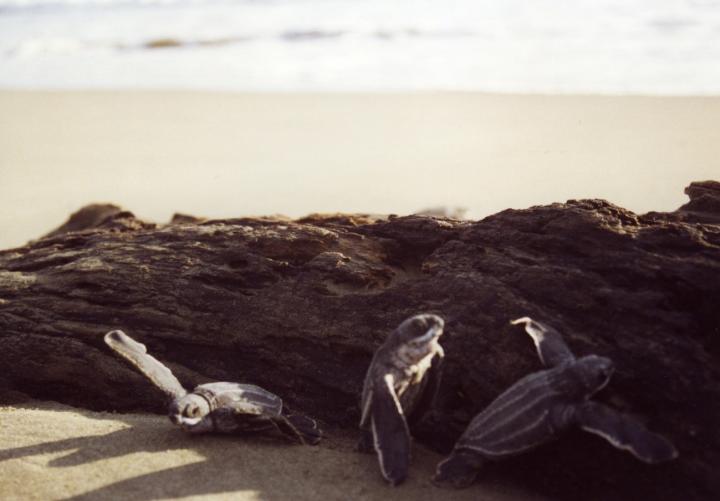
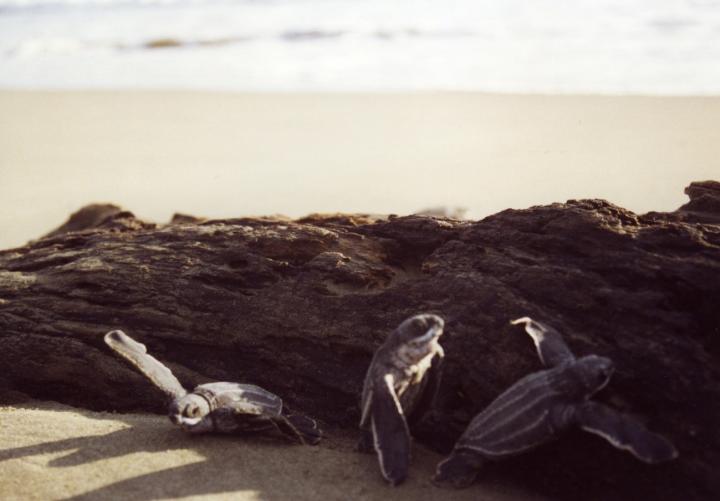
Debris from logging in tropical forests is threatening the survival of hatchling leatherback turtles and the success of mothers at one of the world's most important nesting sites in Colombia.
New research by the University of Exeter and the Doñana Biological Station in Seville, Spain, has found that debris on beaches caused by logging activity is impacting both young turtles and their mothers during the key periods of their life cycles.
Leatherbacks are at particular risk of being caught up in fishing nets and longlines as bycatch, because they are migratory, travelling long distances worldwide.
Many breeding sites are already under pressure from tourism.
But now, research published in the journal Marine Ecology Progress Series has revealed that the logging is an additional, previously underestimated threat.
To nest and breed successfully, females must be able to cross the sandy beaches to dig their nest to successfully incubate their eggs.
In turn, hatchlings must be able to cross the sand unaccompanied to reach the water.
Researchers found that the beach debris hindered this movement.
The team monitored 216 turtles, comparing their activity in areas with high amounts of debris to low amounts, in a globally significant nesting site in Colombia.
They also manipulated the amount of debris to see how it changed behaviour.
They found that females which nested in areas with higher amounts of debris were spent more time building their nest and tended to do so closer to the shoreline.
This meant they were more vulnerable to flooding, which puts their eggs at risk.
Some females were even wounded in the process.
The debris also meant it took longer for hatchlings to reach the sea, increasing their chance of being eaten by predators and meaning they had to expend more energy, making them more vulnerable.
Professor Brendan Godley, director of the Centre for Ecology and Conservation on the University of Exeter's Penryn Campus in Cornwall, is a co-author on the research.
He said: "Leatherback turtles are already under immense pressure, from fisheries bycatch and are also one of the species prone to ingesting marine plastic litter.
"Our research clearly indicates that logging presents another threat.
"It is now paramount that beach clean-up operations are built into logging activities to prevent further damage to this species."
Dr Adolfo Marco Llorente, of the Doñana Biological Station, said: "Although logging debris does not affect rates of nesting, it has a significant impact on where and how nests are built, which negatively affects both mothers and hatchlings.
"This is on a scale that could lead over time to reduction of the overall population.
"Simple measures could make a real difference, such as repositioning organic waste areas, or salvaging the wood debris as an energy source.
"It's also essential that logging practices that reduce the impact on the marine environment are implemented."
###
Media Contact
Alex Morrison
[email protected]
01-392-724-828
@uniofexeter
http://www.exeter.ac.uk
############
Story Source: Materials provided by Scienmag