• HOME
  • NEWS
  • EXPLORE
    • CAREER
      • Companies
      • Jobs
    • EVENTS
    • iGEM
      • News
      • Team
    • PHOTOS
    • VIDEO
    • WIKI
  • BLOG
  • COMMUNITY
    • FACEBOOK
    • INSTAGRAM
    • TWITTER
Saturday, February 7, 2026
BIOENGINEER.ORG
No Result
View All Result
  • Login
  • HOME
  • NEWS
  • EXPLORE
    • CAREER
      • Companies
      • Jobs
        • Lecturer
        • PhD Studentship
        • Postdoc
        • Research Assistant
    • EVENTS
    • iGEM
      • News
      • Team
    • PHOTOS
    • VIDEO
    • WIKI
  • BLOG
  • COMMUNITY
    • FACEBOOK
    • INSTAGRAM
    • TWITTER
  • HOME
  • NEWS
  • EXPLORE
    • CAREER
      • Companies
      • Jobs
        • Lecturer
        • PhD Studentship
        • Postdoc
        • Research Assistant
    • EVENTS
    • iGEM
      • News
      • Team
    • PHOTOS
    • VIDEO
    • WIKI
  • BLOG
  • COMMUNITY
    • FACEBOOK
    • INSTAGRAM
    • TWITTER
No Result
View All Result
Bioengineer.org
No Result
View All Result
Home NEWS Science News

A NASA infrared look at the Southern Indian Ocean’s 15th tropical cyclone

Bioengineer by Bioengineer
April 6, 2017
in Science News
Reading Time: 2 mins read
0
Share on FacebookShare on TwitterShare on LinkedinShare on RedditShare on Telegram
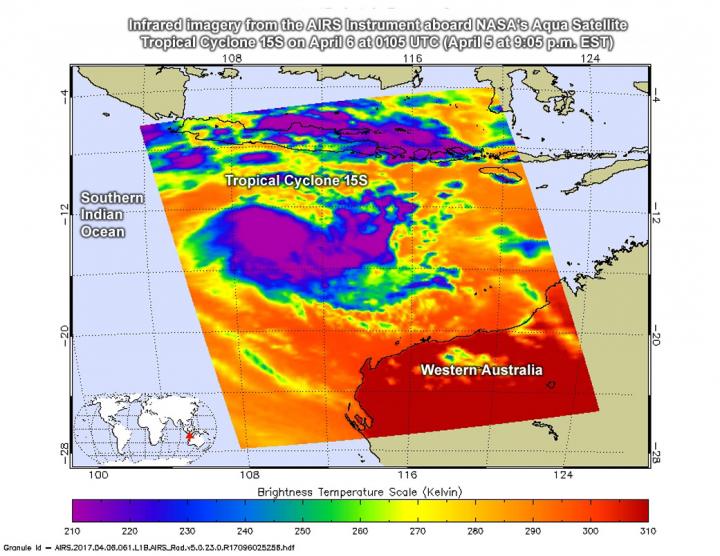
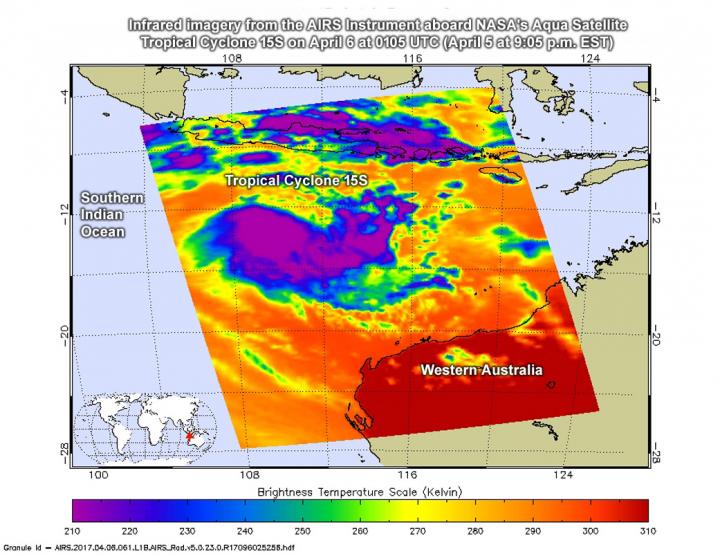
IMAGE

Credit: Credits: NASA JPL, Ed Olsen

NASA's Aqua satellite passed over Tropical Cyclone 15S in the Southern Indian Ocean and obtained temperature data on the cloud tops, enabling scientists to see where the strongest part of the storm was located.

The Atmospheric Infrared Sounder or AIRS instrument aboard NASA's Aqua satellite looked at Tropical Cyclone 15S in infrared light. Infrared light provides scientists with temperature data and that's important when trying to understand how strong storms can be. The higher the cloud tops, the colder and the stronger the storms that make up a tropical cyclone.

NASA's Aqua satellite flew over Tropical Cyclone 15S on April 6 at 0605 UTC (2:05 a.m. EST). AIRS detected strongest storms around the center of circulation with cloud top temperatures as cold as minus 63 degrees Fahrenheit (minus 53 degrees Celsius). Storms with cloud top temperatures that cold have the capability to produce heavy rainfall.

The Joint Typhoon Warning Center or JTWC stated on April 6 at 0900 UTC (5 a.m. EST) newly formed Tropical Cyclone 15S had maximum sustained winds near 35 knots (40 mph/62 kph). 15S was centered near 13.5 degrees south latitude and 110.7 degrees east longitude, about 572 nautical miles (658 miles/1,059 km) north-northwest of Learmonth, Australia. 15S was moving to the south-southwest at 4 knots (4.6 mph/7.4 kph) away from Australia.

The JTWC noted "Upper level atmospheric analysis Indicates the system is in an area of strong westerly vertical wind shear. Additionally, a mid-latitude trough or elongated area of low pressure is causing subsidence along the southwestern quadrant (of the storm)." Subsidence means sinking air, and that prevents cloud formation as air has to rise in order to condense to form clouds and the thunderstorms that make up a tropical cyclone.

Tropical Cyclone 15S is moving along the northwestern edge of an elongated area of subtropical high pressure, which is located southeast of the storm. That means that 15S expected to continue tracking south-southwestward around that high pressure area, turning more to the west as the high pressure builds.

JWTC forecasts this system will be short-lived because vertical wind shear will increase in the direction the storm is heading. It is expected to dissipate in three days by April 9.

###

Media Contact

Rob Gutro
[email protected]
@NASAGoddard

http://www.nasa.gov/goddard

############

Story Source: Materials provided by Scienmag

Share12Tweet8Share2ShareShareShare2

Related Posts

Boosting Remote Healthcare: Stepped-Wedge Trial Insights

February 7, 2026

Barriers and Boosters of Seniors’ Physical Activity in Karachi

February 7, 2026

Evaluating Pediatric Emergency Care Quality in Ethiopia

February 7, 2026

TPMT Expression Predictions Linked to Azathioprine Side Effects

February 7, 2026
Please login to join discussion

POPULAR NEWS

  • Robotic Ureteral Reconstruction: A Novel Approach

    Robotic Ureteral Reconstruction: A Novel Approach

    82 shares
    Share 33 Tweet 21
  • Digital Privacy: Health Data Control in Incarceration

    63 shares
    Share 25 Tweet 16
  • Study Reveals Lipid Accumulation in ME/CFS Cells

    57 shares
    Share 23 Tweet 14
  • Breakthrough in RNA Research Accelerates Medical Innovations Timeline

    53 shares
    Share 21 Tweet 13

About

We bring you the latest biotechnology news from best research centers and universities around the world. Check our website.

Follow us

Recent News

Boosting Remote Healthcare: Stepped-Wedge Trial Insights

Barriers and Boosters of Seniors’ Physical Activity in Karachi

Evaluating Pediatric Emergency Care Quality in Ethiopia

Subscribe to Blog via Email

Enter your email address to subscribe to this blog and receive notifications of new posts by email.

Join 73 other subscribers
  • Contact Us

Bioengineer.org © Copyright 2023 All Rights Reserved.

Welcome Back!

Login to your account below

Forgotten Password?

Retrieve your password

Please enter your username or email address to reset your password.

Log In
No Result
View All Result
  • Homepages
    • Home Page 1
    • Home Page 2
  • News
  • National
  • Business
  • Health
  • Lifestyle
  • Science

Bioengineer.org © Copyright 2023 All Rights Reserved.