


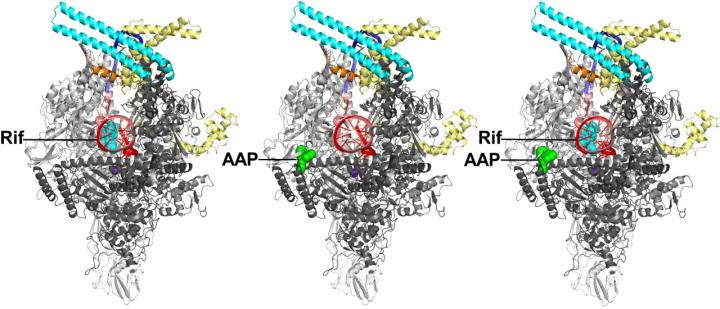
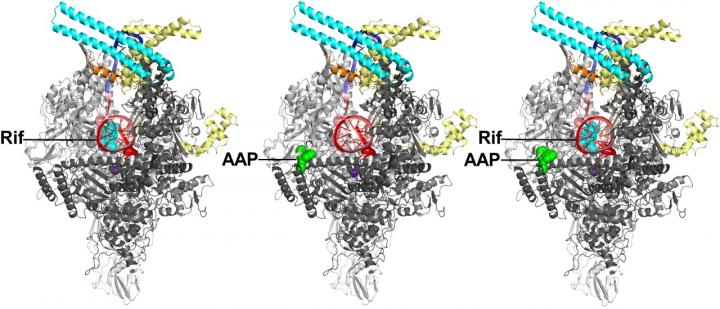
Credit: Wei Lin and Richard H. Ebright
Rutgers University scientists have determined the three-dimensional structure of the target of the first-line anti-tuberculosis drug rifampin. They have also discovered a new class of potential anti-tuberculosis drugs that kill rifampin-resistant and multi-drug-resistant tuberculosis bacteria.
Tuberculosis (TB) bacteria infect a third of the world's population and the disease kills 1.8 million people annually.
Rifampin, a compound that kills TB bacteria, has been the cornerstone of anti-TB therapy since its discovery in 1961. However, rifampin-resistant TB has spread widely, posing an urgent public health crisis. Rifampin resistant TB arises when TB bacteria acquire mutations that alter the binding site for rifampin on the enzyme it inhibits in TB bacteria, Mtb RNA polymerase (Mtb RNAP). The alterations of the rifampin binding site prevent rifampin from binding to and inhibiting Mtb RNAP, preventing rifampin from killing TB bacteria.
Intensive efforts have been underway worldwide to develop improved rifampin derivatives that are unaffected by alterations of the rifampin binding site on Mtb RNAP and that thus can kill rifampin-resistant TB bacteria. Intensive efforts also have been underway to develop new, non rifampin-related Mtb RNAP inhibitors that function through binding sites on Mtb RNAP that do not overlap the rifampin binding site and that thus can kill rifampin-resistant TB bacteria. However, until now, these efforts have been hampered by the absence of structural information for Mtb RNAP, making rational, structure-based drug discovery for Mtb RNAP impossible.
In a paper published online in Molecular Cell today, Richard H. Ebright and other Rutgers scientists report the three-dimensional structures of Mtb RNAP and Mtb RNAP bound to rifampin. The structures were determined by use of X-ray crystallography and are at a resolution sufficient to define the positions, conformations and interactions of individual amino acid residues of Mtb RNAP. The results reveal the interactions between Mtb RNAP and rifampin, reveal the mechanism by which rifampin inhibits Mtb RNAP, and enable rational, structure-based design of improved rifampin derivatives for inhibition of Mtb RNAP.
In addition, the Rutgers scientists report the discovery and properties of new, non‑rifampin‑related compounds–Na-aroyl-N-aryl-phenylalaninamides (AAPs)–that potently and selectively inhibit Mtb RNAP and potently and selectively kill TB bacteria.They also report the structures of Mtb RNAP bound to an AAP and Mtb RNAP bound to both an AAP and rifampin. The results show that AAPs inhibit Mtb RNAP through a binding site that does not overlap the rifampin binding site and thus can inhibit rifampin-resistant Mtb RNAP and kill rifampin-resistant TB bacteria. The results further show that AAPs function additively if co-administered with rifampin and show that AAPs suppress the emergence of resistance if co-administered with rifampin. Taken together, the results show that AAPs are exceptionally promising new lead compounds for anti-TB drug development.
"The structure of Mtb RNAP has been the 'Holy Grail' for TB drug discovery targeting Mtb RNAP," said Ebright, Board of Governors Professor of Chemistry and Chemical Biology and Laboratory Director at the Waksman Institute of Microbiology at Rutgers.
"AAPs represent an entirely new class of Mtb RNAP inhibitors and are, without question, the most promising Mtb RNAP inhibitors for anti-TB drug development since rifampin," Ebright said. "We are very actively pursing AAPs. We have synthesized and evaluated more than 600 novel AAPs and have identified AAPs with high potencies and favorable intravenous and oral pharmacokinetics."
"Tuberculosis (TB) remains a major global health problem and identifying new drug targets and candidate drugs is a major priority," said David S. Perlin, Executive Director and Professor at the Public Health Research Institute and Rutgers Regional Biocontainment Laboratory at the International Center for Public Health at Rutgers New Jersey Medical School in Newark.
"This work by the Ebright laboratory represents a major step forward by providing a detailed structural look at RNA polymerase, an essential enzyme and a well-established drug target in Mycobacterium tuberculosis," Perlin said. "Furthermore, they demonstrate that a new chemical class binds to an alternative site on the enzyme, which overcomes existing drug resistance and opens up the exciting possibility for development of a novel class of anti-TB drugs."
The research team included professors Richard H. Ebright and Eddy Arnold and researchers Wei Lin, Soma Mandal, David Degen, Yu Liu, Yon W. Ebright, Shengjian Li, Feng Yu, Yu Zhang, Sukhendu Mandal, Yi Jiang, Shuang Liu, Matthew Gigliotti, and Kalyan Das from the Waksman Institute of Microbiology and Center for Advanced Biotechnology and Medicine at Rutgers-New Brunswick and professor Nancy Connell and researcher Meliza Talaue from Rutgers New Jersey Medical School in Newark.
"The discovery of an alternative binding site and the AAPs represents a significant step towards the identification of a novel RNAP inhibitor that would behave like rifampin but be devoid of any pre-existing resistance," said Nader Fotouhi, Chief Scientific Officer at the Global Alliance for TB Drug Development, a not-for-profit organization dedicated to finding faster-acting and affordable drug regimens to fight drug sensitive and resistant tuberculosis. "The co-crystal structure of AAP and Mtb RNAP is a critical stepping stone for the design of next generation RNAP inhibitors."
###
A link to the Molecular Cell article can be found here: http://www.cell.com/molecular-cell/fulltext/S1097-2765(17)30168-5
The study was supported by grant R37-GM041376 from the National Institute of General Medical Sciences at the National Institutes of Health, grant U19-AI109713 from the National Institute of Allergy and Infectious Diseases at the NIH, and contracts from the Global Alliance for TB Drug Development. Data for the study were collected at beamline 19-ID of the Argonne Photon Source, which is supported by the Department of Energy and the National Center for Research Resources and National Institute of General Medical Sciences at the NIH.
Media Contact
Todd B. Bates
[email protected]
848-932-0550
@RutgersU
http://www.rutgers.edu
############
Story Source: Materials provided by Scienmag


