• HOME
  • NEWS
  • EXPLORE
    • CAREER
      • Companies
      • Jobs
    • EVENTS
    • iGEM
      • News
      • Team
    • PHOTOS
    • VIDEO
    • WIKI
  • BLOG
  • COMMUNITY
    • FACEBOOK
    • INSTAGRAM
    • TWITTER
Monday, October 5, 2026
BIOENGINEER.ORG
No Result
View All Result
  • Login
  • HOME
  • NEWS
  • EXPLORE
    • CAREER
      • Companies
      • Jobs
        • Lecturer
        • PhD Studentship
        • Postdoc
        • Research Assistant
    • EVENTS
    • iGEM
      • News
      • Team
    • PHOTOS
    • VIDEO
    • WIKI
  • BLOG
  • COMMUNITY
    • FACEBOOK
    • INSTAGRAM
    • TWITTER
No Result
View All Result
Bioengineer.org
No Result
View All Result
Home NEWS Science News

Project Hotspot

Bioengineer by Bioengineer
April 5, 2017
in Science News
Reading Time: 3 mins read
0
Share on FacebookShare on TwitterShare on LinkedinShare on RedditShare on Telegram
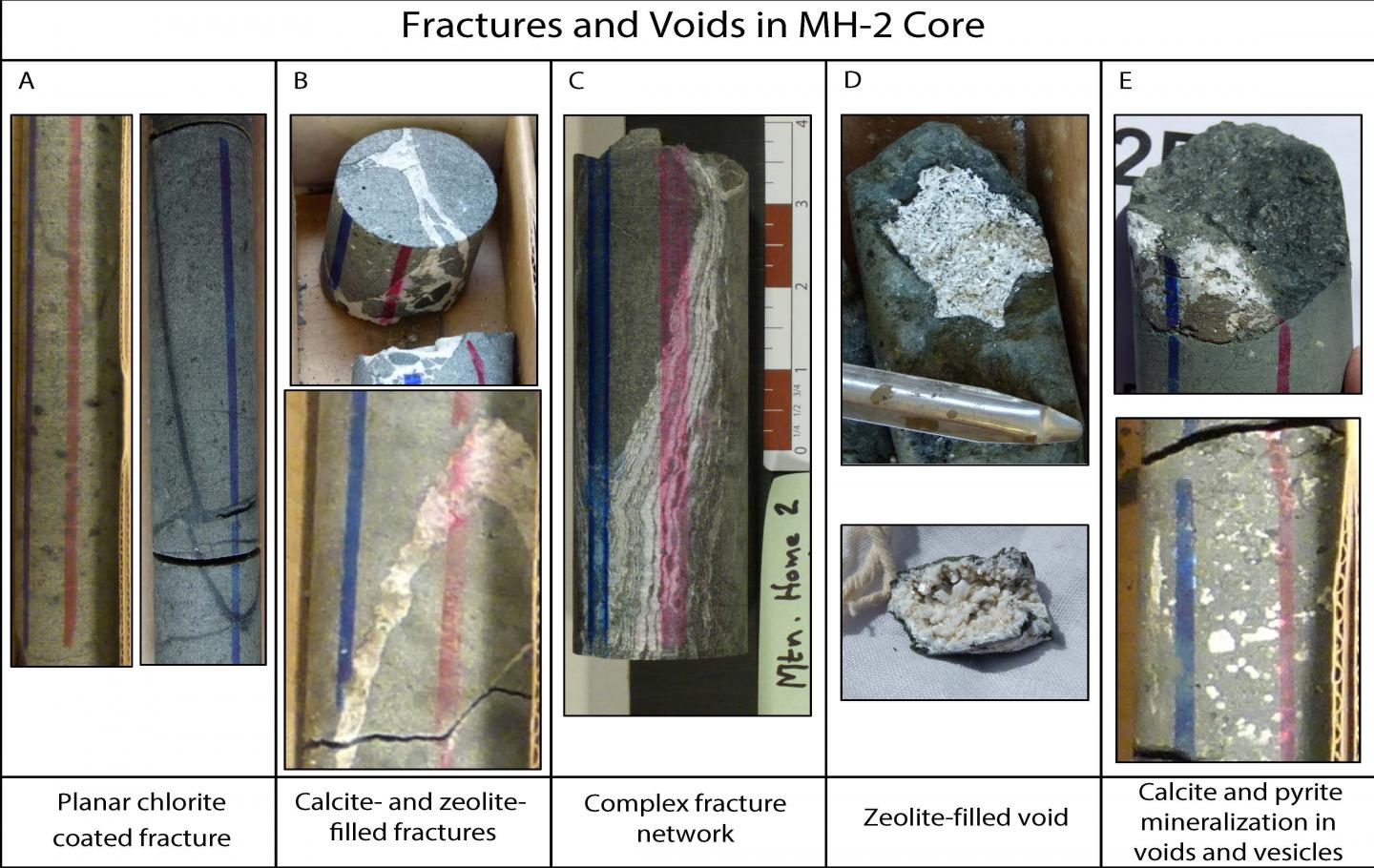
IMAGE

Credit: J.A. Kessler, The Geological Society of America, and Lithosphere

Boulder, Colo., USA: In their study published in Lithosphere this week, James Kessler and colleagues examine the geology of a scientific borehole drilled into the Snake River Plain, Idaho, USA, to investigate the potential for geothermal energy at depth. The site discussed in this paper is on the Mountain Home Air Force Base, where a drillhole in 1984 indicated that geothermal fluids were present at about 1.8 km depth.

With ARRA funding for new energy research and a grant from the International Continental Drilling Program, Kessler and colleagues drilled three 2-km-deep holes in the region. The Snake River Plain is the track of the Yellowstone Hotspot, and consists of rhyolite and basalt. Volcanic rocks near Yellowstone are quite young, whereas at Mountain Home, Idaho, the rocks are three to five million years old. Despite the abundant evidence for heat, the Snake River Plain does not produce geothermal energy due to a cool water aquifer present in the upper 500 m of the rocks.

The work reported in this paper is on the Mountain Home site, where waters of about 150 °C were encounter at 1745 m depth. Kessler and colleagues report on the geology of the basaltic rocks of the borehole, including determining the distribution of the basalts, the presence of faults and fractures at depth, and evidence for older hydrothermal interactions.

They also worked with geophysicists at the University of Alberta to determine the stresses at depth in the site. When holes penetrate rocks at depth, characteristic fractures form and their orientations can be used to determine the orientations of the stresses. The team reports that the maximum horizontal stresses here are at N 45°E, which suggests a complex geology at depth that might contribute to the localization of the geothermal fluids. Kessler and colleagues posit that these stresses are similar to the stresses observed in northern Nevada.

Another high point of this work is that this reports the results of James Kessler's Ph.D. work; it also included two undergraduates, Mikaela Pulsipher and Fallon Rowe, and master's student Jerome Varriale as co-authors.

###

ARTICLE

Geology and in situ Stress of the MH-2 Borehole, Idaho, U.S.A.: Insights into Western Snake River Plain Structure from Geothermal Exploration Drilling http://lithosphere.gsapubs.org/content/early/2017/04/04/L609.1.abstract

Authors: J.A. Kessler, Utah State University; K.K. Bradbury; J.P. Evans*; M.A. Pulsipher; D.R. Schmitt; J.W. Shervais; F.E. Rowe; and J. Varriale

*Contact: James Evans, [email protected]

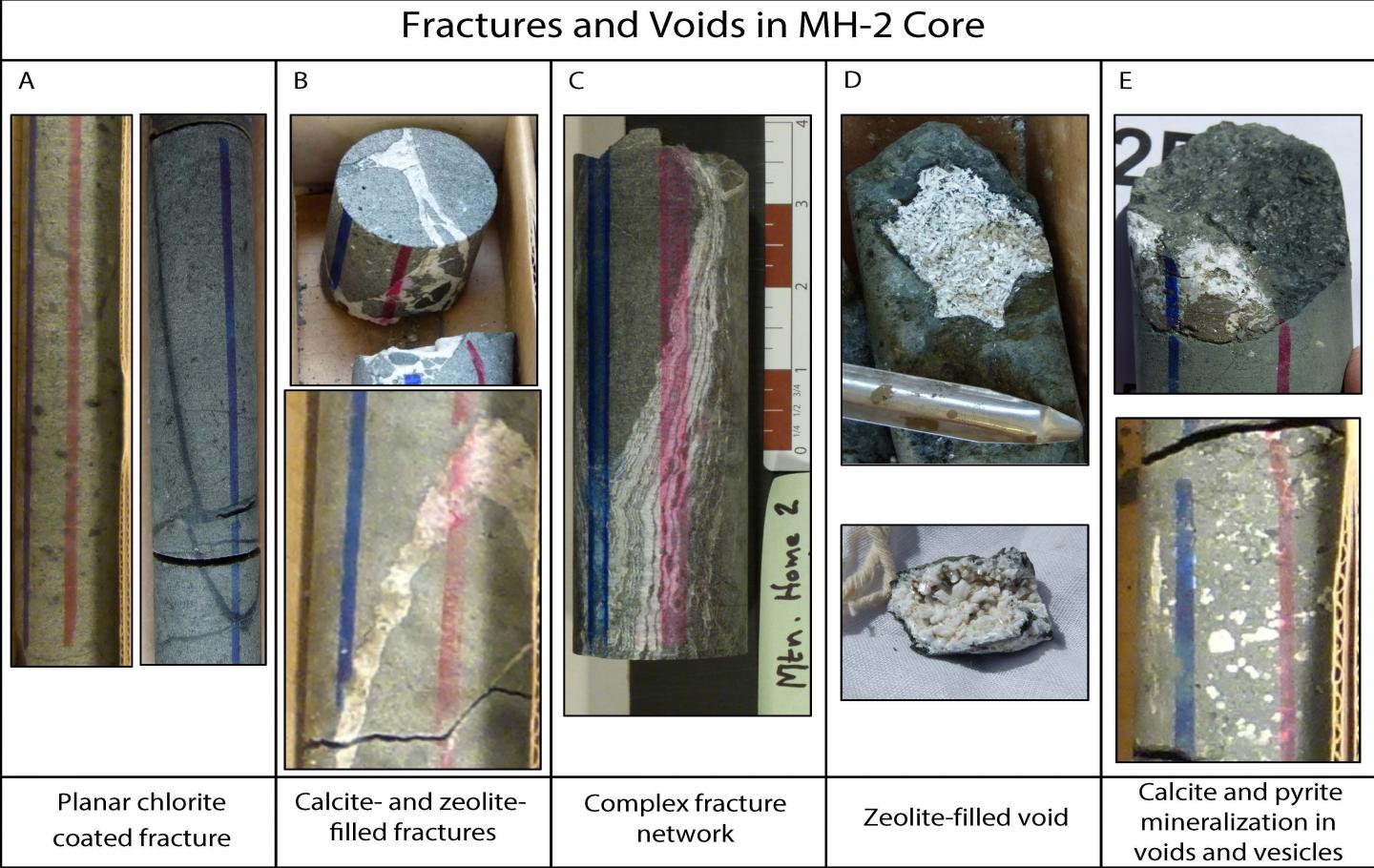
Figure caption: Kessler et al. Figure 5. Examples of fractures and vesicles in the MH-2 core.

Open-access abstracts for LITHOSPHERE papers are online at http://lithosphere.gsapubs.org/content/early/recent. Representatives of the media may obtain complimentary PDF copies of LITHOSPHERE articles by contacting Kea Giles at the address above. Please discuss articles of interest with the authors before publishing stories on their work, and please make reference to LITHOSPHERE in articles published. Contact Kea Giles for additional information or assistance. Non-media requests for articles may be directed to GSA Sales and Service, [email protected].

http://www.geosociety.org/

Media Contact

Kea Giles
[email protected]
@geosociety

http://www.geosociety.org

############

Story Source: Materials provided by Scienmag

Share12Tweet8Share2ShareShareShare2

Related Posts

Chemists Fine-Tune Superplasticizer Recipe to Make Stronger, Flowing Concrete

Chemists Fine-Tune Superplasticizer Recipe to Make Stronger, Flowing Concrete

October 5, 2026
Immune Booster Cells Show Promise After Checkpoint Blockers in Liver Cancer

Immune Booster Cells Show Promise After Checkpoint Blockers in Liver Cancer

October 5, 2026

Cabbage Extract Yields Iron Oxide Nanoparticles With Potent Biological Activity

October 5, 2026

Tiny AI brain lets a $10 microcontroller remember hidden objects and grab them

October 5, 2026
Please login to join discussion

POPULAR NEWS

  • Alloys That Shrink Their Own Grains: New PIX Mechanism Refines Metals With Heat Alone

    Alloys That Shrink Their Own Grains: New PIX Mechanism Refines Metals With Heat Alone

    29 shares
    Share 12 Tweet 7
  • Endurance Exercise Reshapes the Liver in Males and Females Through Distinct Molecular Routes

    29 shares
    Share 12 Tweet 7
  • Single Transcription Factor PU.1 Rapidly Converts Fibroblasts into Macrophage-Lineage Cells

    29 shares
    Share 12 Tweet 7
  • New Scale Measures How Ready Nurse Educators Really Are for the AI Era

    29 shares
    Share 12 Tweet 7

About

We bring you the latest biotechnology news from best research centers and universities around the world. Check our website.

Follow us

Recent News

Alloys That Shrink Their Own Grains: New PIX Mechanism Refines Metals With Heat Alone

Endurance Exercise Reshapes the Liver in Males and Females Through Distinct Molecular Routes

Single Transcription Factor PU.1 Rapidly Converts Fibroblasts into Macrophage-Lineage Cells

Subscribe to Blog via Email

Success! An email was just sent to confirm your subscription. Please find the email now and click 'Confirm' to start subscribing.

Join 85 other subscribers
  • Contact Us

Bioengineer.org © Copyright 2023 All Rights Reserved.

Welcome Back!

Login to your account below

Forgotten Password?

Retrieve your password

Please enter your username or email address to reset your password.

Log In
No Result
View All Result
  • Homepages
    • Home Page 1
    • Home Page 2
  • News
  • National
  • Business
  • Health
  • Lifestyle
  • Science

Bioengineer.org © Copyright 2023 All Rights Reserved.