• HOME
  • NEWS
  • EXPLORE
    • CAREER
      • Companies
      • Jobs
    • EVENTS
    • iGEM
      • News
      • Team
    • PHOTOS
    • VIDEO
    • WIKI
  • BLOG
  • COMMUNITY
    • FACEBOOK
    • INSTAGRAM
    • TWITTER
Tuesday, September 8, 2026
BIOENGINEER.ORG
No Result
View All Result
  • Login
  • HOME
  • NEWS
  • EXPLORE
    • CAREER
      • Companies
      • Jobs
        • Lecturer
        • PhD Studentship
        • Postdoc
        • Research Assistant
    • EVENTS
    • iGEM
      • News
      • Team
    • PHOTOS
    • VIDEO
    • WIKI
  • BLOG
  • COMMUNITY
    • FACEBOOK
    • INSTAGRAM
    • TWITTER
  • HOME
  • NEWS
  • EXPLORE
    • CAREER
      • Companies
      • Jobs
        • Lecturer
        • PhD Studentship
        • Postdoc
        • Research Assistant
    • EVENTS
    • iGEM
      • News
      • Team
    • PHOTOS
    • VIDEO
    • WIKI
  • BLOG
  • COMMUNITY
    • FACEBOOK
    • INSTAGRAM
    • TWITTER
No Result
View All Result
Bioengineer.org
No Result
View All Result
Home NEWS Science News

Technique makes more efficient, independent holograms

Bioengineer by Bioengineer
April 4, 2017
in Science News
Reading Time: 2 mins read
0
Share on FacebookShare on TwitterShare on LinkedinShare on RedditShare on Telegram
IMAGE

Credit: (Image courtesy of The Capasso Lab/Harvard SEAS)

Not far from where Edwin Land — the inventor of the Polaroid camera — made his pioneering discoveries about polarized light, researchers from the Harvard John A. Paulson School of Engineering and Applied Sciences (SEAS) are continuing to unlock the power of polarization.

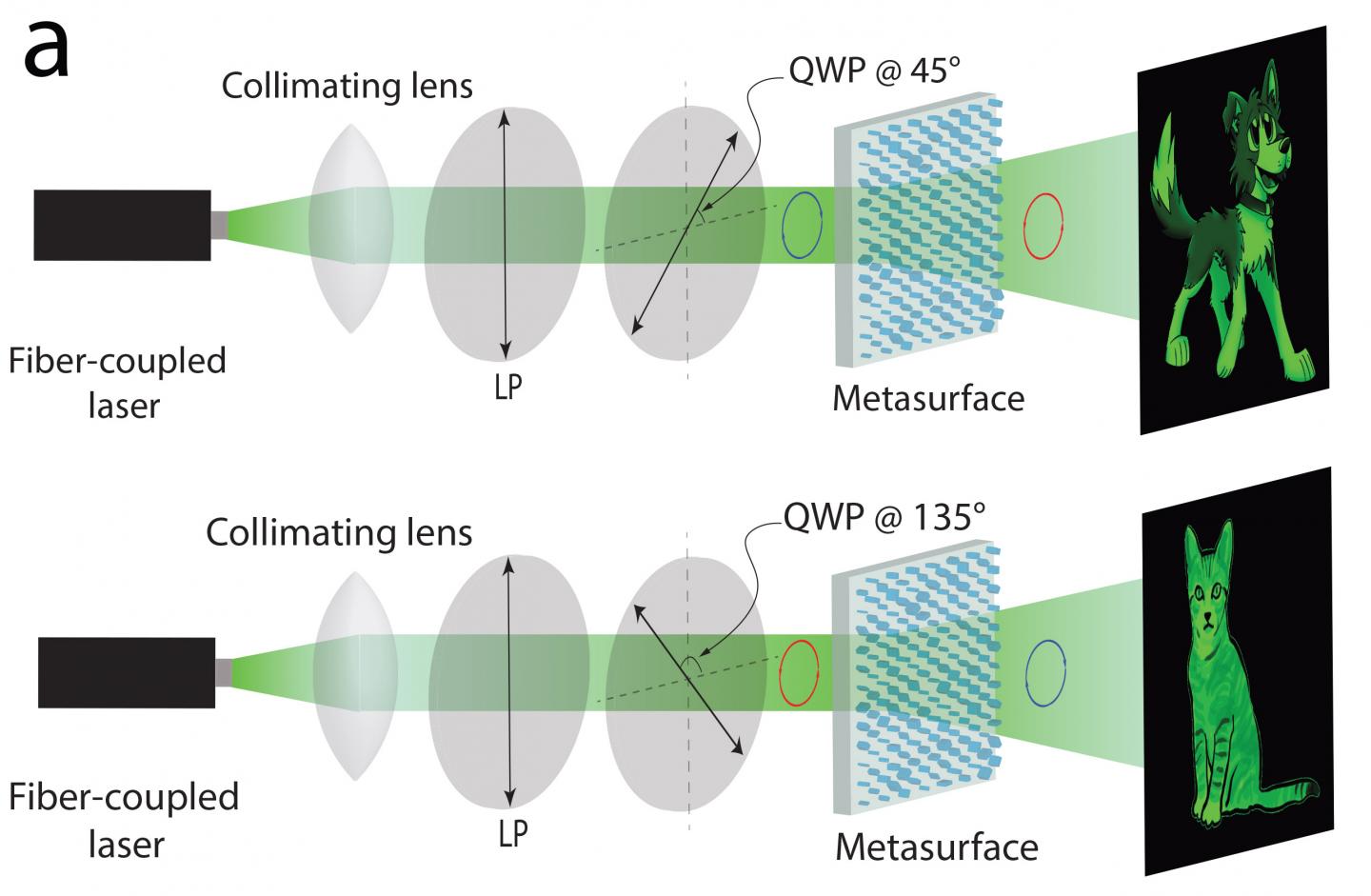
Recently, a team of researchers led by Federico Capasso, the Robert L. Wallace Professor of Applied Physics and Vinton Hayes Senior Research Fellow in Electrical Engineering, encoded multiple holographic images in a metasurface that can be unlocked separately with differently polarized light.

This advancement could improve holograms for anti-fraud protection and entertainment, as well as offer more control over the manipulation and measurement of polarization. The research was published in Physical Review Letters.

"The novelty of this type of metasurface is that for the first time we have been able to embed vastly different images that don't look at all like each other — like a cat and a dog — and access and project them independently using arbitrary states of polarization," said Capasso, the senior author of the paper.

Polarization is the path along which light vibrates. Previous research from the Capasso lab used nanostructures sensitive to polarization to produce two different images encoded in the metasurface. However, those images were dependent on one another, meaning both were created but only one appeared in the field of vision.

The metasurface made of titanium dioxide, a widely available material, consists of an array of polarization-sensitive pillars — also called nanofins — that redirect the incident light. Unlike previous arrays, which were uniform in size, these nanofins vary in orientation, height and width, depending on the encoded images.

"Each nanofin has different, precisely controllable polarization properties," said Noah Rubin, co-first author of the paper and graduate student in the Capasso Lab. "You use this library of elements to design the encoded image."

Different polarizations read different elements.

"This metasurface can be encoded with any two images, and unlocked by any two polarizations, so long as they are perpendicular to each other," said Rubin. "You can also embed different functionalities. It can be a lens for one polarization and if you go to a different polarization, it can be a hologram. So, this work is general statement about what can be done with metasurfaces and enables new optics for polarization."

"This is another powerful example of metasurfaces," said Capasso. "It allows you to compress a number of functionalities, which would normally spread over several components, and put them all in a single optical element."

###

This research was coauthored by J. P. Balthasar Mueller, Robert Devlin and Benedikt Groever. It was supported in part by the Air Force Office of Scientific Research.

Media Contact

Leah Burrows
[email protected]
617-496-1351
@hseas

http://www.seas.harvard.edu/

############

Story Source: Materials provided by Scienmag

Share12Tweet8Share2ShareShareShare2

Related Posts

From preparedness to resilience: rethinking critical care strategies for future pandemics

September 8, 2026

Vestibular implant modulation boosts mid and high frequency gaze reflex

September 8, 2026

Microwave ablation plus anti-LAG-3 boosts CD8+ T cell antitumor immunity

September 8, 2026

Understanding AI’s societal and technical challenges through transdisciplinary research

September 8, 2026
Please login to join discussion

POPULAR NEWS

  • From preparedness to resilience: rethinking critical care strategies for future pandemics

    29 shares
    Share 12 Tweet 7
  • Vestibular implant modulation boosts mid and high frequency gaze reflex

    29 shares
    Share 12 Tweet 7
  • Microwave ablation plus anti-LAG-3 boosts CD8+ T cell antitumor immunity

    29 shares
    Share 12 Tweet 7
  • Understanding AI’s societal and technical challenges through transdisciplinary research

    29 shares
    Share 12 Tweet 7

About

We bring you the latest biotechnology news from best research centers and universities around the world. Check our website.

Follow us

Recent News

From preparedness to resilience: rethinking critical care strategies for future pandemics

Vestibular implant modulation boosts mid and high frequency gaze reflex

Microwave ablation plus anti-LAG-3 boosts CD8+ T cell antitumor immunity

Subscribe to Blog via Email

Enter your email address to subscribe to this blog and receive notifications of new posts by email.

Join 85 other subscribers
  • Contact Us

Bioengineer.org © Copyright 2023 All Rights Reserved.

Welcome Back!

Login to your account below

Forgotten Password?

Retrieve your password

Please enter your username or email address to reset your password.

Log In
No Result
View All Result
  • Homepages
    • Home Page 1
    • Home Page 2
  • News
  • National
  • Business
  • Health
  • Lifestyle
  • Science

Bioengineer.org © Copyright 2023 All Rights Reserved.