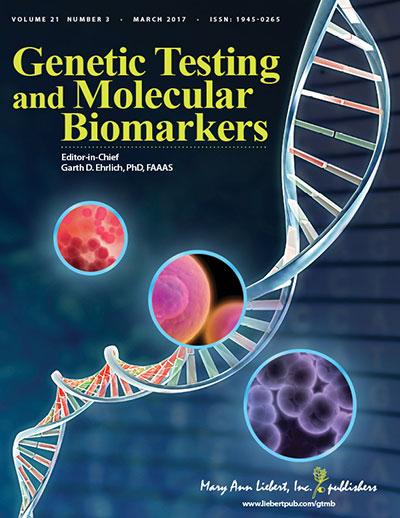
Credit: Mary Ann Liebert, Inc., publishers
New Rochelle, NY, April 3, 2017-Medical use of a patient's genomic sequence information can improve diagnostic capabilities and enable personalized therapies, but technical and practical barriers to understanding the clinical implications of sequence data and interpreting them for patients are contributing to ongoing ethical concerns. Current practices in genome sequencing and ethical controversies related to results reporting, including when to inform patients of incidental findings, are discussed in an article published in Genetic Testing and Molecular Biomarkers, a peer-reviewed journal from Mary Ann Liebert, Inc., publishers. The article is part of a special issue on biobanking that is available free on the Genetic Testing and Molecular Biomarkers website until May 3, 2017.
Ingrid Holm and Timothy Yu, Boston Children's Hospital, Harvard Medical School, Boston, and Broad Institute of MIT/Harvard, Cambridge, MA, and Steven Joffe, University of Pennsylvania Perelman School of Medicine, Philadelphia, PA, describe how human genomic data is collected and interpreted. The researchers provide an insightful perspective on how current scientific and clinical limitations make it difficult even for expert laboratories to determine what is an actual "result" and which results should be reported to patients.
In the article entitled "From Sequence Data to Returnable Results: Ethical Issues in Variant Calling and Interpretation," the authors discuss the potential harm that can be caused by overstating a result or reporting a false-positive finding.
"In the article by Holm and colleagues, the authors address multiple issues that should impact when and if to report incidental findings of potential clinical importance that are uncovered during whole genome sequence (WGS) analyses performed on research study participants," says Genetic Testing and Molecular Biomarkers Editor-in-Chief Garth D. Ehrlich, PhD, FAAAS, Center for Genomic Sciences and Center for Advanced Microbial Processing, Institute for Molecular Medicine and Infectious Disease, Drexel College of Medicine (Philadelphia, PA). "The researchers point out that most variants are novel or imperfectly annotated making it difficult for even clinically experienced teams to determine what results should and should not be returned to the participant. Some of the multiple compounding complexities articulated by the authors that must be considered prior to returning research results to study participants include: the participants indicated preferences; the risk of technical error (false findings); and ascertainment bias of variant risk in predicate studies. They might have also added the lack of knowledge of potential compensating variants elsewhere in the genome."
###
Research reported in this publication was supported by the National Institutes of Health under Award Numbers HG006615, HD077671, HG00828, and HG006492. The content is solely the responsibility of the authors and does not necessarily represent the official views of the National Institutes of Health.
About the Journal
Genetic Testing and Molecular Biomarkers is an authoritative peer-reviewed journal published 12 times per year online with open access options and in print that reports on all aspects of genetic testing, including molecular and biochemical based tests and varied clinical situations; ethical, legal, social, and economic aspects of genetic testing; and issues concerning effective genetic counseling. Tables of content and a free sample issue may be viewed on the Genetic Testing and Molecular Biomarkers website.
About the Publisher
Mary Ann Liebert, Inc., publishers is a privately held, fully integrated media company known for establishing authoritative peer-reviewed journals in many promising areas of science and biomedical research, including Human Gene Therapy and OMICS: A Journal of Integrative Biology. Its biotechnology trade magazine, GEN (Genetic Engineering & Biotechnology News), was the first in its field and is today the industry's most widely read publication worldwide. A complete list of the firm's 80 journals, books, and newsmagazines is available on the Mary Ann Liebert, Inc., publishers website.
Mary Ann Liebert, Inc. 140 Huguenot Street, New Rochelle, NY 10801-5215 http://www.liebertpub.com Phone (914) 740-2100 (800) M-LIEBERT Fax (914) 740-2101
Media Contact
Kathryn Ryan
[email protected]
914-740-2250
@LiebertPub
http://www.liebertpub.com
############
Story Source: Materials provided by Scienmag