


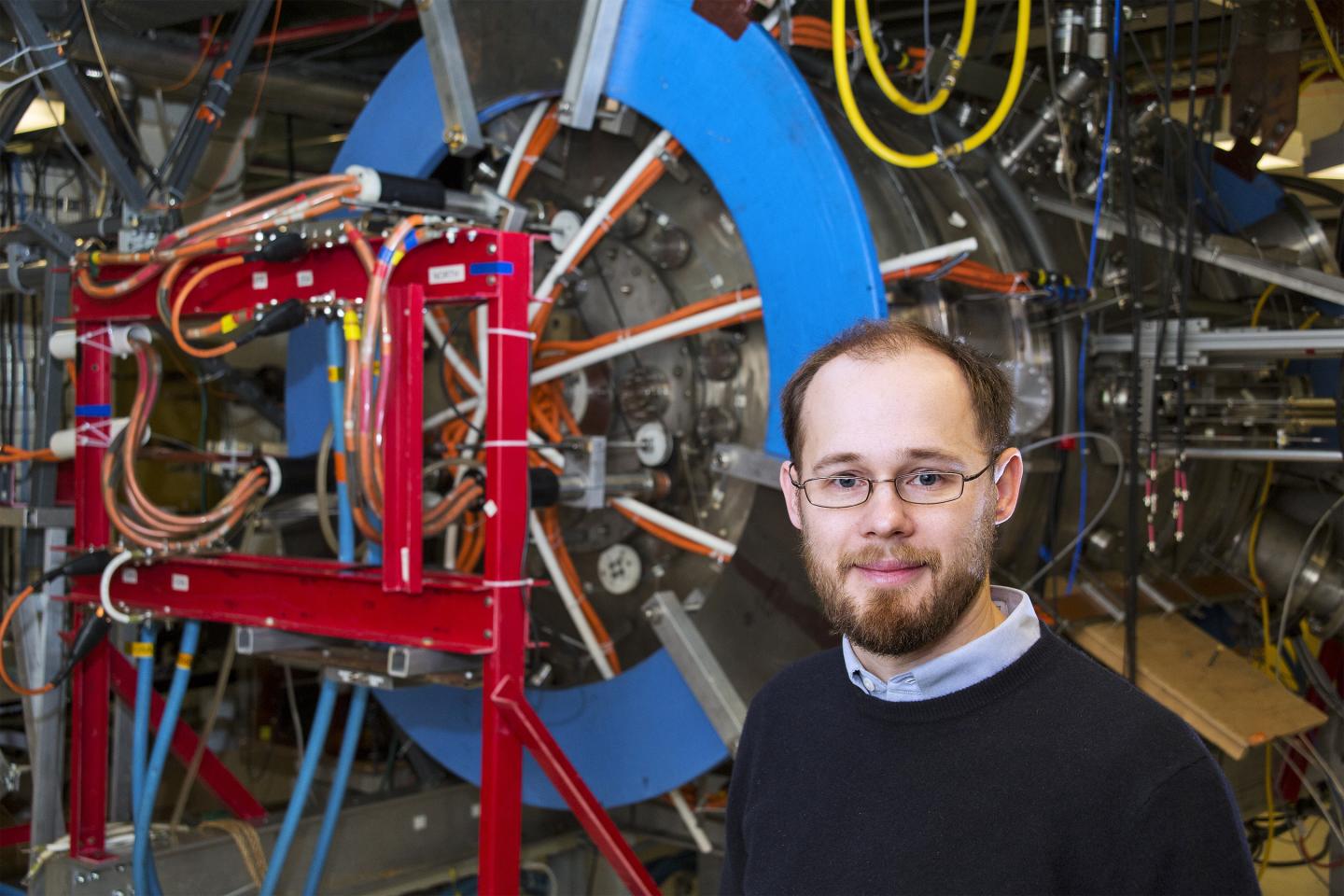
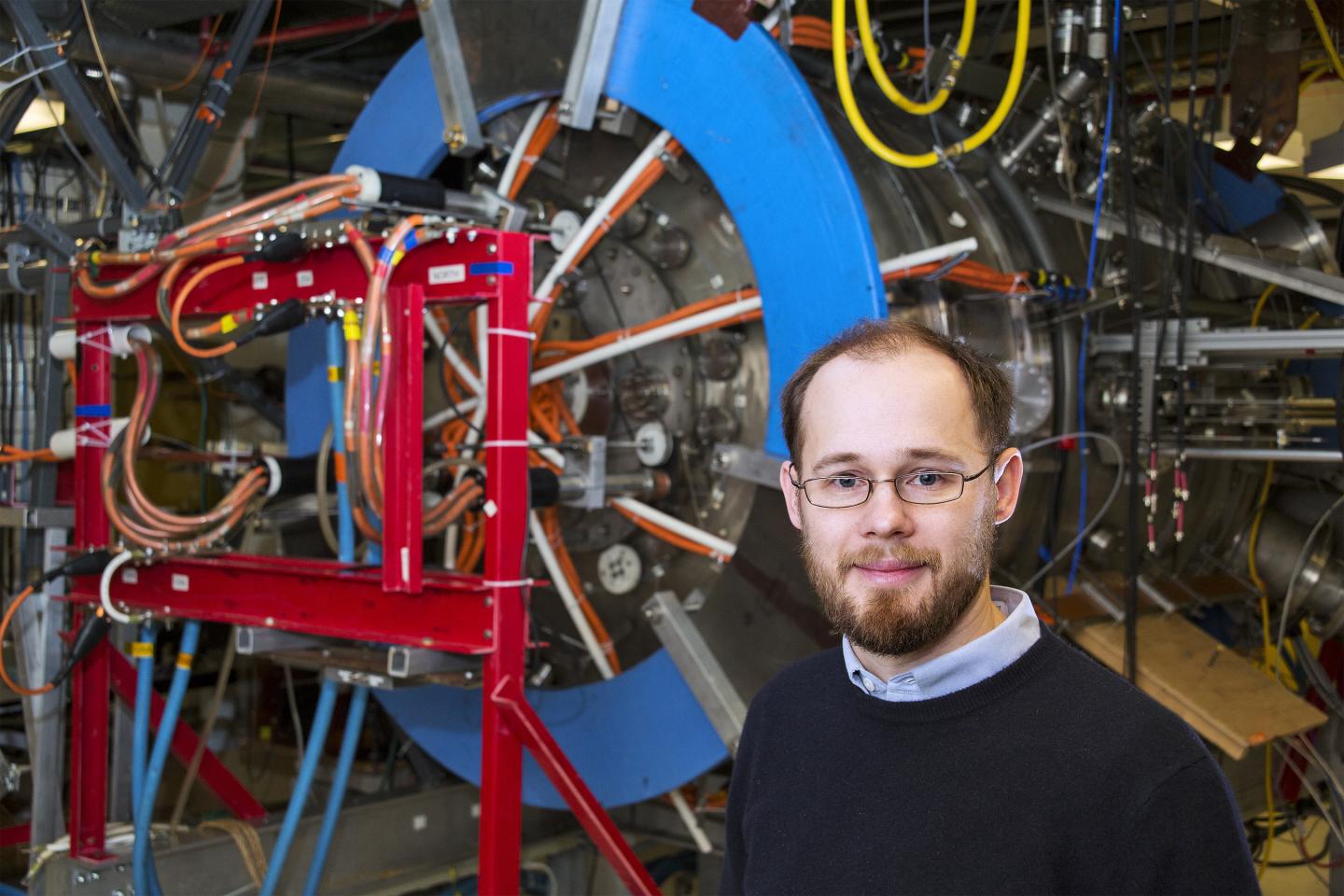
Credit: Elle Starkman/PPPL Office of Communications
Magnetic reconnection, a universal process that triggers solar flares and northern lights and can disrupt cell phone service and fusion experiments, occurs much faster than theory says that it should. Now researchers at the U.S. Department of Energy's (DOE) Princeton Plasma Physics Laboratory (PPPL) and Germany's Max Planck Institute of Plasma Physics have discovered a source of the speed-up in a common form of reconnection. Their findings could lead to more accurate predictions of damaging space weather and improved fusion experiments.
Reconnection occurs when the magnetic field lines in plasma — the collection of atoms and charged electrons and atomic nuclei, or ions, that make up 99 percent of the visible universe — converge and forcefully snap apart. Electrons that exert a varying degree of pressure form an important part of this process as reconnection takes place.
The research team found that variation in the electron pressure develops along the magnetic field lines in the region undergoing reconnection. This variation balances and keeps a strong electric current inside the plasma from growing out of control and halting the reconnection process. It is this balancing act that makes possible fast reconnection.
"The main issue we addressed is how reconnection can take place so quickly," said Will Fox, lead author of a paper that detailed the findings in March in the journal Physical Review Letters. "Here we've shown experimentally how electron pressure accelerates the process."
The physics team built a picture of the gradient and other parameters of reconnection from research conducted on the Magnetic Reconnection Experiment (MRX) at PPPL, the leading laboratory device for studying reconnection. The findings marked the first experimental confirmation of predictions made by earlier simulations performed by other researchers of the behavior of ions and electrons during reconnection. "The experiments demonstrate how the plasma can sustain a large electric field while preventing a large electric current from building up and halting the reconnection process," said Fox.
Among potential applications of the results:
- Predictions of space storms. Magnetic reconnection in the magnetosphere, the magnetic field that surrounds the Earth, can set off geomagnetic "substorms" that disable communications and global positioning satellites (GPS) and disrupt electrical grids. Improved understanding of fast reconnection can help locate regions where the process triggering storms is ready to take place.
- Mitigation of the impact. Advanced warning of reconnection and the disruptions that may follow can lead to steps to protect sensitive satellite systems and electric grids.
- Improvement of fusion facility performance. The process observed in MRX likely plays a key role in producing what are called "sawtooth" instabilities that can halt fusion reactions. Understanding the process could open the door to controlling it and limiting such instabilities. "How sawtooth happens so fast has been a mystery that this research helps to explain," said Fox. "In fact, it was computer simulations of sawtooth crashes that first linked electron pressure to the source of fast reconnection."
###
Support for this work comes from the DOE Office of Fusion Science and the Max Planck-Princeton Center for Plasma Physics.
PPPL, on Princeton University's Forrestal Campus in Plainsboro, N.J., is devoted to creating new knowledge about the physics of plasmas — the collection of atoms and charged electrons and atomic nuclei, or ions, that make up 99 percent of the visible universe — and to developing practical solutions for the creation of fusion energy. The Laboratory is managed by the University for the U.S. Department of Energy's Office of Science, which is the largest single supporter of basic research in the physical sciences in the United States, and is working to address some of the most pressing challenges of our time. For more information, please visit science.energy.gov.
Media Contact
John Greenwald
[email protected]
609-243-2672
@PPPLab
http://www.pppl.gov
############
Story Source: Materials provided by Scienmag


