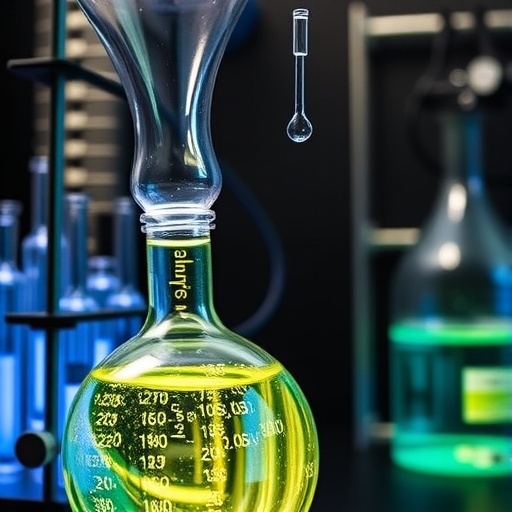
In the realm of industrial chemistry, the Haber-Bosch process has long reigned supreme as the foundational method for synthesizing ammonia, a critical precursor for global fertilizer production. Despite its century-old legacy, this method’s underlying catalytic mechanisms remained only partially understood, primarily due to the intricate nature of the catalysts involved. However, a recent breakthrough by researchers from the Fritz Haber Institute, Max Planck Institute for Chemical Energy Conversion, and Clariant has profoundly advanced our molecular-level comprehension of these technical multi-promoted ammonia synthesis catalysts, potentially heralding a new chapter in sustainable and efficient fertilizer manufacture.
Central to this advancement is the revelation that catalyst activation is not merely a procedural step but the defining phase where the active catalytic species are actually formed. By employing cutting-edge operando techniques such as scanning electron microscopy and near-ambient pressure X-ray photoelectron spectroscopy, the scientific team decoded the transformations occurring at the catalyst surface during activation. These insights firmly establish that the evolution of a porous iron-based structure, coated by a mobile potassium species, lies at the heart of catalytic activity enhancement.
The role of promoters within these catalysts emerges as a pivotal theme. Frequently overshadowed in conventional understanding, promoters such as potassium, calcium, and aluminum oxides act cooperatively to engineer cementitious mineral phases. These phases are not mere spectators; they actively stabilize the overall catalyst architecture, bolstering the hierarchical porous network that sustains reactivity under industrially relevant conditions. Furthermore, the discovery of a highly dispersed K+ species—dubbed ammonia K—acting as the kinetic driver or “pacemaker” of the catalytic process adds a new dimension to promoter function that was previously unappreciated.
This refined perspective unravels the complexity behind the mineral phases containing oxides of key elements like aluminum, silicon, and calcium. Rather than inert additives, these mineral constituents underpin structural robustness and durability, thereby mitigating catalyst deactivation pathways that have long plagued industrial ammonia synthesis. The synergy between these mineral phases and the iron-potassium catalytic surface confers a resilience that extends catalyst operational life while maintaining sustained reactivity.
Historically, the Fritz Haber Institute holds a distinguished position in the lineage of catalytic innovation, dating back to Fritz Haber himself, whose groundbreaking synthesis of ammonia revolutionized agriculture and chemistry worldwide. This latest work stands as a testament to that legacy, weaving together decades of surface science and catalysis research — including the Nobel-recognized contributions of Gerhard Ertl in understanding surface chemical processes — to illuminate the dynamic and often elusive behaviors within real-world catalysts.
Operationally, the activation phase with its promoter-induced transformations is now understood as a finely choreographed process in which chemical and structural rearrangements occur simultaneously. The formation of porous iron structures, enhanced by mobile potassium species dynamically interacting with adsorbed nitrogen and hydrogen, optimizes the surface for nitrogen activation—a rate-limiting step in ammonia synthesis. These novel insights challenge the previous static models, emphasizing the catalyst’s dynamic nature under working conditions.
The methodological prowess displayed in this research stems from the integration of operando microscopy and spectroscopy techniques. These allow scientists to observe the catalyst’s structural and chemical states in real time, under industrially relevant pressures and temperatures. Such a sophisticated approach enables the disentanglement of complex multi-component interactions and sheds light on the precise mechanisms by which promoters enhance activity and stability, a feat unattainable with traditional ex situ analyses.
Implications of this research extend far beyond academic interest; by decoding the functional roles of promoters and mineral phases, the study offers a blueprint for designing next-generation catalysts. These catalysts are predicted to exhibit not only higher efficiency but also greater sustainability, all vital for meeting the increasing global demand for ammonia with reduced energy footprints and lower environmental impact.
Moreover, the identification of ammonia K as a transient yet essential species presents new opportunities for catalyst tuning at the molecular level. By controlling the dispersion and mobility of such promoter species, catalyst performance and longevity can potentially be tailored, creating customized catalytic systems adapted to various industrial scales and feedstock compositions.
The revelation that the catalyst’s hierarchical porous architecture is integral to its function introduces an additional dimension to catalyst design. Porosity not only facilitates efficient gas transport but also provides extensive active surface area, balanced by the structural stability conferred by mineral-based cementitious phases. This intricate balance ensures optimal exposure of active sites while resisting mechanical and chemical degradation during prolonged operation.
These findings also contribute to a paradigm shift in industrial catalysis, promoting the concept that active catalytic surfaces are inherently dynamic entities. The insights affirm the necessity of evaluating catalysts under operando conditions to capture the transient species and transformations pivotal to their function, thereby moving beyond oversimplified static models that fail to encapsulate real-world performance.
Looking ahead, this research paves the way for more rational catalyst design strategies that integrate atomic-level insights with materials engineering. With global pressures to reduce energy consumption and carbon emissions intensifying, innovations stemming from such fundamental understanding may well redefine the industrial ammonia synthesis landscape, enhancing food security and sustainability simultaneously.
The collaborative effort between leading research institutions and industrial partners exemplifies how multidisciplinary approaches can unravel longstanding chemical enigmas. By bringing together expertise in inorganic chemistry, interface science, and advanced characterization methods, the team has set a new standard for catalyst research that blends fundamental science with practical industrial relevance.
In sum, this landmark study illuminates the complex interplay of promoters, mineral phases, and structural dynamics in multi-promoted ammonia synthesis catalysts. It redefines the activation process as a transformational step, integral to catalyst efficiency and durability, thereby opening avenues for future breakthroughs in catalytic ammonia production and beyond.
Subject of Research: Multi-promoted catalysts in ammonia synthesis and their activation mechanisms
Article Title: Decoding technical multi-promoted ammonia synthesis catalysts
News Publication Date: 21-Aug-2025
Web References: http://dx.doi.org/10.1038/s41467-025-63061-6
Image Credits: © FHI
Keywords
Ammonia synthesis, catalyst activation, multi-promoted catalysts, potassium species, operando microscopy, near-ambient pressure XPS, catalytic stability, porous iron structure, cementitious mineral phases, industrial catalysis, ammonia K species, catalyst design
Tags: advancements in fertilizer manufacturingammonia synthesis catalystscatalytic activity enhancementcatalytic mechanisms in ammonia synthesischemical energy conversion researchHaber-Bosch processindustrial chemistry breakthroughsmolecular-level understanding of catalystsoperando techniques in catalysisporous iron-based catalystspotassium promoter in catalysissustainable fertilizer production