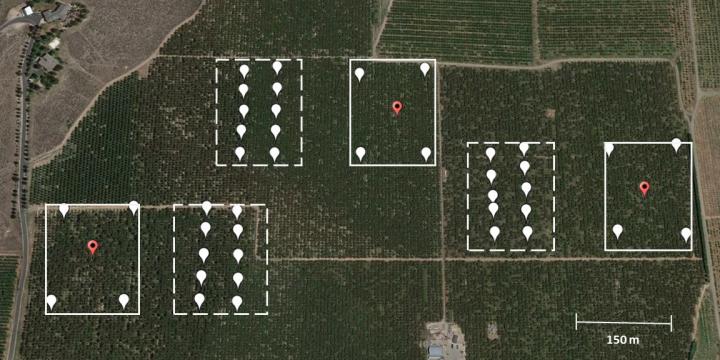
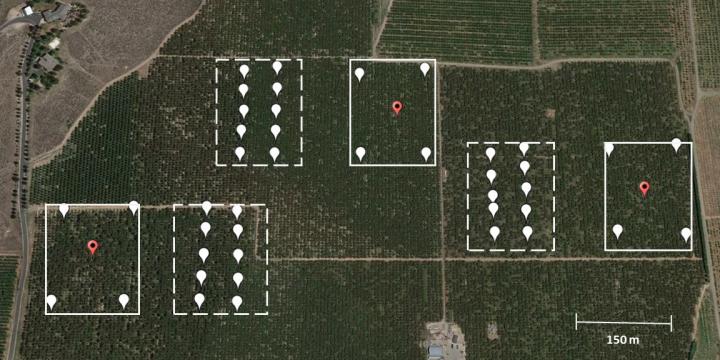
Credit: Natalie K. Boyle, Ph.D.
Annapolis, MD; March 23, 2017 — Orchard growers looking for alternatives to honey bees for managed pollination services have new reason to be optimistic about the potential of one honey bee cousin, the blue orchard bee.
A recent research experiment has shown blue orchard bees can be a sustainable option in tart cherry orchards, and a simple change to the distribution of the bees' nesting boxes makes the bees more likely to remain in the orchard to nest–a crucial requirement for their viability as a cost-effective managed pollinator. The results of the study will be published next week in the Entomological Society of America's Journal of Insect Science.
Unlike social bee species that gather in colonies, the blue orchard bee (Osmia lignaria) is a solitary bee that nests in cavities in wood, stems, or even artificial materials like cardboard or paper tubes. It is known to be a pollinator of spring-blooming orchard trees, but management practices for commercial pollination with the blue orchard bee aren't as well researched as they are for honey bees, says Natalie Boyle, Ph.D., entomologist at the U.S. Department of Agriculture-Agricultural Research Service in the Pollinating Insect-biology, Management, Systematics Research unit in Logan, Utah, and lead author of the new study.
"Presently, the greatest challenge to using blue orchard bees for commercial pollination of orchard crops is their high rates of dispersal away from the orchard upon their release," says Boyle. "This study shows that by simply changing the availability and distribution of nesting sites in the orchard, we can substantially increase overall blue orchard bee nesting success in a commercially managed orchard."
Prevailing wisdom among managers of blue orchard bees has been to provide a large central nesting location for the bees in a test area, with smaller satellite nest locations near the perimeter. Boyle's experiment, conducted in April and May of 2016 in Santaquin, Utah, tested this approach against a uniform design that spread small nest boxes evenly throughout the test area.
The results showed a successful return of bees to nesting sites in both distribution types–meaning females produced more total new larvae in the nests than the number of bees initially released. But the uniform nest-box distribution resulted in significantly higher nesting by all three factors measured: average nest-tube occupancy (33 percent higher), average live larvae per location (45 percent higher), and average larvae per individual nest tube (9 percent higher).
The return of the bees to the managed nests is critical, as the primary way to repopulate them if they disperse is to catch them in the wild. "Commercial O. lignaria pollination will only be economically feasible if sustainable year-to-year reproduction within orchards is achieved," Boyle and Singer note in their study.
The experiment did not evaluate the blue orchard bees' impact on pollination and orchard yield, though a follow-up study is in the works for 2017, Boyle says.
"There is tremendous interest from both the blue orchard bee supplier community and orchard growers in developing management strategies that rely, either fully or in part, on managed blue orchard bee pollination," says Boyle. "We hope that this study provides practical information that orchardists can use to incorporate blue orchard bee pollination into their current management efforts, particularly with varieties that have been historically fruit set-limited when honey bees are used alone."
###
"The Effect of Nest Box Distribution on Sustainable Propagation of Osmia lignaria (Hymenoptera: Megachilidae) in Commercial Tart Cherry Orchards," by Natalie K. Boyle, Ph.D., and Theresa L. Singer, Ph.D., will be published March 30 in the Journal of Insect Science. Journalists may request advance copies of the study via the contact below.
CONTACT: Joe Rominiecki, [email protected], 301-731-4535 x3009
ABOUT: ESA is the largest organization in the world serving the professional and scientific needs of entomologists and people in related disciplines. Founded in 1889, ESA today has over 6,000 members affiliated with educational institutions, health agencies, private industry, and government. The Society stands ready as a non-partisan scientific and educational resource for all insect-related topics. For more information, visit http://www.entsoc.org.
Journal of Insect Science publishes research on all aspects of the biology of insects and other arthropods from the molecular to the ecological, and their agricultural and medical impact. For more information, visit https://academic.oup.com/jinsectscience, or visit http://www.insectscience.org to view the full portfolio of ESA journals and publications.
Media Contact
Joe Rominiecki
[email protected]
301-731-4535 x3009
@EntsocAmerica
http://www.entsoc.org
############
Story Source: Materials provided by Scienmag