• HOME
  • NEWS
  • EXPLORE
    • CAREER
      • Companies
      • Jobs
    • EVENTS
    • iGEM
      • News
      • Team
    • PHOTOS
    • VIDEO
    • WIKI
  • BLOG
  • COMMUNITY
    • FACEBOOK
    • INSTAGRAM
    • TWITTER
Monday, October 5, 2026
BIOENGINEER.ORG
No Result
View All Result
  • Login
  • HOME
  • NEWS
  • EXPLORE
    • CAREER
      • Companies
      • Jobs
        • Lecturer
        • PhD Studentship
        • Postdoc
        • Research Assistant
    • EVENTS
    • iGEM
      • News
      • Team
    • PHOTOS
    • VIDEO
    • WIKI
  • BLOG
  • COMMUNITY
    • FACEBOOK
    • INSTAGRAM
    • TWITTER
  • HOME
  • NEWS
  • EXPLORE
    • CAREER
      • Companies
      • Jobs
        • Lecturer
        • PhD Studentship
        • Postdoc
        • Research Assistant
    • EVENTS
    • iGEM
      • News
      • Team
    • PHOTOS
    • VIDEO
    • WIKI
  • BLOG
  • COMMUNITY
    • FACEBOOK
    • INSTAGRAM
    • TWITTER
No Result
View All Result
Bioengineer.org
No Result
View All Result
Home NEWS Science News

Nanomagnets for future data storage

Bioengineer by Bioengineer
March 30, 2017
in Science News
Reading Time: 3 mins read
0
Share on FacebookShare on TwitterShare on LinkedinShare on RedditShare on Telegram
IMAGE

Credit: ETH Zurich / Université de Rennes

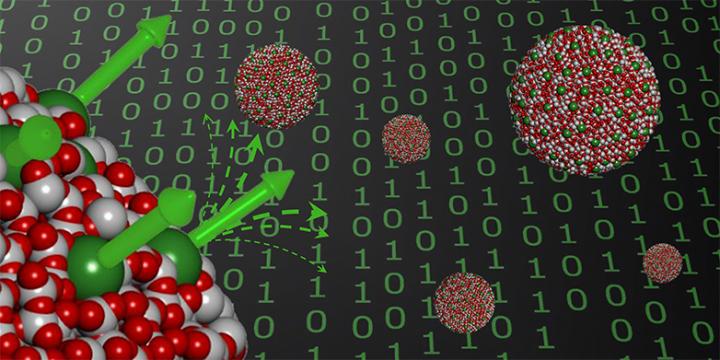
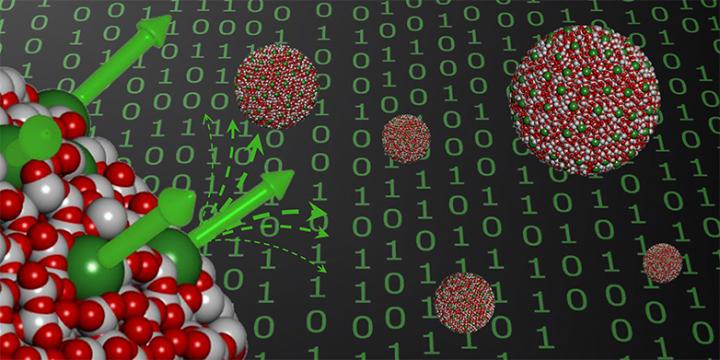
The idea is intriguing: if only a single atom or small molecule was needed for a single unit of data (a zero or a one in the case of binary digital technology), massive volumes of data could be stored in the tiniest amount of space. This is theoretically possible, because certain atoms can be magnetised in only one of two possible directions: "spin up" or "spin down". Information could then be stored and read by the sequence of the molecules' magnetisation directions.

However, several obstacles still need to be overcome before single-molecule magnet data storage becomes a reality. Finding molecules that can store the magnetic information permanently and not just fleetingly is a challenge, and it is even more difficult to arrange these molecules on a solid surface to build data storage carriers. To address the latter problem, an international team of researchers led by chemists from ETH Zurich has now developed a new method that offers numerous advantages over other approaches.

Fusing atoms to the surface

Christophe Copéret, a professor at the Laboratory of Inorganic Chemistry at ETH Zurich, and his team developed a molecule with a dysprosium atom at its centre (dysprosium is a metal belonging to the rare-earth elements). This atom is surrounded by a molecular scaffold that serves as a vehicle. The scientists also developed a method for depositing such molecules on the surface of silica nanoparticles and fusing them by annealing at 400 degrees Celsius. The molecular structure used as a vehicle disintegrates in the process, yielding nanoparticles with dysprosium atoms well-dispersed at their surface. The scientists showed that these atoms can be magnetised and maintain their magnetic information.

The magnetisation process currently only works at around minus 270 degrees Celsius (near absolute zero), and the magnetisation can be maintained for up to one and a half minute. The scientists are therefore looking for methods that will allow the magnetisation to be stabilised at higher temperatures and for longer periods of time. They are also looking for ways to fuse atoms to a flat surface instead of to nanoparticles.

Simple preparation

One of the advantages of the new method is its simplicity. "Nanoparticles bonded with dysprosium can be made in any chemical laboratory. No cleanroom and complex equipment are required," says Florian Allouche, a doctoral student in Copéret's group. In addition, the magnetisable nanoparticles can be stored at room temperature and re-utilized.

Other preparation methods include the direct deposition of individual atoms onto a surface, yet the materials obtained are only stable at very low temperatures mainly due to the agglomeration of these individual atoms. Alternatively, molecules with ideal magnetic properties can be deposited onto a surface, but this immobilization often negatively affects the structure and the magnetic properties of the final object.

###

For this research project, ETH scientists worked with colleagues from the Universities of Lyon and Rennes, Collège de France in Paris, Paul Scherrer Institute in Switzerland, and Berkeley National Laboratory in the USA.

Reference

Allouche F et al.: Magnetic Memory from Site Isolated Dy(III) on Silica Materials. ACS Central Science 2017, doi: 10.1021/acscentsci.7b00035

Media Contact

Prof. Dr. Christophe Copéret
[email protected]
41-446-339-394
@ETH_en

http://www.ethz.ch/index_EN

############

Story Source: Materials provided by Scienmag

Share12Tweet8Share2ShareShareShare2

Related Posts

Machine Learning Outsmarts Design Codes in Predicting Shear Strength of Recycled Concrete Beams

Machine Learning Outsmarts Design Codes in Predicting Shear Strength of Recycled Concrete Beams

October 5, 2026
Forgotten Almond Trees in Central Italy Reveal a Hidden Genetic Treasure

Forgotten Almond Trees in Central Italy Reveal a Hidden Genetic Treasure

October 5, 2026

City Life Reshapes the Microbes Inside Thailand’s Brown Dog Ticks

October 5, 2026

Hidden Metabolic Diseases Found in Unexplained Child Deaths Through Blood Spot and DNA Analysis

October 5, 2026
Please login to join discussion

POPULAR NEWS

  • Alloys That Shrink Their Own Grains: New PIX Mechanism Refines Metals With Heat Alone

    Alloys That Shrink Their Own Grains: New PIX Mechanism Refines Metals With Heat Alone

    29 shares
    Share 12 Tweet 7
  • Endurance Exercise Reshapes the Liver in Males and Females Through Distinct Molecular Routes

    29 shares
    Share 12 Tweet 7
  • Single Transcription Factor PU.1 Rapidly Converts Fibroblasts into Macrophage-Lineage Cells

    29 shares
    Share 12 Tweet 7
  • New Scale Measures How Ready Nurse Educators Really Are for the AI Era

    29 shares
    Share 12 Tweet 7

About

We bring you the latest biotechnology news from best research centers and universities around the world. Check our website.

Follow us

Recent News

Alloys That Shrink Their Own Grains: New PIX Mechanism Refines Metals With Heat Alone

Endurance Exercise Reshapes the Liver in Males and Females Through Distinct Molecular Routes

Single Transcription Factor PU.1 Rapidly Converts Fibroblasts into Macrophage-Lineage Cells

Subscribe to Blog via Email

Success! An email was just sent to confirm your subscription. Please find the email now and click 'Confirm' to start subscribing.

Join 85 other subscribers
  • Contact Us

Bioengineer.org © Copyright 2023 All Rights Reserved.

Welcome Back!

Login to your account below

Forgotten Password?

Retrieve your password

Please enter your username or email address to reset your password.

Log In
No Result
View All Result
  • Homepages
    • Home Page 1
    • Home Page 2
  • News
  • National
  • Business
  • Health
  • Lifestyle
  • Science

Bioengineer.org © Copyright 2023 All Rights Reserved.