Credit: Virginia Tech
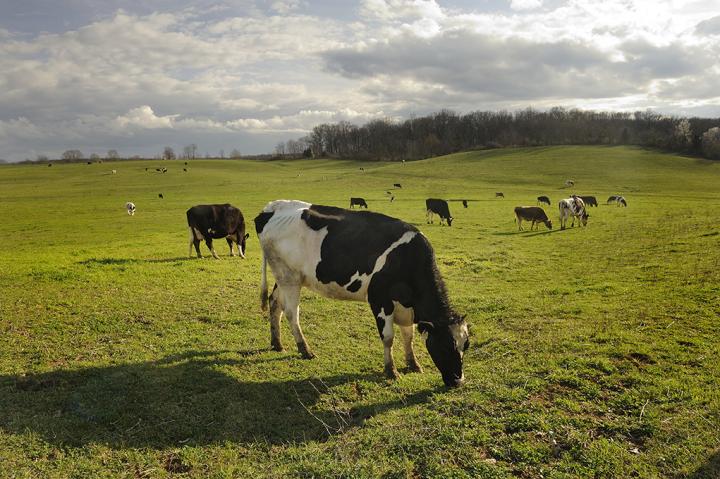
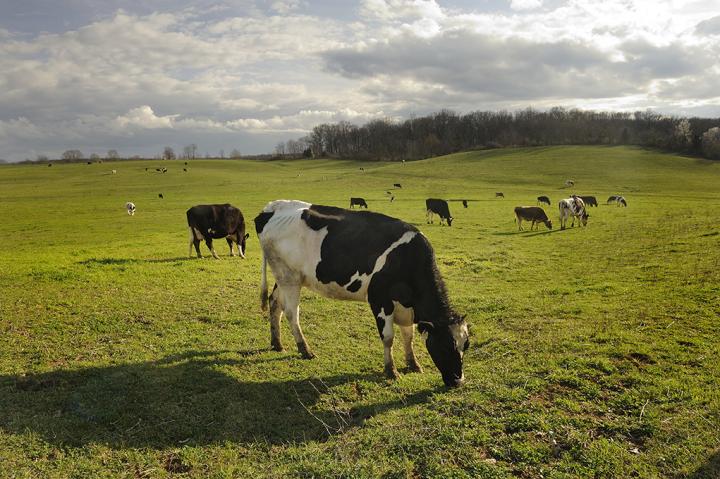
Manure from cattle administered antibiotics drastically changes the bacterial and fungal make-up of surrounding soil, leading to ecosystem dysfunction, according to a Virginia Tech research team.
The team analyzed soil samples from 11 dairy farms in the United States, and found that the amount of antibiotic resistant genes was 200 times greater in soil near manure piles compared with soil that wasn't.
Furthermore, microbes with greater antibiotic-resistance showed higher stress levels. Their findings were published March 29 in the Proceedings of the Royal Society B.
"The development of antibiotic resistance can be an energy-sucker for a microorganism, and would explain why we've seen higher stress levels. We need to continue to investigate this possible link," said lead author Michael Strickland, an assistant professor of biological sciences in the College of Science and researcher with Virginia Tech's Global Change Center.
Soil microbial communities are important for sustaining ecosystem services such as climate regulation, soil fertility, and food production. Perturbations, such as antibiotic exposure, can have marked effects on soil microbes and these services.
The use of antibiotics on livestock in the United States is a growing concern, especially in instances when they are used to prevent rather than specifically treat disease, according to Carl Wepking of Lancaster, Wisconsin, a doctoral student in biological sciences in the College of Science and first author on the paper.
Wepking spent part of his childhood on a beef cattle farm, and is familiar with the challenges that farmers face.
"The growing human population and growing global middle class puts pressure on farmers to produce more livestock products," said Wepking, who is also an Interfaces of Global Change fellow. "However, the use of antibiotics to increase production can negatively impact the ecosystem and agricultural soils, not to mention human health."
However, for their current project, funded by USDA, Strickland and Wepking will focus on the antibiotics' impact on soil communities. The project has three phases, of which surveying the 11 dairy farms was the first. The next step will be to sample soil at Kentland Farm in order to disentangle manure from antibiotic effects on soil microbes. The third phase will involve direct application of the antibiotics to soil in the lab.
"While the human health implications of widespread antibiotic use are well known, Wepking et al. investigate another potentially important affect–how exposure to antibiotics shapes the soil microbial community and its functioning," said Serita Frey, a professor of soil microbial ecology at the University of New Hampshire. "This research highlights that antibiotic additions to soil (through cattle manure application) have the potential to alter soil function in important ways, particularly as related to carbon cycling."
Other Virginia Tech authors on the paper include Brian Badgley, an assistant professor of crop and soil environmental sciences in the College of Agriculture and Life Sciences; Jeb Barrett an associate professor of biological sciences in the College of Science; and Katharine Knowlton, a professor of dairy science in the College of Agriculture and Life Sciences.
###
Media Contact
Lindsay Key
[email protected]
540-231-6594
@VTresearch
http://www.vtnews.vt.edu
############
Story Source: Materials provided by Scienmag