Credit: Chelsea Carey, Point Blue Conservation Science
Collecting dust isn't usually considered a good thing.
But dust from as close as California's Central Valley and as far away as Asia's Gobi Desert provides nutrients, especially phosphorus, to vegetation in the Sierra Nevada Mountains, a team of scientists has found. Their study, published in the journal Nature Communications, highlights the importance of dust and the phosphorus it carries in sustaining plant life.
The researchers examined soil samples from four sites at the National Science Foundation (NSF) Southern Sierra Critical Zone Observatory (SSCZO) in the Sierra National Forest, at elevations from 1,300 feet to 8,800 feet. The SSCZO is part of a network of nine NSF Critical Zone Observatories across the United States and the U.S. territory of Puerto Rico.
The critical zone — Earth's living environment — is the region between the top of the forest canopy and the base of weathered rock.
The zone consists of multiple interactive processes, including the water cycle, the breakdown of rocks and the formation of soil, the evolution of rivers and valleys, the patterns of vegetation, and the form and function of the Earth. Scientists at all nine CZO sites study this zone and its response to climate and land use changes.
"The CZO network was set up to carry out research that integrates physical, geochemical and biological measurements from the subsurface through the land surface, giving us the ability to improve management of these rapidly changing landscapes," said University of California, Merced scientist Roger Bales, who leads the SSCZO.
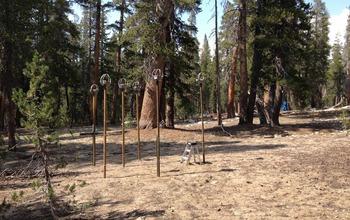
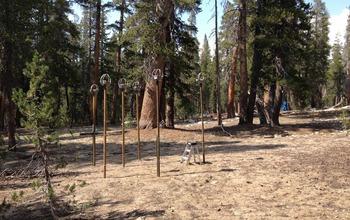
The research team — including geochemists, a geomorphologist, ecosystem ecologists and microbial ecologists from UC Merced, UC Riverside, the University of Michigan and University of Wyoming — worked to quantify the importance of transoceanic and regional dust as a nutrient source to Sierra Nevada ecosystems. They used household items — for example, Bundt pans filled with marbles attached to wooden posts — to capture dust. They also studied microbes hitchhiking on dust particles to pinpoint the dust's origins.
"Dust provides important inputs of phosphorus to Sierra Nevada ecosystems," said UC Merced scientist Stephen Hart, a co-author of the paper. "The dust brings critical nutrients [such as phosphorus] for maintaining plant productivity in these mountain environments. Dust inputs may increase as land use in the Central Valley intensifies and as the climate changes in the future."
The Sierra Nevada Mountains are considered a phosphorus-limited ecosystem; the mountains are geologically young with bedrock that has not yet extensively broken down into nutrient-carrying soil.
The researchers said their findings could hold true for similar geologically young mountain ecosystems developed on bedrock with low phosphorus concentration.
"Dust is an important source of nutrients for landscapes like the island of Kauai, where intensive weathering has depleted the underlying bedrock of life-sustaining elements, including phosphorus, potassium, calcium and magnesium," the researchers wrote.
As bedrock converts to soil, the process releases nutrients vital to plants. To a large degree, nutrients regulate the distribution of life across Earth's surface, so understanding the importance of different nutrient sources — including bedrock and dust — is an important question in ecology, biogeochemistry and geobiology. Such research also has implications for predicting forest responses to changes in climate and land use.
"This new research reveals that the transport of dust in the atmosphere is important for the ecological health of many parts of our planet," said Richard Yuretich, program director for NSF's Critical Zone Observatory network. "Complex cycles and feedbacks regulate conditions at the surface of the Earth. This study adds a significant piece to our knowledge of how Earth works, and what we can do to keep it functioning properly."
###
More information on the National Science Foundation's Critical Zone Observatories is available online.
Media Contact
Cheryl Dybas
[email protected]
703-292-7734
@NSF
http://www.nsf.gov
############
Story Source: Materials provided by Scienmag