• HOME
  • NEWS
  • EXPLORE
    • CAREER
      • Companies
      • Jobs
    • EVENTS
    • iGEM
      • News
      • Team
    • PHOTOS
    • VIDEO
    • WIKI
  • BLOG
  • COMMUNITY
    • FACEBOOK
    • INSTAGRAM
    • TWITTER
Friday, June 26, 2026
BIOENGINEER.ORG
No Result
View All Result
  • Login
  • HOME
  • NEWS
  • EXPLORE
    • CAREER
      • Companies
      • Jobs
        • Lecturer
        • PhD Studentship
        • Postdoc
        • Research Assistant
    • EVENTS
    • iGEM
      • News
      • Team
    • PHOTOS
    • VIDEO
    • WIKI
  • BLOG
  • COMMUNITY
    • FACEBOOK
    • INSTAGRAM
    • TWITTER
  • HOME
  • NEWS
  • EXPLORE
    • CAREER
      • Companies
      • Jobs
        • Lecturer
        • PhD Studentship
        • Postdoc
        • Research Assistant
    • EVENTS
    • iGEM
      • News
      • Team
    • PHOTOS
    • VIDEO
    • WIKI
  • BLOG
  • COMMUNITY
    • FACEBOOK
    • INSTAGRAM
    • TWITTER
No Result
View All Result
Bioengineer.org
No Result
View All Result
Home NEWS Science News

Sharing expert experimental knowledge to expedite design

Bioengineer by Bioengineer
March 28, 2017
in Science News
Reading Time: 2 mins read
0
Share on FacebookShare on TwitterShare on LinkedinShare on RedditShare on Telegram
IMAGE

Credit: © 2017 KAUST

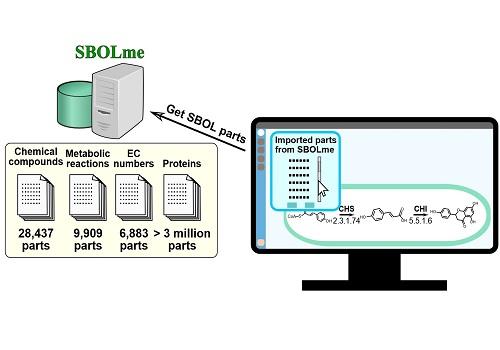
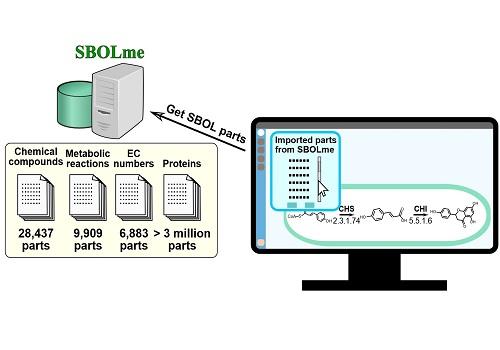
A reference tool specific to metabolic engineering that optimizes processes to make cells produce useful substances gives researchers a common language and will facilitate novel designs.

When building synthetic biological systems, the number of available biological components and interactions is mind boggling. To make them accessible, a global community of researchers developed the Synthetic Biology Open Language (SBOL), an online standard that allows experimental and computational biologists to quickly exchange and reuse designs1.

Now, Dr. Hiroyuki Kuwahara and Associate Professor Xin Gao of the KAUST Computational Bioscience Research Center (CBRC) collaborated with co-workers in China and the US1 to take this a step further by developing an SBOL repository of parts specific to metabolic engineering.

"So far, support for SBOL has been lacking in metabolic engineering," says Kuwahara. "But, since many applications of synthetic biology focus on biosynthesis of high-value natural products, such as biofuels, cosmetics, perfumes and drugs, we thought that a repository of SBOL parts for metabolic engineering would be useful."

Kuwahara, Gao and co-workers drew on several existing databases to compile the new, easily searchable repository of metabolic parts, which they named SBOLme, because it is entirely compliant with SBOL.

SBOLme contains several thousand chemical compounds, enzyme classes, metabolic proteins and metabolic reactions from almost 4000 different organisms, and all the parts are annotated with information about their common interactions and thermodynamics. This will make it possible for researchers to design new ways of carrying out useful reactions, as Kuwahara explained:

"Suppose you want to design a pathway to produce 1,3-propanediol, a commodity chemical mainly used to make polyester fiber from Glycerol that is readily available and inexpensive. This would involve introducing two enzymatic reactions into a microbe that could perform the job. SBOLme has all the metabolic parts you need to specify this pathway within the microbe, and it allows you to exchange and discuss the design with colleagues."

"Finally, when you publish your paper, you would include your design in the SBOL format so that readers can find it."

Kuwahara and Gao say that the talented computer scientists at KAUST and the CBRC's cluster computing facilities played a vital role in the success of their project.

They hope to continue developing computational methods that help facilitate the design of metabolic engineering. Ultimately, they plan on making the industrial-scale use of microbes for producing useful chemicals accessible.

The potential applications of metabolic engineering include the production of new drugs and the storage of information on strands of DNA.

###

Media Contact

Michelle D'Antoni
[email protected]

http://kaust.edu.sa/

############

Story Source: Materials provided by Scienmag

Share12Tweet8Share2ShareShareShare2

Related Posts

Tracking Lanthanide-Labeled Microplastics in Plants

June 25, 2026

POSTECH Researchers Slash Cost of Reconstituted Cell-Free Systems by 95%

June 25, 2026

AI and Physics Collaborate to Design Advanced Hydrogen Storage Materials

June 25, 2026

Natural Hallucinogens: Evolution’s Ecological Tools, Not Mere Chemical Byproducts

June 25, 2026
Please login to join discussion

POPULAR NEWS

  • Saying Goodbye to PGY-6: Pediatric Fellowship Realities

    103 shares
    Share 41 Tweet 26
  • Multi-Hospital Study Reveals Long Covid Burden Is Twice as High as Current Estimates

    92 shares
    Share 36 Tweet 23
  • Detection of EDCs in Breast Milk and Infant Urine Up to Six Months Highlights Early Exposure Risks

    77 shares
    Share 31 Tweet 19
  • New Drug Candidate Developed at McMaster Shows Potential for Treating Brain Cancer

    58 shares
    Share 23 Tweet 15

About

We bring you the latest biotechnology news from best research centers and universities around the world. Check our website.

Follow us

Recent News

Tracking Lanthanide-Labeled Microplastics in Plants

POSTECH Researchers Slash Cost of Reconstituted Cell-Free Systems by 95%

AI and Physics Collaborate to Design Advanced Hydrogen Storage Materials

Subscribe to Blog via Email

Success! An email was just sent to confirm your subscription. Please find the email now and click 'Confirm' to start subscribing.

Join 82 other subscribers
  • Contact Us

Bioengineer.org © Copyright 2023 All Rights Reserved.

Welcome Back!

Login to your account below

Forgotten Password?

Retrieve your password

Please enter your username or email address to reset your password.

Log In
No Result
View All Result
  • Homepages
    • Home Page 1
    • Home Page 2
  • News
  • National
  • Business
  • Health
  • Lifestyle
  • Science

Bioengineer.org © Copyright 2023 All Rights Reserved.