• HOME
  • NEWS
  • EXPLORE
    • CAREER
      • Companies
      • Jobs
    • EVENTS
    • iGEM
      • News
      • Team
    • PHOTOS
    • VIDEO
    • WIKI
  • BLOG
  • COMMUNITY
    • FACEBOOK
    • INSTAGRAM
    • TWITTER
Friday, June 19, 2026
BIOENGINEER.ORG
No Result
View All Result
  • Login
  • HOME
  • NEWS
  • EXPLORE
    • CAREER
      • Companies
      • Jobs
        • Lecturer
        • PhD Studentship
        • Postdoc
        • Research Assistant
    • EVENTS
    • iGEM
      • News
      • Team
    • PHOTOS
    • VIDEO
    • WIKI
  • BLOG
  • COMMUNITY
    • FACEBOOK
    • INSTAGRAM
    • TWITTER
  • HOME
  • NEWS
  • EXPLORE
    • CAREER
      • Companies
      • Jobs
        • Lecturer
        • PhD Studentship
        • Postdoc
        • Research Assistant
    • EVENTS
    • iGEM
      • News
      • Team
    • PHOTOS
    • VIDEO
    • WIKI
  • BLOG
  • COMMUNITY
    • FACEBOOK
    • INSTAGRAM
    • TWITTER
No Result
View All Result
Bioengineer.org
No Result
View All Result
Home NEWS Science News

Argon is not the ‘dope’ for metallic hydrogen

Bioengineer by Bioengineer
March 23, 2017
in Science News
Reading Time: 2 mins read
0
Share on FacebookShare on TwitterShare on LinkedinShare on RedditShare on Telegram
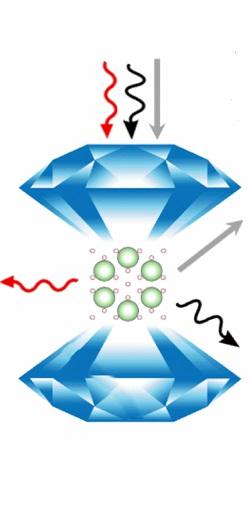
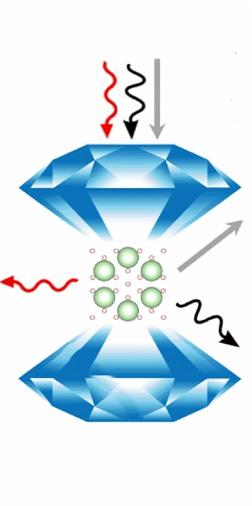
IMAGE

Credit: Image courtesy of Cheng Ji.

Washington, DC–Hydrogen is both the simplest and the most-abundant element in the universe, so studying it can teach scientists about the essence of matter. And yet there are still many hydrogen secrets to unlock, including how best to force it into a superconductive, metallic state with no electrical resistance.

"Although theoretically ideal for energy transfer or storage, metallic hydrogen is extremely challenging to produce experimentally," said Ho-kwang "Dave" Mao, who led a team of physicists in researching the effect of the noble gas argon on pressurized hydrogen.

It has long been proposed that introducing impurities into a sample of molecular hydrogen, H2, could help ease the transition to a metallic state. So Mao and his team set out to study the intermolecular interactions of hydrogen that's weakly-bound, or "doped," with argon, Ar(H2)2, under extreme pressures. The idea is that the impurity could change the nature of the bonds between the hydrogen molecules, reducing the pressure necessary to induce the nonmetal-to-metal transition. Previous research had indicated that Ar(H2)2 might be a good candidate.

Surprisingly, they discovered that the addition of argon did not facilitate the molecular changes needed to initiate a metallic state in hydrogen. Their findings are published by the Proceedings of the National Academy of Sciences.

The team brought the argon-doped hydrogen up to 3.5 million times normal atmospheric pressure–or 358 gigapascals–inside a diamond anvil cell and observed its structural changes using advanced spectroscopic tools.

What they found was that hydrogen stayed in its molecular form even up to the highest pressures, indicating that argon is not the facilitator many had hoped it would be.

"Counter to predictions, the addition of argon did not create a kind of 'chemical pressure' on the hydrogen, pushing its molecules closer together. Rather, it had the opposite effect," said lead author Cheng Ji.

###

The study's other co-authors are: Carnegie's Alexander Goncharov, Dmitry Popov, Bing Li, Junyue Wang, Yue Meng, Jesse Smith, and Wenge Yang; as well as Vivekanand Shukla, Naresh Jena, and Rajeev Ahuja of Uppsala University; and Vitali Prakpenka of the University of Chicago.

This work was supported by the U.S. National Science Foundation, the U.S. Department of Energy, the Chinese Academy of Sciences Visiting Professorship for Senior International Scientists and Recruitment of Foreign Experts, the European Erasmus Fellowship program, and the Swedish Research Council.

The Carnegie Institution for Science (carnegiescience.edu) is a private, nonprofit organization headquartered in Washington, D.C., with six research departments throughout the U.S. Since its founding in 1902, the Carnegie Institution has been a pioneering force in basic scientific research. Carnegie scientists are leaders in plant biology, developmental biology, astronomy, materials science, global ecology, and Earth and planetary science.

Media Contact

Cheng Ji
[email protected]
@carnegiescience

https://carnegiescience.edu/

############

Story Source: Materials provided by Scienmag

Share12Tweet8Share2ShareShareShare2

Related Posts

Tiny Genetic Fragments Crucial for Signaling Brain Rest Identified — Biology

Tiny Genetic Fragments Crucial for Signaling Brain Rest Identified

June 19, 2026
How H5N1 Bird Flu Went Undetected for Weeks in Dairy Cattle — Biology

How H5N1 Bird Flu Went Undetected for Weeks in Dairy Cattle

June 19, 2026

Turning Quantum Potential into Reality

June 19, 2026

Advancing Metal Alloy Behavior Modeling for Enhanced Accuracy

June 19, 2026
Please login to join discussion

POPULAR NEWS

  • Saying Goodbye to PGY-6: Pediatric Fellowship Realities

    103 shares
    Share 41 Tweet 26
  • Multi-Hospital Study Reveals Long Covid Burden Is Twice as High as Current Estimates

    92 shares
    Share 36 Tweet 23
  • Detection of EDCs in Breast Milk and Infant Urine Up to Six Months Highlights Early Exposure Risks

    77 shares
    Share 31 Tweet 19
  • Common Food Preservatives Associated with Elevated Blood Pressure and Increased Heart Disease Risk

    59 shares
    Share 24 Tweet 15

About

We bring you the latest biotechnology news from best research centers and universities around the world. Check our website.

Follow us

Recent News

Tiny Genetic Fragments Crucial for Signaling Brain Rest Identified

How H5N1 Bird Flu Went Undetected for Weeks in Dairy Cattle

Turning Quantum Potential into Reality

Subscribe to Blog via Email

Enter your email address to subscribe to this blog and receive notifications of new posts by email.

Join 82 other subscribers
  • Contact Us

Bioengineer.org © Copyright 2023 All Rights Reserved.

Welcome Back!

Login to your account below

Forgotten Password?

Retrieve your password

Please enter your username or email address to reset your password.

Log In
No Result
View All Result
  • Homepages
    • Home Page 1
    • Home Page 2
  • News
  • National
  • Business
  • Health
  • Lifestyle
  • Science

Bioengineer.org © Copyright 2023 All Rights Reserved.