• HOME
  • NEWS
  • EXPLORE
    • CAREER
      • Companies
      • Jobs
    • EVENTS
    • iGEM
      • News
      • Team
    • PHOTOS
    • VIDEO
    • WIKI
  • BLOG
  • COMMUNITY
    • FACEBOOK
    • INSTAGRAM
    • TWITTER
Friday, April 3, 2026
BIOENGINEER.ORG
No Result
View All Result
  • Login
  • HOME
  • NEWS
  • EXPLORE
    • CAREER
      • Companies
      • Jobs
        • Lecturer
        • PhD Studentship
        • Postdoc
        • Research Assistant
    • EVENTS
    • iGEM
      • News
      • Team
    • PHOTOS
    • VIDEO
    • WIKI
  • BLOG
  • COMMUNITY
    • FACEBOOK
    • INSTAGRAM
    • TWITTER
  • HOME
  • NEWS
  • EXPLORE
    • CAREER
      • Companies
      • Jobs
        • Lecturer
        • PhD Studentship
        • Postdoc
        • Research Assistant
    • EVENTS
    • iGEM
      • News
      • Team
    • PHOTOS
    • VIDEO
    • WIKI
  • BLOG
  • COMMUNITY
    • FACEBOOK
    • INSTAGRAM
    • TWITTER
No Result
View All Result
Bioengineer.org
No Result
View All Result
Home NEWS Science News

Visualizing nuclear radiation

Bioengineer by Bioengineer
March 22, 2017
in Science News
Reading Time: 2 mins read
0
Share on FacebookShare on TwitterShare on LinkedinShare on RedditShare on Telegram
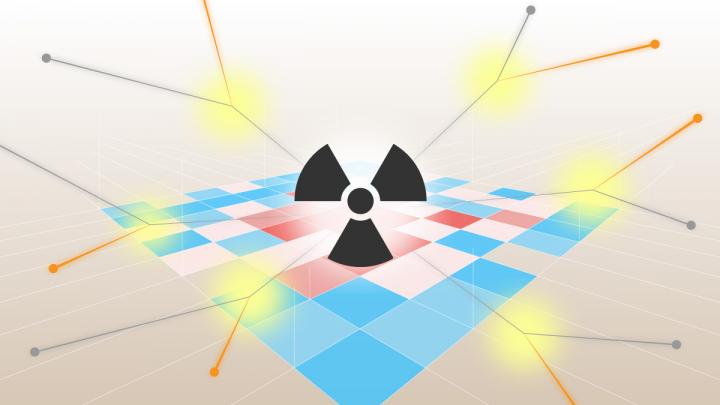
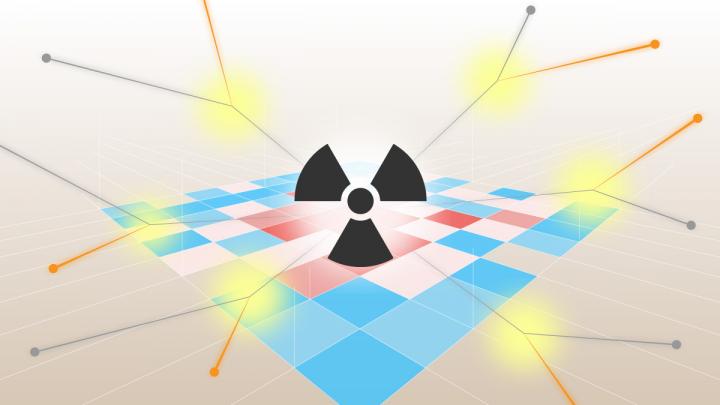
IMAGE

Credit: Kyoto University/Eiri Ono

Kyoto, Japan — Extraordinary decontamination efforts are underway in areas affected by the 2011 nuclear accidents in Japan. The creation of total radioactivity maps is essential for thorough cleanup, but the most common methods, according to Kyoto University's Toru Tanimori, do not 'see' enough ground-level radiation.

"The best methods we have currently are labor intensive, and to measure surface radiation accurately," he says, "complex analysis is needed."

In their latest work published in Scientific Reports, Tanimori and his group explain how gamma-ray imaging spectroscopy is more versatile and robust, resulting in a clearer image.

"We constructed an Electron Tracking Compton Camera (ETCC) to detect nuclear gamma rays quantitatively. Typically this is used to study radiation from space, but we have shown that it can also measure contamination, such as at Fukushima."

The imaging revealed what Tanimori calls "micro hot spots" around the Fukushima Daiichi Nuclear Power Plant, even in regions that had already been considered decontaminated. In fact, the cleaning in some regions appeared to be far less than what could be measured by other means.

Current methods for measuring gamma rays do not reliably pinpoint the source of the radiation. According to Tanimori, "radiation sources including distant galaxies can disrupt the measurements."

The key to creating a clear image is taking a color image including the direction and energy of all gamma rays emitted in the vicinity.

"Quantitative imaging produces a surface radioactivity distribution that can be converted to show dosage on the ground," says Tanimori. "The ETCC makes true images of the gamma rays based on proper geometrical optics."

This distribution can then be used to relatively easily measure ground dosage levels, showing that most gamma rays scatter and spread in the air, putting decontamination efforts at risk.

"Our ETCC will make it easier to respond to nuclear emergencies," continues Tanimori. "Using it, we can detect where and how radiation is being released. This will not only help decontamination, but also the eventual dismantling of nuclear reactors."

###

The paper "First On-Site True Gamma-Ray Imaging-Spectroscopy of Contamination near Fukushima Plant" appeared 3 February 2017 in Scientific Reports, with doi: 10.1038/srep41972

Kyoto University is one of Japan and Asia's premier research institutions, founded in 1897 and responsible for producing numerous Nobel laureates and winners of other prestigious international prizes. A broad curriculum across the arts and sciences at both undergraduate and graduate levels is complemented by numerous research centers, as well as facilities and offices around Japan and the world. For more information please see: http://www.kyoto-u.ac.jp/en

Media Contact

David Kornhauser
[email protected]
81-757-535-727
@KyotoU_News

http://www.kyoto-u.ac.jp/en

############

Story Source: Materials provided by Scienmag

Share12Tweet8Share2ShareShareShare2

Related Posts

SKKU Develops Advanced Platinum Catalyst, Paving the Way for High-Efficiency Hydrogen Fuel Cell Vehicles

SKKU Develops Advanced Platinum Catalyst, Paving the Way for High-Efficiency Hydrogen Fuel Cell Vehicles

April 3, 2026
How the Human Brain Constructs Our Sense of Time

How the Human Brain Constructs Our Sense of Time

April 3, 2026

Voluntary Sustainability Standards Boost Tropical Agrifood Trade

April 3, 2026

Maternal Genes Drive Faster Drying in Hybrid Maize Seeds Through Imprinting

April 3, 2026
Please login to join discussion

POPULAR NEWS

  • blank

    Revolutionary AI Model Enhances Precision in Detecting Food Contamination

    96 shares
    Share 38 Tweet 24
  • Imagine a Social Media Feed That Challenges Your Views Instead of Reinforcing Them

    1007 shares
    Share 398 Tweet 249
  • Promising Outcomes from First Clinical Trials of Gene Regulation in Epilepsy

    51 shares
    Share 20 Tweet 13
  • Popular Anti-Aging Compound Linked to Damage in Corpus Callosum, Study Finds

    44 shares
    Share 18 Tweet 11

About

We bring you the latest biotechnology news from best research centers and universities around the world. Check our website.

Follow us

Recent News

SKKU Develops Advanced Platinum Catalyst, Paving the Way for High-Efficiency Hydrogen Fuel Cell Vehicles

How the Human Brain Constructs Our Sense of Time

Voluntary Sustainability Standards Boost Tropical Agrifood Trade

Subscribe to Blog via Email

Enter your email address to subscribe to this blog and receive notifications of new posts by email.

Join 78 other subscribers
  • Contact Us

Bioengineer.org © Copyright 2023 All Rights Reserved.

Welcome Back!

Login to your account below

Forgotten Password?

Retrieve your password

Please enter your username or email address to reset your password.

Log In
No Result
View All Result
  • Homepages
    • Home Page 1
    • Home Page 2
  • News
  • National
  • Business
  • Health
  • Lifestyle
  • Science

Bioengineer.org © Copyright 2023 All Rights Reserved.