Credit: Chandra Sekhar Tiwary/Rice University
Researchers at Rice University and the Indian Institute of Science have an idea to simplify electronic waste recycling: Crush it into nanodust.
Specifically, they want to make the particles so small that separating different components is relatively simple compared with processes used to recycle electronic junk now.
Chandra Sekhar Tiwary, a postdoctoral researcher at Rice and a researcher at the Indian Institute of Science in Bangalore, uses a low-temperature cryo-mill to pulverize electronic waste – primarily the chips, other electronic components and polymers that make up printed circuit boards (PCBs) — into particles so small that they do not contaminate each other.
Then they can be sorted and reused, he said.
The process is the subject of a Materials Today paper by Tiwary, Rice materials scientist Pulickel Ajayan and Indian Institute professors Kamanio Chattopadhyay and D.P. Mahapatra.
The researchers intend it to replace current processes that involve dumping outdated electronics into landfills, or burning or treating them with chemicals to recover valuable metals and alloys. None are particularly friendly to the environment, Tiwary said.
"In every case, the cycle is one way, and burning or using chemicals takes a lot of energy while still leaving waste," he said. "We propose a system that breaks all of the components – metals, oxides and polymers – into homogenous powders and makes them easy to reuse."
The researchers estimate that so-called e-waste will grow by 33 percent over the next four years, and by 2030 will weigh more than a billion tons. Nearly 80 to 85 percent of often-toxic e-waste ends up in an incinerator or a landfill, Tiwary said, and is the fastest-growing waste stream in the United States, according to the Environmental Protection Agency.
The answer may be scaled-up versions of a cryo-mill designed by the Indian team that, rather than heating them, keeps materials at ultra-low temperatures during crushing.
Cold materials are more brittle and easier to pulverize, Tiwary said. "We take advantage of the physics. When you heat things, they are more likely to combine: You can put metals into polymer, oxides into polymers. That's what high-temperature processing is for, and it makes mixing really easy.
"But in low temperatures, they don't like to mix. The materials' basic properties – their elastic modulus, thermal conductivity and coefficient of thermal expansion – all change. They allow everything to separate really well," he said.
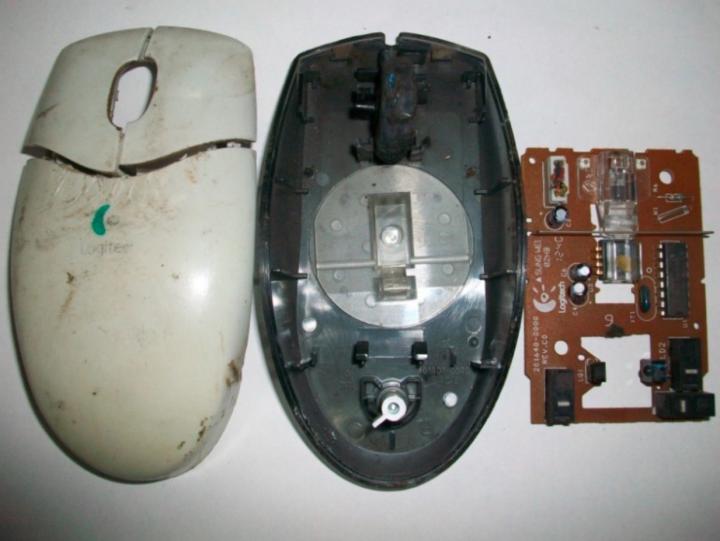
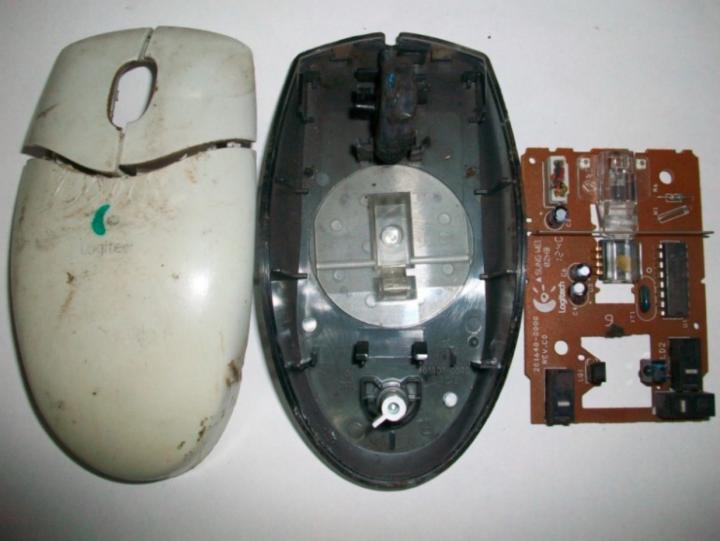
The test subjects in this case were computer mice – or at least their PCB innards. The cryo-mill contained argon gas and a single tool-grade steel ball. A steady stream of liquid nitrogen kept the container at 154 kelvins (minus 182 degrees Fahrenheit).
When shaken, the ball smashes the polymer first, then the metals and then the oxides just long enough to separate the materials into a powder, with particles between 20 and 100 nanometers wide. That can take up to three hours, after which the particles are bathed in water to separate them.
"Then they can be reused," he said. "Nothing is wasted."
###
S. Kishore of the Indian Institute of Science is co-lead author of the paper. R. Vasireddi, also of the Indian Institute of Science, is a co-author. Ajayan is chair of Rice's Department of Materials Science and NanoEngineering, the Benjamin M. and Mary Greenwood Anderson Professor in Engineering and a professor of chemistry.
Read the abstract at http://www.sciencedirect.com/science/article/pii/S1369702116303972
This news release can be found online at http://news.rice.edu/2017/03/20/pulverizing-e-waste-is-green-clean-and-cold/
Follow Rice News and Media Relations via Twitter @RiceUNews.
Related materials:
Ajayan Research Group: http://ajayan.rice.edu
Non-Equilibrium Processing and Nano Materials Group (Chattopadhyay lab): materials.iisc.ernet.in/~kamanio/
Rice Department of Materials Science and NanoEngineering: https://msne.rice.edu
Located on a 300-acre forested campus in Houston, Rice University is consistently ranked among the nation's top 20 universities by U.S. News & World Report. Rice has highly respected schools of Architecture, Business, Continuing Studies, Engineering, Humanities, Music, Natural Sciences and Social Sciences and is home to the Baker Institute for Public Policy. With 3,879 undergraduates and 2,861 graduate students, Rice's undergraduate student-to-faculty ratio is 6-to-1. Its residential college system builds close-knit communities and lifelong friendships, just one reason why Rice is ranked No. 1 for happiest students and for lots of race/class interaction by the Princeton Review. Rice is also rated as a best value among private universities by Kiplinger's Personal Finance. To read "What they're saying about Rice," go to http://tinyurl.com/RiceUniversityoverview.
Media Contact
David Ruth
[email protected]
713-348-6327
@RiceUNews
http://news.rice.edu
############
Story Source: Materials provided by Scienmag