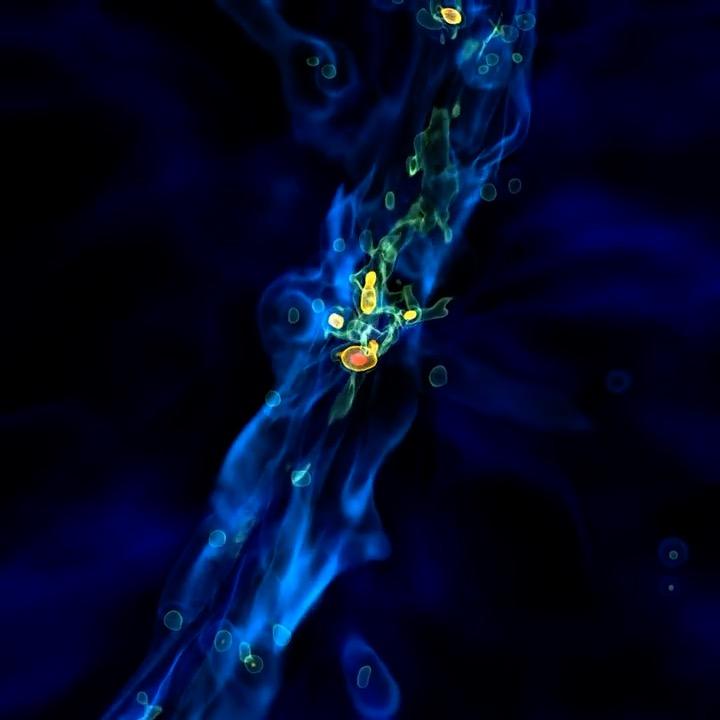
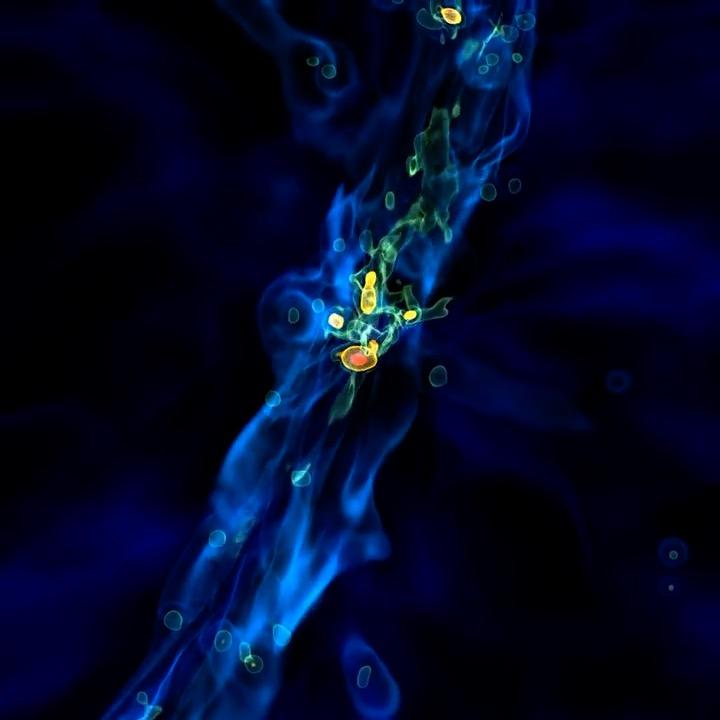
Credit: Los Alamos National Laboratory
LOS ALAMOS, New Mexico, March 21, 2017–A new computer simulation helps explain the existence of puzzling supermassive black holes observed in the early universe. The simulation is based on a computer code used to understand the coupling of radiation and certain materials.
"Supermassive black holes have a speed limit that governs how fast and how large they can grow," said Joseph Smidt of the Theoretical Design Division at Los Alamos National Laboratory, "The relatively recent discovery of supermassive black holes in the early development of the universe raised a fundamental question, how did they get so big so fast?"
Using computer codes developed at Los Alamos for modeling the interaction of matter and radiation related to the Lab's stockpile stewardship mission, Smidt and colleagues created a simulation of collapsing stars that resulted in supermassive black holes forming in less time than expected, cosmologically speaking, in the first billion years of the universe.
"It turns out that while supermassive black holes have a growth speed limit, certain types of massive stars do not," said Smidt. "We asked, what if we could find a place where stars could grow much faster, perhaps to the size of many thousands of suns; could they form supermassive black holes in less time?"
A video about the discovery is available here.
It turns out the Los Alamos computer model not only confirms the possibility of speedy supermassive black hole formation, but also fits many other phenomena of black holes that are routinely observed by astrophysicists. The research shows that the simulated supermassive black holes are also interacting with galaxies in the same way that is observed in nature, including star formation rates, galaxy density profiles, and thermal and ionization rates in gasses.
"This was largely unexpected," said Smidt. "I thought this idea of growing a massive star in a special configuration and forming a black hole with the right kind of masses was something we could approximate, but to see the black hole inducing star formation and driving the dynamics in ways that we've observed in nature was really icing on the cake."
A key mission area at Los Alamos National Laboratory is understanding how radiation interacts with certain materials. Because supermassive black holes produce huge quantities of hot radiation, their behavior helps test computer codes designed to model the coupling of radiation and matter. The codes are used, along with large- and small-scale experiments, to assure the safety, security, and effectiveness of the U.S. nuclear deterrent.
"We've gotten to a point at Los Alamos," said Smidt, "with the computer codes we're using, the physics understanding, and the supercomputing facilities, that we can do detailed calculations that replicate some of the forces driving the evolution of the Universe."
###
Research paper available at https://arxiv.org/pdf/1703.00449.pdf
About Los Alamos National Laboratory
Los Alamos National Laboratory, a multidisciplinary research institution engaged in strategic science on behalf of national security, is operated by Los Alamos National Security, LLC, a team composed of Bechtel National, the University of California, BWXT Government Group, and URS, an AECOM company, for the Department of Energy's National Nuclear Security Administration.
Los Alamos enhances national security by ensuring the safety and reliability of the U.S. nuclear stockpile, developing technologies to reduce threats from weapons of mass destruction, and solving problems related to energy, environment, infrastructure, health, and global security concerns.
Media Contact
Kevin Roark
[email protected]
505-665-9202
@LosAlamosNatLab
http://www.lanl.gov
############
Story Source: Materials provided by Scienmag