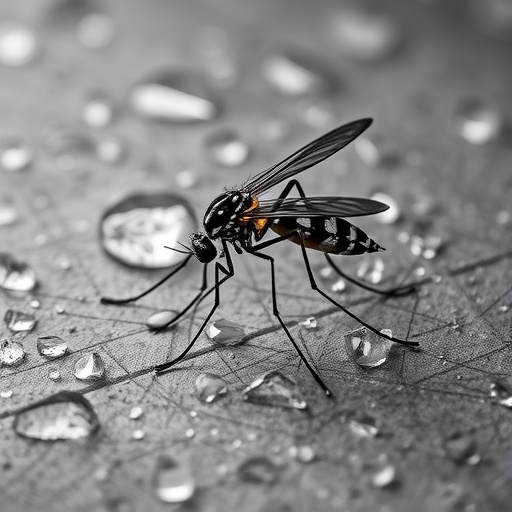

In the realm of public health, one of the persistent threats remains the spread of malaria, a disease primarily transmitted by the Anopheles mosquito. Recent research conducted by Bello et al. has meticulously explored the influence of meteorological variables on the population dynamics of Anopheles mosquitoes in Lagos, Nigeria, precisely in regions such as Epe and Orimedu. Understanding these dynamics is crucial for malaria vector control programs aimed at reducing disease transmission.
The research delineates how environmental factors significantly impact the abundance and distribution of these mosquitoes. Temperature, humidity, rainfall, and other meteorological elements play crucial roles in determining the life cycle of Anopheles mosquitoes, thereby influencing their breeding and feeding behaviors. These factors can create conditions that either favor or hinder mosquito populations, affecting malaria transmission rates in human populations.
Bello and colleagues systematically collected data on meteorological variables and correlated them with the abundance of Anopheles mosquitoes. The study revealed that not only does temperature play a pivotal role in the lifecycle of these vectors, but other factors, such as rainfall patterns, also govern their availability and activity. Crucially, the researchers noted that periods of high rainfall often coincide with peaks in mosquito populations, creating a robust association between environmental changes and malaria transmission potential.
.adsslot_aEW4iHvPS2{width:728px !important;height:90px !important;}
@media(max-width:1199px){ .adsslot_aEW4iHvPS2{width:468px !important;height:60px !important;}
}
@media(max-width:767px){ .adsslot_aEW4iHvPS2{width:320px !important;height:50px !important;}
}
ADVERTISEMENT
Humidity is another variable that emerged as significant in the study. Anopheles mosquitoes thrive in humid environments, which facilitate their survival and reproduction. Therefore, understanding local weather patterns and climate trends becomes essential for forecasting mosquito outbreaks. Increased humidity levels can enhance mosquito longevity, thus prolonging the malaria transmission season in affected areas.
The research offers valuable insights into how climate change could further exacerbate difficulties in managing mosquito populations. As global temperatures rise, the resultant shifts in weather patterns could create unprecedented conditions for Anopheles mosquitoes, potentially leading to increased transmission rates of malaria in regions currently witnessing fluctuations in climate. Consequently, this study signals an urgent need for adaptive public health strategies to address potential future challenges exacerbated by climate change.
Another vital component of the research is its geographic focus. Epe and Orimedu are regions that experience distinct meteorological conditions, which contribute to varying Anopheles populations. By examining these areas, the researchers highlighted the importance of localized studies to enhance our understanding of malaria vector dynamics. Tailoring malaria control strategies to accommodate specific environmental and geographic contexts can lead to more effective interventions.
The implications of such research extend beyond academic inquiry. By providing empirical data that correlates meteorological conditions with mosquito populations, policymakers can formulate evidence-based strategies for vector control. This proactive approach can lead to the implementation of targeted interventions during high-risk periods, ultimately aiming to reduce the incidence of malaria in vulnerable populations.
In aiding public health authorities, this research reinforces the necessity of integrating meteorological data into health surveillance systems. By establishing connections between environmental variables and vector populations, health officials can enhance their response mechanisms, effectively using weather forecasting as a tool for malaria prevention. Understanding when and where mosquito populations are likely to spike allows for refined resource allocation towards vector control measures.
Furthermore, in the ongoing fight against malaria, community awareness and education become paramount. Public health campaigns should inform communities in endemic regions about the significance of environmental conditions in mosquito proliferation. Educating populations on simple measures, such as ensuring proper drainage to reduce standing water or utilizing natural repellents, can empower individuals to play a part in vector control.
These findings underscore the importance of interdisciplinary collaboration in tackling malaria. Integrating entomology, meteorology, public health, and social sciences can lead to a comprehensive understanding of malaria dynamics. The research conducted by Bello et al. serves as a call to action for experts across disciplines to join forces in developing holistic approaches to combat malaria.
Ultimately, the investigation into the influence of meteorological variables on Anopheles mosquito populations highlights a critical gap in global health strategies. The link between climate and disease transmission illuminates the urgency of utilizing existing data to adapt to a changing environment. Investments in research that elucidate these connections can pave the way for groundbreaking interventions aimed at preventing malaria resurgence.
As the research progresses towards publication, its contributions to malaria vector control will resonate with scientists and policymakers alike. The clear message is that addressing mosquito populations cannot solely be approached through insecticide application or environmental management. A more nuanced understanding based on meteorological patterns is essential for sustainable and effective malaria control initiatives.
In conclusion, understanding the multifaceted relationships between meteorological conditions and the life cycle of Anopheles mosquitoes is critical to mitigating malaria transmission. The research by Bello et al. serves as an essential reminder of the impacts of climate on health, encouraging a shift towards evidence-based interventions tailored to specific environmental contexts.
Subject of Research: Influence of meteorological variables on the abundance and distribution patterns of Anopheles mosquitoes.
Article Title: Influence of meteorological variables on the abundance and distribution patterns of Anopheles mosquitoes in Epe and Orimedu, Lagos, Nigeria.
Article References: Bello, A.B., Hassan, A.A., Oladejo, S.O. et al. Influence of meteorological variables on the abundance and distribution patterns of Anopheles mosquitoes in Epe and Orimedu, Lagos, Nigeria. Discov Anim 2, 28 (2025). https://doi.org/10.1007/s44338-025-00076-9
Image Credits: AI Generated
DOI:
Keywords: malaria, Anopheles mosquitoes, meteorological variables, public health, climate change, vector control.
Tags: Anopheles mosquito behavior and environmental conditionsclimate influence on disease spreadenvironmental factors influencing mosquito abundanceEpe and Orimedu mosquito studieshumidity effects on Anopheles breedingLagos mosquito population dynamicsmalaria prevention through environmental managementmeteorological variables and malaria transmissionpublic health and vector control strategiesrainfall patterns and malaria vectorstemperature and mosquito life cycleweather impact on Anopheles mosquito populations