• HOME
  • NEWS
  • EXPLORE
    • CAREER
      • Companies
      • Jobs
    • EVENTS
    • iGEM
      • News
      • Team
    • PHOTOS
    • VIDEO
    • WIKI
  • BLOG
  • COMMUNITY
    • FACEBOOK
    • INSTAGRAM
    • TWITTER
Monday, October 5, 2026
BIOENGINEER.ORG
No Result
View All Result
  • Login
  • HOME
  • NEWS
  • EXPLORE
    • CAREER
      • Companies
      • Jobs
        • Lecturer
        • PhD Studentship
        • Postdoc
        • Research Assistant
    • EVENTS
    • iGEM
      • News
      • Team
    • PHOTOS
    • VIDEO
    • WIKI
  • BLOG
  • COMMUNITY
    • FACEBOOK
    • INSTAGRAM
    • TWITTER
No Result
View All Result
Bioengineer.org
No Result
View All Result
Home NEWS Science News

A multi-channel nano-optical device dramatically increases the parallel processing speed

Bioengineer by Bioengineer
March 17, 2017
in Science News
Reading Time: 2 mins read
0
Share on FacebookShare on TwitterShare on LinkedinShare on RedditShare on Telegram
IMAGE

Credit: IBS

Microprocessors play a pivotal role in computers and have steadily increased the speed of information processing over the past several decades. However, due to technical limitations such as heat generation due to integration, the processing speed of semiconductors has remained at several gigahertz (GHz) for the past decade. As a current alternative to this, many microprocessors are used in parallel, but the electrical connection between the processors is slow, creating a bottleneck for data transfer. To solve this problem, many studies have been conducted to merge processors by using optical signals which are several hundred times faster than electrical signals.

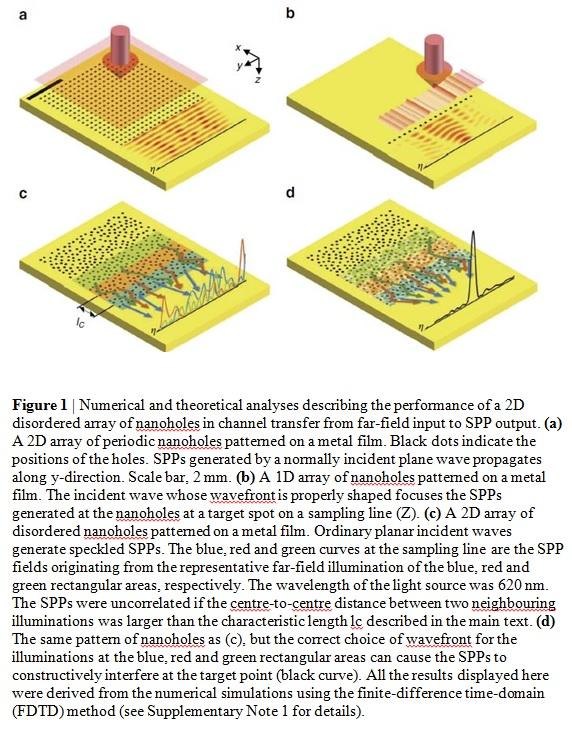
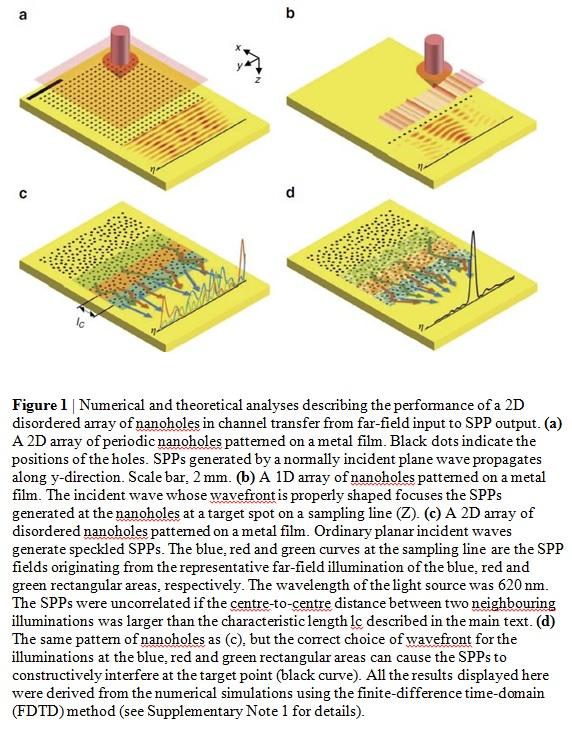
CHOI Wonshik, Associate Director of the CMSD, lead the research team that created an innovative device. The team discarded with the conventional method of periodically arranging the nano antennas. Instead, they devised disordered arrangement of the antennas to minimize redundancy between the antennas and enabled each antenna to function independently. As a result, the device can provide 40 times wider bandwidth than existing antennas periodically arranged. "We are proposing a new way to connect nanoscale microprocessors to ultra-high-speed optical communications," commented Dr. Choi. The research will appear in the March edition of Nature Communications.

The team used surface plasmons to mediate optoelectronic signaling. At nano antennas, optical signals are converted to surface plasmons, which then propagate through metal surface as electric signals. The researchers randomly arranged the nano antennas, and the surface plasmons generated at each antenna underwent multiple scattering to minimize redundancy between the antennas. In this way, each of the antennas can be used independently, resulting in a substantial increase in the effective number of antennas to more than 40 times. An increase in the number of antennas means an increase in the number of multiple input channels in the MIMO communication, which leads to an increase in the information transmission bandwidth.

To exploit the benefit of disordered arrangement of antennas, the team had to resolve an innate problem. Random multiple scattering by disorderly arranged nano antennas is unpredictable, and cannot be used for information transfer without special measure. The researchers analyzed the patterns of multiple-scattered surface plasmons for various optical inputs and found a particular optical input signal that could send the desired signal to a particular microprocessor. The spatial light modulator was used to generate the identified optical input signal, and the surface plasmon could be controlled freely. "Using this," offered Doctor Choi. "We proved that we can transmit signals to six different microprocessors at the same time and proved that optical images are converted into plasmons."

###

Media Contact

Dahee Carol Kim
[email protected]
82-428-788-133
@IBS_media

http://www.ibs.re.kr/en/

############

Story Source: Materials provided by Scienmag

Share12Tweet8Share2ShareShareShare2

Related Posts

Magnetic Composite Photocatalyst Destroys Dye Pollution and Lifts Itself Out With a Magnet

Magnetic Composite Photocatalyst Destroys Dye Pollution and Lifts Itself Out With a Magnet

October 5, 2026
Gut Microbes Take Center Stage in Gastrointestinal Cancer Research

Gut Microbes Take Center Stage in Gastrointestinal Cancer Research

October 5, 2026

Coal Country Speaks: What a Colombian Mining Town Taught Scientists About Just Energy Transitions

October 5, 2026

Memory-Guided AI Learns What Normal Looks Like to Spot Surveillance Anomalies

October 5, 2026
Please login to join discussion

POPULAR NEWS

  • Alloys That Shrink Their Own Grains: New PIX Mechanism Refines Metals With Heat Alone

    Alloys That Shrink Their Own Grains: New PIX Mechanism Refines Metals With Heat Alone

    29 shares
    Share 12 Tweet 7
  • Endurance Exercise Reshapes the Liver in Males and Females Through Distinct Molecular Routes

    29 shares
    Share 12 Tweet 7
  • Single Transcription Factor PU.1 Rapidly Converts Fibroblasts into Macrophage-Lineage Cells

    29 shares
    Share 12 Tweet 7
  • New Scale Measures How Ready Nurse Educators Really Are for the AI Era

    29 shares
    Share 12 Tweet 7

About

We bring you the latest biotechnology news from best research centers and universities around the world. Check our website.

Follow us

Recent News

Alloys That Shrink Their Own Grains: New PIX Mechanism Refines Metals With Heat Alone

Endurance Exercise Reshapes the Liver in Males and Females Through Distinct Molecular Routes

Single Transcription Factor PU.1 Rapidly Converts Fibroblasts into Macrophage-Lineage Cells

Subscribe to Blog via Email

Success! An email was just sent to confirm your subscription. Please find the email now and click 'Confirm' to start subscribing.

Join 85 other subscribers
  • Contact Us

Bioengineer.org © Copyright 2023 All Rights Reserved.

Welcome Back!

Login to your account below

Forgotten Password?

Retrieve your password

Please enter your username or email address to reset your password.

Log In
No Result
View All Result
  • Homepages
    • Home Page 1
    • Home Page 2
  • News
  • National
  • Business
  • Health
  • Lifestyle
  • Science

Bioengineer.org © Copyright 2023 All Rights Reserved.