Vincent van Gogh’s iconic masterpiece, “The Starry Night,” has long captivated admirers worldwide with its swirling nocturnal landscape. Now, this evocative artwork provides an unexpected visual analogue for a groundbreaking quantum phenomenon recently observed by physicists. Researchers at Osaka Metropolitan University in collaboration with the Korea Advanced Institute of Science and Technology have reported the first-ever experimental observation of the quantum Kelvin–Helmholtz instability (KHI) — a phenomenon originally theorized decades ago but never before witnessed in quantum fluids. This discovery opens a novel window into the complex vortex structures and topologies that manifest in the quantum realm, bearing striking resemblance to the dynamic swirls that decorate Van Gogh’s skies.
The Kelvin–Helmholtz instability is a classical fluid dynamics effect that occurs at the interface between two fluids moving at different velocities. It is responsible for the formation of characteristic rolling waves and vortices seen in phenomena such as cloud formations, ocean waves, and even atmospheric patterns. Despite its ubiquity in the classical world, the quantum counterpart of KHI had remained elusive — until now. By cooling lithium atoms to near absolute zero, the researchers created a two-component Bose–Einstein condensate (BEC), an exotic state of matter that behaves as a quantum superfluid. This condensate hosted two fluid streams flowing at distinct velocities, setting the stage for the quantum KHI to unfold.
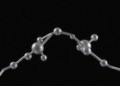
At the interface between these counterflowing quantum streams, the team observed a wavy interface that transitioned into the formation of vortices, closely mirroring the classical phenomenon but governed by fundamentally different quantum mechanical and topological rules. Unlike classical vortices, which can be described using standard fluid mechanics, the vortices observed in this experiment are shaped by quantum spin textures and topological defects intrinsic to superfluid systems. These vortices manifested as “eccentric fractional skyrmions” (EFSs)—a heretofore unknown variety of topological spin configuration characterized by a distinctive crescent shape, rather than the symmetrical, centered forms typically associated with skyrmions.
.adsslot_5jgR3eM1Qr{ width:728px !important; height:90px !important; }
@media (max-width:1199px) { .adsslot_5jgR3eM1Qr{ width:468px !important; height:60px !important; } }
@media (max-width:767px) { .adsslot_5jgR3eM1Qr{ width:320px !important; height:50px !important; } }
ADVERTISEMENT
Skyrmions are topological solitons originally identified in magnetic systems, wherein the orientation of electron spins organizes into stable, whirlpool-like structures. Their unique properties, including remarkable stability and nanoscale dimensions, have made them promising candidates for next-generation technologies such as spintronic devices and high-density memory storage. The discovery of fractional and eccentric skyrmion forms within a quantum superfluid not only broadens the landscape of skyrmion physics but also suggests new pathways for controlling and exploiting quantum fluid dynamics at ultra-low temperatures.
A key insight from the Osaka team was the identification of embedded singularities within these EFS structures. Singularities represent points at which the conventional description of the spin texture breaks down, leading to abrupt distortions or discontinuities. These traits render EFSs fundamentally distinct from their classical skyrmion analogues and complicate their topological classification. According to lead researcher Hiromitsu Takeuchi, the crescent moon prominently featured in Van Gogh’s “The Starry Night” closely resembles the shape of these eccentric fractional skyrmions, forging a poetic link between 19th-century art and 21st-century quantum physics.
Looking forward, the researchers aim to refine their experimental precision to quantitatively analyze the wave properties of the quantum KHI interface, such as the characteristic wavelengths and oscillation frequencies that classical instability theory predicts. Such measurements could validate longstanding theoretical models from the early 20th century, applied in a novel quantum context. Moreover, the existence of EFSs challenges the traditional framework for categorizing topological defects, inviting further theoretical exploration into whether similar fractional structures exist in other multi-component or higher-dimensional quantum systems.
This study also exemplifies the fruitful confluence of abstract mathematics, theoretical modeling, and precision experimental physics. By bridging centuries-old art with cutting-edge quantum phenomena, it demonstrates the unexpected ways in which human creativity and scientific inquiry can intersect, enriching both fields. The cross-disciplinary resonance between Van Gogh’s swirling night skies and the quantum spin textures observed in the laboratory underscores the profound beauty embedded in the laws of nature.
Ultimately, the discovery of stable singular fractional skyrmions emerging from quantum Kelvin–Helmholtz instability offers a captivating glimpse into the complex and beautiful behaviors possible in quantum fluids. It opens new horizons for exploring the dynamic interplay of quantum mechanics, topology, and fluid dynamics, inspiring further research at the intersection of physics, materials science, and applied technology. As experimental techniques continue to advance, quantum fluids promise to reveal even more surprising phenomena, with implications that will undoubtedly ripple across fundamental science and applied innovation alike.
Subject of Research: Not applicable
Article Title: Stable singular fractional skyrmion spin texture from the quantum Kelvin–Helmholtz instability
News Publication Date: 8-Aug-2025
Web References:
http://dx.doi.org/10.1038/s41567-025-02982-x
Image Credits: Public Domain
Keywords
Quantum Kelvin–Helmholtz instability, Bose–Einstein condensate, quantum turbulence, eccentric fractional skyrmions, topological defects, quantum fluids, spin textures, vortex dynamics, superfluidity, quantum spintronics, topological singularities, quantum fluid interface
Tags: Bose-Einstein condensate researchexotic vortex structures in quantum fluidsexperimental observation of quantum phenomenafluid dynamics in quantum mechanicsimplications of quantum superfluidityKorea Advanced Institute of Science and Technology collaborationOsaka Metropolitan University researchquantum fluid dynamicsquantum Kelvin-Helmholtz instabilityunderstanding complex vortex topologiesVincent van Gogh’s Starry Nightvisual analogues in physics