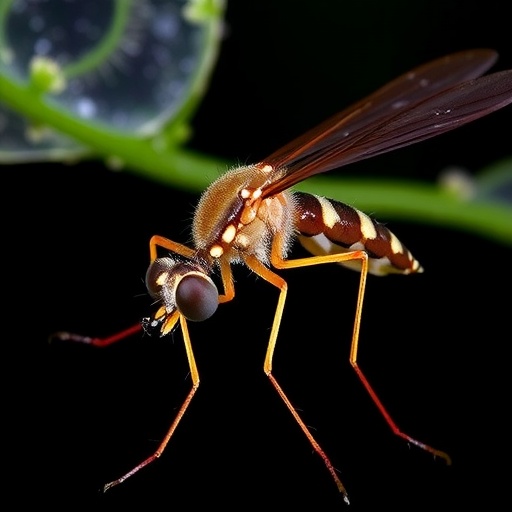

In a ground-breaking study, researchers have delved into the intricate world of bacterial communities associated with the developmental stages of Anopheles subpictus, a notable mosquito species that plays a critical role in transmitting malaria. As global attention remains focused on combating malaria and other vector-borne diseases, understanding the microbiota of these vectors offers new pathways for innovative strategies. This research opens a window into the complex interactions between mosquitoes and the microorganisms that inhabit them, glorifying the importance of microbial diversity in public health.
The research team, spearheaded by Agrawal, Acharya, and Sahu, embarked on a journey to analyze the bacterial communities residing within Anopheles subpictus at various developmental stages. The significance of this study cannot be overstated, as it sheds light on how these bacterial compositions can influence the mosquito’s physiology, ecology, and, by extension, its capacity to transmit diseases. By pinpointing the fluctuations in bacterial diversity across life stages, the team aims to enrich our understanding of the mosquito holobiont—the complex of a host and its associated microbiota.
Through meticulous sampling and advanced sequencing techniques, the researchers were able to categorize and characterize the bacterial taxa present throughout the larval, pupal, and adult stages of the mosquito’s life cycle. Each stage exhibited distinct bacterial communities, revealing a dynamic relationship between Anopheles subpictus and its microbial companions. These findings may have far-reaching implications for vector control strategies, particularly in a world increasingly beset by the challenges posed by insecticide resistance.
.adsslot_dtqBOLC9wi{width:728px !important;height:90px !important;}
@media(max-width:1199px){ .adsslot_dtqBOLC9wi{width:468px !important;height:60px !important;}
}
@media(max-width:767px){ .adsslot_dtqBOLC9wi{width:320px !important;height:50px !important;}
}
ADVERTISEMENT
One of the most striking revelations from this study is the identification of specific bacterial taxa that appear to dominate at different life stages of the mosquito. For instance, the larval stage was found to host a diverse array of bacteria, which may play a crucial role in nutrient acquisition and detoxification. The presence of specific genera could indicate their potential involvement in mediating immune responses within the larvae, thus influencing their growth and development. This discovery highlights the transformative role bacteria play in shaping the life history traits of Anopheles subpictus.
As the infestation of urban environments by mosquitoes continues to escalate, understanding how environmental factors influence microbial communities becomes paramount. The researchers noted that variations in temperature, salinity, and nutrient availability can drastically alter the bacterial composition of Anopheles subpictus. Such environmental interactions suggest that microbial communities are not static but are highly responsive to changes in ecological conditions. This adaptability of the microbiome could pose challenges in developing sustainable control measures for malaria vectors.
The study not only contributes to our fundamental knowledge of microbial ecology but also paves the way for bioengineering approaches that might manipulate these bacterial communities for public health benefit. By harnessing the power of beneficial bacteria, there exists the potential to elevate the mosquito’s resistance to pathogens, thereby decreasing the disease risk posed to humans. Such biocontrol tactics would align well with integrated pest management strategies currently in practice.
Moreover, considering that bacterial communities in mosquitoes can impact their susceptibility to pathogens, the researchers emphasized the need to study these microorganisms in greater detail. For example, some bacteria are known to possess anti-pathogenic properties, which could be exploited to reduce the transmission of malaria parasites. Understanding these intricate relationships may allow scientists to develop novel interventions that could revolutionize public health initiatives within endemic regions.
The implications of this research extend beyond Anopheles subpictus alone. Insights gleaned could also be relevant to other mosquito species and vectors responsible for transmitting various diseases. The techniques employed in this study, including high-throughput sequencing and bioinformatics analyses, represent standard methodologies that can be adapted for broader applications in entomological and microbiological research.
This work has also reignited discussions surrounding the concept of heritable microbiomes in insects, particularly in vectors that have adapted to human environments. As Anopheles subpictus exploits diverse habitats, understanding how these bacteria propagate and evolve in different ecological niches is crucial for predicting future public health challenges. Such foresight is essential in designing interventions that not only target adult mosquitoes but also exploit the vulnerabilities present in their developmental stages.
The researchers’ findings stand to contribute significantly to the broader discourse around microbiota’s role in the life cycles of insects and their interaction with the environment. By establishing a comprehensive understanding of Anopheles subpictus at the microbial level, this study calls for a multidisciplinary approach in vector biology, integrating microbiology, ecology, and evolutionary biology into a cohesive body of knowledge.
As the field of mosquito research continues to expand, this study serves as a critical reminder of the importance of microbial diversity. The bacteria associated with mosquitoes could hold the key to enhancing our ability to combat malaria and other vector-borne diseases. As the global community gears up to implement more effective and sustainable strategies, investigations like these will be foundational in steering the future of public health initiatives that aim to reduce the burden of disease around the world.
Ultimately, the rich interplay between Anopheles subpictus and its bacteria exemplifies the interconnectedness of life forms and ecosystems. Researchers are now tasked with exploring these interactions further, unraveling the mysteries cloaked within microbial communities, and leveraging this knowledge to build a healthier world. The implications of such research reach far beyond academic circles and touch the lives of countless individuals who rely on successful malaria control efforts to safeguard their health.
In summary, as we stand on the cusp of a new era in malaria research, the work led by Agrawal, Acharya, and Sahu offers hope and direction. The study not only emphasizes the complexity of life forms involved in disease transmission but also illustrates how patterns in bacterial community composition can illuminate pathways for innovative solutions. The vibrant tapestry of life, seen through the lens of microbiomes, opens doors to possibilities that could ultimately shape the landscape of public health for generations to come.
Subject of Research: Bacterial community composition and diversity associated with developmental stages of Anopheles subpictus.
Article Title: Bacterial community composition and diversity associated with developmental stages of Anopheles subpictus.
Article References:
Agrawal, A., Acharya, A.B., Sahu, B. et al. Bacterial community composition and diversity associated with developmental stages of Anopheles subpictus. Int Microbiol (2025). https://doi.org/10.1007/s10123-025-00688-x
Image Credits: AI Generated
DOI: https://doi.org/10.1007/s10123-025-00688-x
Keywords: Bacterial community, Anopheles subpictus, microbial ecology, malaria transmission, vector control, holobiont, microbial diversity, public health.
Tags: advanced sequencing techniques in microbiologyAnopheles subpictus microbiotabacterial diversity in Anopheles subpictusbacterial taxa characterizationecological role of mosquito-associated bacteriaholobiont interactions in mosquitoesimpact of microbiota on mosquito physiologyinnovative malaria control strategiesmalaria vector-borne diseasesmicrobial communities in mosquitoesmosquito developmental stagespublic health implications of mosquito microbiomes