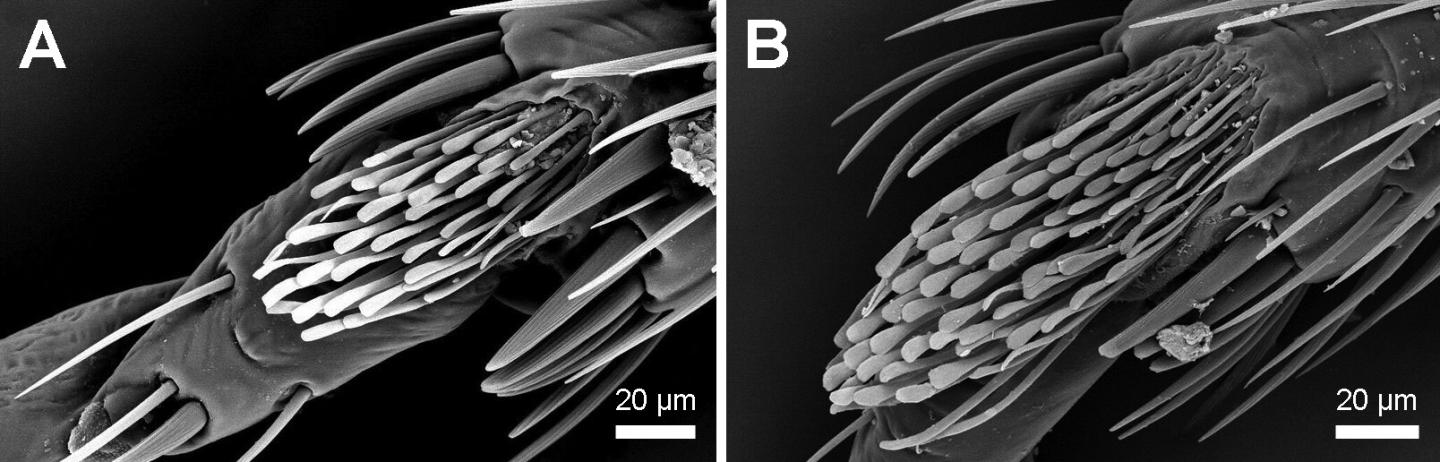
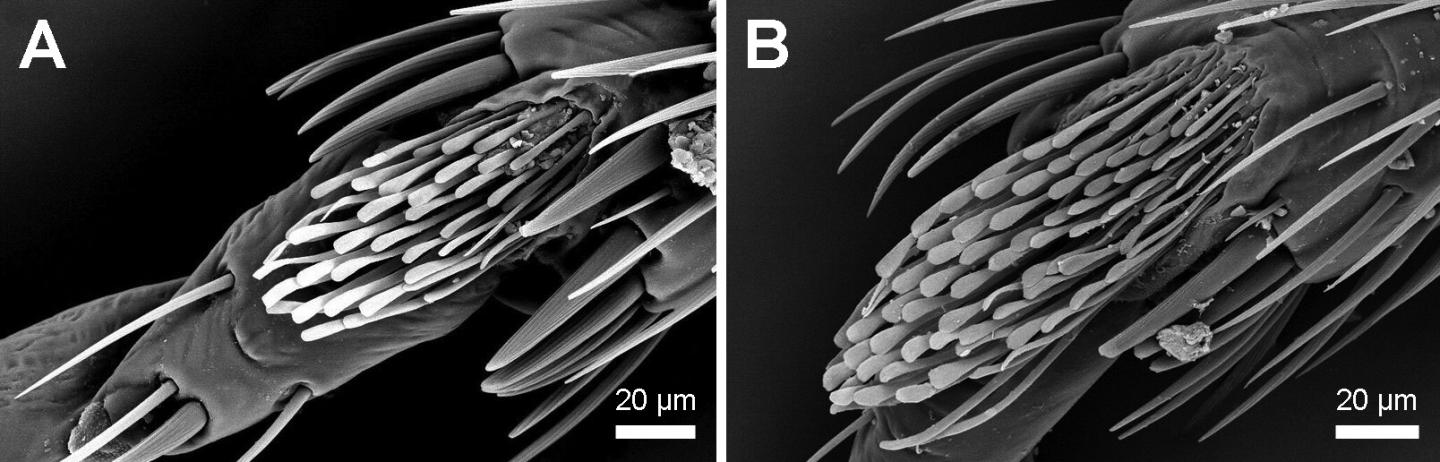
Credit: Journal of Economic Entomology
Annapolis, MD; March 8, 2017 — Not all bed bugs are created equal, and some of the leading bed bug traps used by pest management professionals are ineffective against species with better climbing abilities than others.
In a study soon to be published in the Entomological Society of America's Journal of Economic Entomology, a research team led by Dae-Yun Kim at Universiti Sains Malaysia, has shown that the tropical bed bug, Cimex hemipterus, can readily climb out of smooth-walled pitfall traps.
The researchers tested four leading traps, all designed in the United States, where the bed bug Cimex lectularius is more common. The traps were effective at trapping adult C. lectularius but not adult C. hemipterus. The tropical bed bugs, researchers found, are better able to use small pads on their legs to grip the surface of the trap and scale the inner wall.
Taking a close look using a scanning electron microscope, Kim and colleagues found that the tibial pad of adult C. hemipterus bed bugs showed the presence of a greater number of hairs than on that of C. lectularius, as well as a more well-developed organ for glandular secretion at the base of the hairs. They observed the bed bugs using the tibial pad while climbing on the smooth surfaces, though they say further research is needed to understand exactly how the enhanced hairs and glands in the tibial pads enable C. hemipterus to grip a smooth vertical surface.
Regardless of how tropical bed bugs do it, their ability to escape pitfall traps "has profound implications in the monitoring and potential management of bed bug infestations," says Chow-Yang Lee, professor of entomology at Universiti Sains Malaysia, and a co-author on the study.
C. lectularius is mainly found in temperate regions, and C. hemipterus is found primarily in tropical regions, but they often co-exist in regions such as Africa, Australia, Florida, Japan, Taiwan, and southern China. "Unfortunately, due to their close resemblance, most pest management professionals are unable to tell between C. lectularius and C. hemipterus," Lee says. "Hence, if some of the pitfall traps used in this study, which otherwise could effectively contain C. lectularius, were used during the monitoring process, they would not be able to contain C. hemipterus, which may give a false impression that the monitored premises are free of bed bugs or having a low infestation rate. This may affect the decision-making process on the treatment type, and eventually lead to control failure."
###
"Differences in Climbing Ability of Cimex lectularius and Cimex hemipterus (Hemiptera: Cimicidae)," by Dae-Yun Kim, Johan Billen, Stephen L. Doggett, and Chow-Yang Lee, will be published in the Journal of Economic Entomology on March 15, 2017. Journalists may request advance copies via the contact below.
CONTACT:
Joe Rominiecki
[email protected]
301-731-4535 x3009
ABOUT: ESA is the largest organization in the world serving the professional and scientific needs of entomologists and people in related disciplines. Founded in 1889, ESA today has over 6,000 members affiliated with educational institutions, health agencies, private industry, and government. The Society stands ready as a non-partisan scientific and educational resource for all insect-related topics. For more information, visit http://www.entsoc.org.
Journal of Economic Entomology publishes research on the economic significance of insects and is the highest-cited journal in entomology. It includes sections on apiculture and social insects, insecticides, biological control, household and structural insects, crop protection, forest entomology, and more. For more information, visit https://academic.oup.com/jee, or visit https://academic.oup.com/insect-science to view the full portfolio of ESA journals and publications.
Media Contact
Joe Rominiecki
[email protected]
301-731-4535 x3009
@EntsocAmerica
http://www.entsoc.org
############
Story Source: Materials provided by Scienmag