• HOME
  • NEWS
  • EXPLORE
    • CAREER
      • Companies
      • Jobs
    • EVENTS
    • iGEM
      • News
      • Team
    • PHOTOS
    • VIDEO
    • WIKI
  • BLOG
  • COMMUNITY
    • FACEBOOK
    • INSTAGRAM
    • TWITTER
Saturday, February 7, 2026
BIOENGINEER.ORG
No Result
View All Result
  • Login
  • HOME
  • NEWS
  • EXPLORE
    • CAREER
      • Companies
      • Jobs
        • Lecturer
        • PhD Studentship
        • Postdoc
        • Research Assistant
    • EVENTS
    • iGEM
      • News
      • Team
    • PHOTOS
    • VIDEO
    • WIKI
  • BLOG
  • COMMUNITY
    • FACEBOOK
    • INSTAGRAM
    • TWITTER
  • HOME
  • NEWS
  • EXPLORE
    • CAREER
      • Companies
      • Jobs
        • Lecturer
        • PhD Studentship
        • Postdoc
        • Research Assistant
    • EVENTS
    • iGEM
      • News
      • Team
    • PHOTOS
    • VIDEO
    • WIKI
  • BLOG
  • COMMUNITY
    • FACEBOOK
    • INSTAGRAM
    • TWITTER
No Result
View All Result
Bioengineer.org
No Result
View All Result
Home NEWS Science News

From space to the streets: New battery model also makes electric cars more reliable

Bioengineer by Bioengineer
March 15, 2017
in Science News
Reading Time: 2 mins read
0
Share on FacebookShare on TwitterShare on LinkedinShare on RedditShare on Telegram
IMAGE

Credit: Oliver Dietze

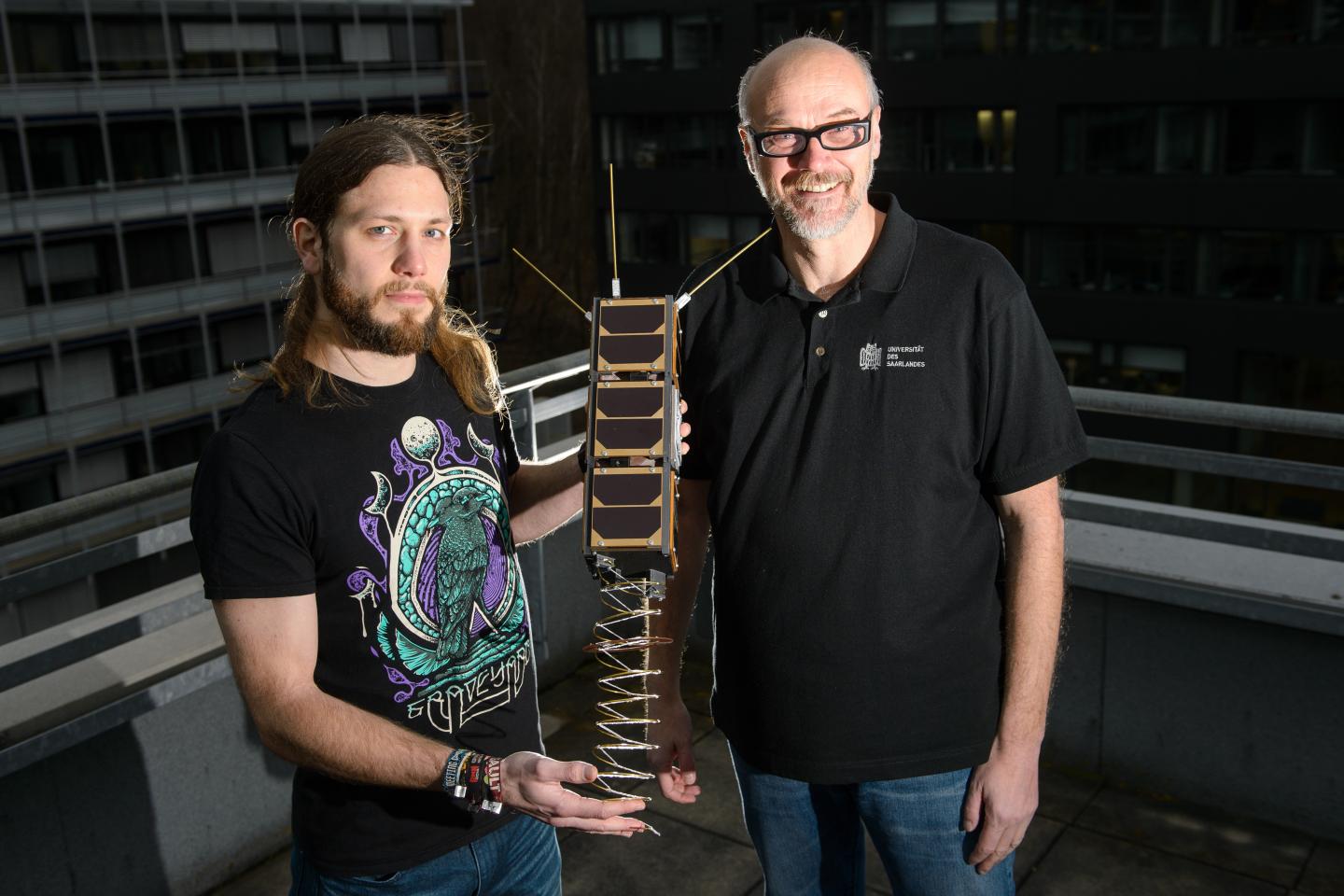
They are able to predict how much the on-board battery will in fact be utilized in the course of the satellite's mission. The efficiency achieved here is about five times greater than with conventional systems. And electric cars on Earth are already benefiting from the procedure as well. The researchers will present their methods at the Cebit computer fair in Hannover (Hall 6, Stand E28).

"As far as we know, there is nothing like it in Earth orbit so far," says Holger Hermanns, professor of Computer Science at Saarland University. In collaboration with his doctoral student Gilles Nies and student Marvin Stenger, Hermanns has developed a procedure that allows for far more accurate predictions of the amount of battery power needed for a particular operation in space. Until now, space logisticians have tended to plan with overly large and heavy batteries, conceding valuable space needed for other equipment and experiments. "Amongst other things, not enough attention has been paid to the recovery effect, a phenomenon well-known from mobile phones. If the phone dies due to an empty battery, it often takes just a few minutes of waiting, then you can turn the phone back on again and use it, for a short time at least," Hermanns says. The new battery model can be used to monitor the exact amount of energy currently available, and determine how much of it is present in chemically bound form, that is, not immediately usable. This lets the computer scientists calculate the probability of the battery being discharged at any given moment.

The Saarbruecken computer scientists' findings can also be applied on Earth. "Batteries are ubiquitous — and a good battery model helps in a lot of situations," says Holger Hermanns. Consider, for instance, the energy demands of an electric car: "So far, we could only answer the following question: Under ideal conditions, will the battery charge be enough for this electric car to make it to Frankfurt Airport? Now we can see whether the air conditioning system can be operated in such a way that you have a chance greater than 99 percent at all times to make it to your plane in time with the current charge", explains Hermanns.

###

Further Information:

Group website "Dependable Systems and Software": http://depend.cs.uni-sb.de/

Press photos are available free of charge at http://www.uni-saarland.de/pressefotos.

Please observe the terms of use.

Media Inquiries:

Professor Holger Hermanns
Dependable Systems and Software
Saarland University
Phone: +49-681-302-5631
E-Mail: [email protected]

Editor:

Gordon Bolduan
Competence Center Computer Science Saarland
Phone: +49-681-302-70741
E-Mail: [email protected]

Media Contact

Gordon Bolduan
[email protected]
49-681-302-70741
@Saar_Uni

http://www.uni-saarland.de

############

Story Source: Materials provided by Scienmag
Share12Tweet8Share2ShareShareShare2

Related Posts

Inflammasome Protein ASC Drives Pancreatic Cancer Metabolism

February 7, 2026

Phage-Antibiotic Combo Beats Resistant Peritoneal Infection

February 7, 2026

Boosting Remote Healthcare: Stepped-Wedge Trial Insights

February 7, 2026

Barriers and Boosters of Seniors’ Physical Activity in Karachi

February 7, 2026
Please login to join discussion

POPULAR NEWS

  • Robotic Ureteral Reconstruction: A Novel Approach

    Robotic Ureteral Reconstruction: A Novel Approach

    82 shares
    Share 33 Tweet 21
  • Digital Privacy: Health Data Control in Incarceration

    63 shares
    Share 25 Tweet 16
  • Study Reveals Lipid Accumulation in ME/CFS Cells

    57 shares
    Share 23 Tweet 14
  • Breakthrough in RNA Research Accelerates Medical Innovations Timeline

    53 shares
    Share 21 Tweet 13

About

We bring you the latest biotechnology news from best research centers and universities around the world. Check our website.

Follow us

Recent News

Inflammasome Protein ASC Drives Pancreatic Cancer Metabolism

Phage-Antibiotic Combo Beats Resistant Peritoneal Infection

Boosting Remote Healthcare: Stepped-Wedge Trial Insights

Subscribe to Blog via Email

Enter your email address to subscribe to this blog and receive notifications of new posts by email.

Join 73 other subscribers
  • Contact Us

Bioengineer.org © Copyright 2023 All Rights Reserved.

Welcome Back!

Login to your account below

Forgotten Password?

Retrieve your password

Please enter your username or email address to reset your password.

Log In
No Result
View All Result
  • Homepages
    • Home Page 1
    • Home Page 2
  • News
  • National
  • Business
  • Health
  • Lifestyle
  • Science

Bioengineer.org © Copyright 2023 All Rights Reserved.