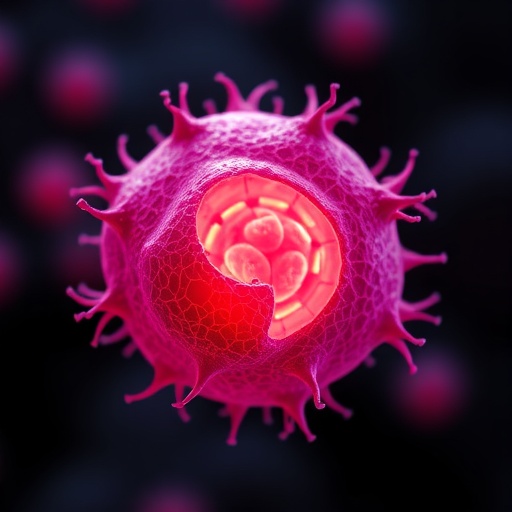

In a remarkable breakthrough poised to reshape our understanding of cellular biology, scientists have unveiled a previously unknown organelle that functions as a critical hub for intracellular cargo management. This tiny but indispensable structure, coined the “hemifusome,” was identified through cutting-edge cryo-electron tomography techniques by a collaborative team of researchers at the University of Virginia School of Medicine and the National Institutes of Health. The discovery of the hemifusome heralds a new era for exploring the intricate processes cells employ to sort, recycle, and dispose of molecular components essential for maintaining cellular integrity.
Cells, the fundamental units of life, depend on a highly orchestrated system to shuttle proteins, lipids, and other molecular cargo to precise destinations. This system ensures cellular homeostasis and function, and its disruption is implicated in numerous complex diseases. The hemifusome has emerged as a vital player in this system, acting as a specialized sorting and processing station where vesicles—microscopic, bubble-like structures—converge to exchange their contents. These vesicles, analogous to delivery trucks ferrying biochemical packages, rely on the hemifusome as a logistical hub facilitating the efficient transfer and repackaging of molecular cargo.
The importance of this discovery becomes even more pronounced when considering genetic disorders that stem from cellular trafficking defects. Hermansky-Pudlak syndrome, a rare but devastating inherited disease characterized by albinism, pulmonary fibrosis, and bleeding abnormalities, is one such condition that may hold the key to understanding the hemifusome’s physiological significance. Dysfunctions in cellular recycling pathways underlie many genetic disorders, and recognizing the hemifusome’s role provides a fresh vantage point from which to investigate these pathologies.
.adsslot_2p0mbMkNtd{width:728px !important;height:90px !important;}
@media(max-width:1199px){ .adsslot_2p0mbMkNtd{width:468px !important;height:60px !important;}
}
@media(max-width:767px){ .adsslot_2p0mbMkNtd{width:320px !important;height:50px !important;}
}
ADVERTISEMENT
Employing cryo-electron tomography, the research team captured ultra-detailed, three-dimensional images of cells frozen in a near-native state, revealing hemifusomes’ dynamic presence within the cytoplasmic milieu. Unlike conventional electron microscopy, cryo-ET preserves cell structures without chemical fixation, allowing unmatched insights into the organelle’s morphology and interactions. These images uncovered that hemifusomes are not static entities but transient facilitators that assemble and disassemble depending on the cell’s needs, implicating them in responsive and adaptive intracellular sorting mechanisms.
Further examination indicates that hemifusomes facilitate the biogenesis of multi-vesicular organelles, which compartmentalize and segregate cellular cargo. This vesicle fusion process—previously enigmatic in its intermediate stages—now gains clarity with the hemifusome at its core. By enabling vesicle docking and cargo handoff, hemifusomes maintain the fluidity and specificity of intracellular transport routes, essentially serving as molecular triage centers that prioritize cellular waste removal and the redistribution of valuable components.
The discovery resonates beyond fundamental cell biology, as it opens avenues for therapeutic innovation targeting disorders rooted in cellular housekeeping failures. Conditions like cystic fibrosis, Down syndrome, and Fragile X syndrome involve complex disruptions in cellular trafficking and signaling pathways. Understanding how hemifusomes operate under physiological and pathological conditions offers the tantalizing prospect of novel intervention points to correct or mitigate disease progression at the cellular level.
Importantly, the ubiquity of hemifusomes across diverse mammalian cell types underscores their fundamental role. Prior assumptions that these organelles were absent or exceedingly rare in human cells have been overturned, highlighting the limitations of previous imaging technologies and the power of advanced cryo-ET approaches. The realization that hemifusomes are common yet elusive structures transforms our conceptual framework of intracellular organization, suggesting that many cellular processes may hinge on these understated yet essential organelles.
The multidisciplinary collaboration spearheaded by Dr. Seham Ebrahim at UVA’s Department of Molecular Physiology and Biological Physics, alongside colleagues Dr. Bechara Kachar, Dr. Amirrasoul Tavakoli, and Dr. Shiqiong Hu at the NIH, emphasizes the synergy between technical innovation and biological discovery. Their work illustrates how deploying novel imaging modalities can unveil hidden dimensions of cellular life, ultimately translating into medical insights and potential treatments.
As researchers delve deeper into the hemifusome’s functional repertoire, several compelling questions arise about its molecular composition, regulation, and interaction with established cellular pathways. Is the hemifusome involved in signaling cascades beyond cargo transport? How do mutations affecting hemifusome components manifest in disease phenotypes? Addressing these questions will require integrative approaches combining genomics, proteomics, and live-cell imaging to parse the dynamic choreography of these organelles in health and disease.
The publication of these findings in the prestigious journal Nature Communications marks a pivotal milestone. It not only disseminates foundational knowledge about the hemifusome but also invites the broader scientific community to investigate this organelle’s roles across biology and medicine. The research was generously supported by the NIH’s National Institute on Deafness and Other Communication Disorders, the Owens Family Foundation, and UVA’s Center for Cell and Membrane Physiology, underscoring the value of sustained funding in advancing frontier science.
Looking forward, the hemifusome discovery sets the stage for a paradigm shift in how genetic diseases linked to cellular trafficking are conceptualized and treated. By illuminating a previously unseen cellular infrastructure, scientists now have a new target for drug development and gene therapy strategies poised to restore normal cellular housekeeping processes. This organelle’s characterization could ultimately improve prognoses and quality of life for patients suffering from a diverse array of inherited disorders.
In summary, the unveiling of the hemifusome illuminates a new facet of the cellular interior with profound implications for biology and medicine. As a specialized organelle orchestrating vesicular traffic and cargo management, it represents a critical linchpin in maintaining cellular homeostasis. This breakthrough introduces an exciting frontier ripe with opportunities for innovative research and therapeutic advances targeting some of the most challenging genetic diseases known to humanity. The scientific journey to decode the hemifusome’s mysteries has just begun, promising significant discoveries in the years to come.
Subject of Research: Discovery and characterization of a novel organelle termed the hemifusome involved in intracellular vesicle trafficking and cargo processing.
Article Title: Previously Undetected Hemifusome Organelles Redefine Views on Cellular Sorting and Genetic Disease Mechanisms
Web References: https://doi.org/10.1038/s41467-025-59887-9
References: A. Tavakoli, S. Hu, S. Ebrahim, B. Kachar, “Hemifusome: A novel organelle mediating vesicle fusion and cargo sorting in mammalian cells,” Nature Communications, 2024.
Keywords: Cell biology, intracellular transport, hemifusome, vesicle trafficking, genetic disorders, Hermansky-Pudlak syndrome, molecular physiology, cryo-electron tomography, cellular recycling, inherited diseases, membrane biology, vesicle fusion
Tags: cellular biology breakthroughscellular homeostasis mechanismscryo-electron tomography techniquesgenetic disorders and cell functionhemifusome organelle discoveryimplications for complex diseasesintracellular cargo managementmaintaining cellular integritymolecular cargo transfer hubNational Institutes of Health collaborationUniversity of Virginia School of Medicine researchvesicle sorting and processing