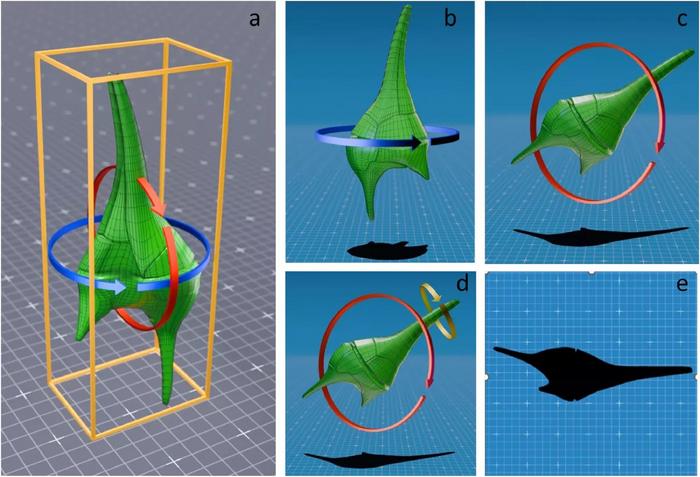
In the realm of aquatic ecology, the ability to accurately measure how microscopic organisms influence their environment has always presented a formidable challenge. At the forefront of a transformative breakthrough, researchers from the HUN-REN Centre for Ecological Research have unveiled a groundbreaking computational methodology that leverages three-dimensional modeling to precisely quantify the light-blocking capabilities of freshwater microalgae. This advancement not only redefines how scientists assess algal influence on underwater light availability but also promises to reshape our fundamental understanding of aquatic ecosystem dynamics.
The study, recently published in Water Research, addresses a critical but historically intractable problem in hydrobiological research: quantifying the projected area of microalgae species—effectively, the surface area they present that obstructs light penetration. Microalgae encompass an extraordinary diversity of shapes and colony formations, many of which defy straightforward measurement techniques. By moving beyond simple biomass estimations, the research team has harnessed high-fidelity 3D modeling to capture the intricate morphologies of these microorganisms, facilitating unparalleled insights into how their physical structure influences underwater light regimes.
Dr. Gábor Borics, the study’s lead author, emphasizes a pivotal conceptual shift driven by this work: “It’s not just about how much algal biomass is present; the geometry and spatial configuration of these organisms are equally vital. Two species with identical volumes can exhibit up to a sixfold difference in their capacity to shade aquatic environments due to their shape.” This insight reframes traditional paradigms of phytoplankton monitoring, underscoring the necessity of integrating morphological traits into ecological assessments.
.adsslot_1CqX6F3onK{ width:728px !important; height:90px !important; }
@media (max-width:1199px) { .adsslot_1CqX6F3onK{ width:468px !important; height:60px !important; } }
@media (max-width:767px) { .adsslot_1CqX6F3onK{ width:320px !important; height:50px !important; } }
ADVERTISEMENT
To achieve these results, the researchers constructed detailed 3D models for 844 species of common freshwater microalgae, including representatives from cyanobacteria, diatoms, and green algae. These models were subjected to intensive virtual simulations, exceeding 2,000 iterations per species, wherein rotational and tilting adjustments emulated natural orientation variations in aquatic habitats. Using Blender, a sophisticated open-source 3D software, the team virtually manipulated these model organisms around multiple axes to estimate changes in projected surface area under realistic environmental conditions.
Validation played a crucial role in ensuring the robustness of this approach. The projection calculations were meticulously compared against existing analytical models tailored for convex shapes, a benchmark in computational geometry. Resulting accuracies exceeded 95%, reinforcing confidence that these simulations faithfully represent real-world light interaction phenomena with microalgal surfaces. This level of precision is unprecedented in the field and opens new avenues for ecological modeling that demand high-resolution input data.
Beyond its immediate practical application, the study elucidates how particular morphological adaptations serve as ecological strategies under varied light environments. Features such as filament length in cyanobacteria, spatial colony configurations, and spiral cell shapes are not merely structural curiosities but active determinants of species success. The ability to shed or capture light according to these shapes affects photosynthetic efficiency, nutrient uptake, and ultimately, survival and proliferation within aquatic systems. This morphological lens deepens scientific comprehension of algal bloom dynamics and their ecological ramifications.
The implications extend far beyond academic circles. Co-author Dr. Gábor Várbíró articulates the transformative impact on environmental monitoring: “This tool transcends traditional metrics, allowing us to reinterpret decades of phytoplankton data in terms of ecological function. Instead of counting cells or mass alone, we can now assess actual biological effects on underwater light regimes.” By reframing ecological assessments through a functional trait framework, this research empowers more accurate water quality evaluations and ecosystem health diagnostics.
The project benefited significantly from support by the Hungarian Scientific Research Fund and harnesses the computational power of the HUN-REN Cloud infrastructure, showcasing the synergistic potential of collaborative scientific research and modern data technologies. Its methodology sets a new benchmark for trait-based aquatic ecology, exemplifying how detailed morphological data integration can yield superior, actionable environmental insights.
Looking ahead, this novel modeling method offers fertile ground for advancing bioindicator development, allowing environmental scientists to design light-informed monitoring tools that reflect real-time ecosystem dynamics with unprecedented fidelity. Such innovations will be essential as freshwater systems worldwide face mounting pressure from climate change, pollution, and eutrophication—challenges where subtle alterations in underwater light regimes can herald cascading ecological shifts.
Crucially, the publicly available Projected Area Database fosters democratization of ecological data, enabling diverse stakeholders—from academic researchers to water resource managers—to harness cutting-edge tools for modeling phytoplankton light interactions. This accessibility is poised to accelerate cross-disciplinary collaboration and the development of robust, scalable management strategies for freshwater systems globally.
In conclusion, the integration of 3D morphometric modeling into aquatic ecology heralds a new era where the complex interplay between organismal shape and environmental function can be rigorously quantified and understood. This leap forward transforms theoretical knowledge into a practical framework with profound implications for research, conservation, and sustainable management of freshwater resources. The study not only addresses a longstanding scientific challenge but also equips the global community with innovative tools to better protect vital aquatic ecosystems for generations to come.
Subject of Research: Freshwater microalgae morphology and light projection modeling
Article Title: Projected area calculation for microalgae using three-dimensional models
News Publication Date: 11-Jun-2025
Web References: https://shiny.freshwater-ecology.com/Projected_Area
References: DOI: 10.1016/j.watres.2025.123951
Image Credits: Image: Tibor Kisantal
Keywords: Microalgae, 3D modeling, projected area, light-blocking effect, freshwater ecosystems, phytoplankton, shading factor, aquatic ecology, computational simulation, morphological adaptation
Tags: 3D modeling of freshwater microalgaeaquatic ecosystem dynamicscomputational methodology in ecologyDr. Gábor Borics researchhigh-fidelity modeling techniqueshydrobiological research advancementslight-blocking capabilities of microalgaemeasuring algal influence on light availabilitymorphologies of microscopic organismsquantifying microalgae surface areatransformative breakthroughs in aquatic researchunderstanding underwater light regimes