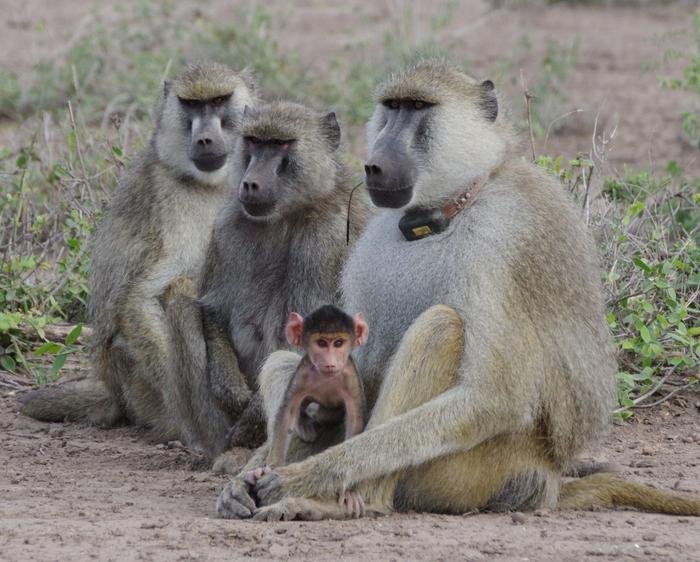

In the animal kingdom, paternal care is a rarity observed in very few mammalian species. Most offspring survival and development hinge heavily on maternal investment. However, emerging research from the University of Notre Dame has begun to unravel the profound impact fathers can have, even in species where paternal care is minimal or subtle. Specifically, recent findings on wild baboons in East Africa reveal that the quality of early-life relationships between father and daughter profoundly influences female longevity, shedding new light on the evolutionary nuances of paternal behavior in primates.
This groundbreaking study, published in the Proceedings of the Royal Society B, challenges traditional notions that baboon fathers exert negligible influence post-conception. Although mothers remain the primary caregivers within baboon social structures, the research underscores that fatherhood – particularly the duration and depth of father-daughter co-residence and interaction – correlates with significant survival advantages for female offspring.
Male baboons exhibit a unique life-history strategy that contributes to this paternal effect. Elizabeth Archie, professor of biological sciences and the study’s lead author, explains that male baboons typically experience peak reproductive output during their early adulthood. Subsequently, as their physical condition declines with age and after siring multiple offspring, these males tend to adopt what researchers colloquially term “dad mode.” In this phase, males reduce their roaming and mating efforts, instead investing more time in maintaining proximity and social bonds with their offspring, especially daughters.
.adsslot_ZP1bSG9LoI{width:728px !important;height:90px !important;}
@media(max-width:1199px){ .adsslot_ZP1bSG9LoI{width:468px !important;height:60px !important;}
}
@media(max-width:767px){ .adsslot_ZP1bSG9LoI{width:320px !important;height:50px !important;}
}
ADVERTISEMENT
The research centered on a meticulously monitored population of 216 female baboons from the Amboseli ecosystem, a renowned field site in Kenya. By scrutinizing longitudinal data, researchers observed that approximately one-third of these females cohabited with their fathers in the same social group for three or more years during their early development. Conversely, the majority had fathers who either migrated away or died within the formative years, limiting father-daughter interactions. This variance provided a powerful natural experiment for examining paternal influence on daughter survival.
A critical behavioral metric assessed was grooming frequency, a key social interaction in primate societies that serves functions beyond mere hygiene, encompassing social bonding and alliance formation. Grooming between juvenile females and their fathers emerged as a robust indicator of the strength of their relationship, with more frequent grooming heralding closer bonds. Importantly, grooming interactions with other adult males did not yield similar correlations with survival outcomes, spotlighting the unique role of fathers rather than adult males in general.
Daughters surrounded by enduring paternal presence and intimate grooming relationships enjoyed a remarkable lifespan extension of two to four years compared to their counterparts lacking such paternal ties. This effect is particularly striking considering the harsh ecological challenges in the Amboseli region, where early-life adversity commonly truncates lifespan. The buffering influence of a father present and socially engaged during early life appears to partially mitigate these adversities, enhancing resilience and longevity.
The implications extend beyond mere survival statistics; they suggest that paternal involvement, albeit indirect and limited, may facilitate expanded social integration for offspring. Male baboons frequently occupy influential social positions, attracting interactions from multiple group members. Consequently, daughters in proximity to their fathers experience enriched social environments, fostering broader social networks that can be crucial for assistance, protection, and stress alleviation throughout their lives.
In conflict scenarios, paternal males have been observed intervening to defend their daughters and even the mothers, hinting at a protective mechanism underlying these associations. This form of social buffering may lower offspring vulnerability to aggression or social exclusion, factors known to affect health and survival in group-living primates.
These findings compel a reevaluation of paternal roles in mammalian societies, especially in species where paternal care has been historically undervalued. The nuanced benefits of father-offspring relationships in baboons might mirror fundamental evolutionary pathways that have shaped human paternal investment. Notably, while human fathers typically engage in extensive caregiving, the baboon model presents a scenario where minimal but targeted paternal behaviors yield measurable survival benefits.
The Amboseli Baboon Research Project, with continuous data collection since 1971, enabled this comprehensive exploration into primate paternal effects. Funded by the U.S. National Science Foundation and the National Institutes of Health, the project rigorously follows baboon social dynamics, longevity, reproduction, and behavior, providing unparalleled insight into how environmental, social, and biological variables intertwine in shaping life trajectories.
Key contributors to this research include co-authors Susan Alberts (Duke University), Jenny Tung (Max Planck Institute for Evolutionary Anthropology), David Jansen (University of Wisconsin-Madison), and J. Kinyua Warutere (Amboseli National Park, Kenya). Their collective expertise in primate behavior, ecology, and genetics enriches the interpretation of these findings within a broad evolutionary framework.
In summarizing their findings, Professor Archie emphasizes that even subtle paternal investments – those seemingly “minor” in the grand scheme of animal caregiving – can have profound, meaningful consequences on offspring viability and fitness. This revelation broadens our understanding of the complexity of parental strategies and highlights the importance of considering social bonds beyond maternal care alone.
As science continues to uncover the intricate social scaffolding that supports survival in wild animal populations, studies such as this propel us closer to decoding the evolutionary roots of family dynamics and parental care. Ultimately, they underscore how social relationships, even in the harsh crucible of natural ecosystems, are vital components shaping lifespan and reproductive success.
Subject of Research: Animals
Article Title: Early-life paternal relationships predict female survival in wild baboons
News Publication Date: 17-Jun-2025
Image Credits: Photo by Elizabeth Archie, professor at Notre Dame
Keywords: Animal research, Ethology, Family, Fathers, Daughters, Animals, Life span
Tags: baboon social structuresevolutionary biology of primatesfather-daughter relationships in baboonsimpact of paternal care on offspringmale baboon life-history strategiesmaternal vs paternal investment in baboonspaternal influence on female longevityProceedings of the Royal Society B baboon studysignificance of early-life paternal interactionssurvival advantages in female primatesUniversity of Notre Dame baboon studywild baboon research findings