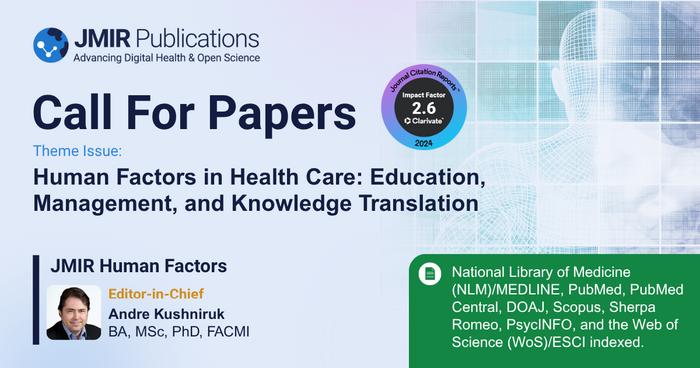
In a transformative move poised to advance the nexus of healthcare, technology, and education, JMIR Publications has announced the launch of a dedicated theme issue in its esteemed open-access journal, JMIR Human Factors. The forthcoming edition, titled “Human Factors in Health Care: Education, Management, and Knowledge Translation,” intends to explore and illuminate the critical role that human factors science plays in optimizing healthcare delivery through educational innovation and applied digital competencies.
Human factors, an interdisciplinary domain focused on the design and evaluation of systems with respect to human capabilities and limitations, serves as a cornerstone in enhancing safety, efficiency, and patient outcomes in clinical environments. The burgeoning complexity of healthcare technologies mandates a robust understanding of cognitive, physical, and organizational factors to mitigate risk and foster intuitive user interactions. By centering education and knowledge translation, this special issue aims to bridge gaps between theoretical human factors frameworks and practical implementation within healthcare ecosystems.
At the core of this thematic exploration lies the imperative to develop and disseminate digital competencies tailored for human factors professionals operating within healthcare settings. As digital transformation accelerates, the adaptation of training methodologies encompassing simulation, augmented reality (AR), and virtual environments becomes pivotal. These immersive technologies permit safe, repeatable, and scalable experiential learning that is capable of replicating the multifaceted challenges faced in real-world clinical scenarios, optimizing both skill acquisition and retention.
.adsslot_yocKTW8r9M{width:728px !important;height:90px !important;}
@media(max-width:1199px){ .adsslot_yocKTW8r9M{width:468px !important;height:60px !important;}
}
@media(max-width:767px){ .adsslot_yocKTW8r9M{width:320px !important;height:50px !important;}
}
ADVERTISEMENT
Moreover, the issue champions research into innovative pedagogical strategies designed to elevate comprehension and integration of human factors principles. Workshops, tutorials, and continuing education programs are scrutinized for their effectiveness in propagating foundational knowledge and fostering a culture that prioritizes ergonomic design and user-centered thinking. Such approaches are vital in cultivating a workforce proficient in navigating the dynamic interface between clinicians, patients, and technology.
The intersection of human factors with clinical workflow optimization also commands significant attention. Digital tools that streamline processes—from electronic health records (EHR) to telehealth platforms—must align with human cognitive processes and environmental constraints to avoid unintended consequences. Training healthcare professionals in these systems with a human factors lens ensures that technology acts as an enabler rather than a hindrance, promoting efficiency while safeguarding against errors.
Decision-making in healthcare presents a complex interplay of uncertainty, time pressure, and high stakes. Incorporating human factors education focused on clinical decision support systems (CDSS) elevates the capacity for healthcare workers to leverage technology effectively, accounting for cognitive biases and situational awareness. Understanding the nuances of human-technology interaction in decision contexts is crucial for enhancing diagnostic accuracy and treatment efficacy.
As artificial intelligence (AI), machine learning (ML), and automation become increasingly ubiquitous in health information technology, their integration within human factors education and practice surfaces both opportunities and challenges. Proficiency in these emergent domains requires a specialized skill set to evaluate algorithmic outputs, interpret results appropriately, and maintain ethical standards. Competency development in these areas is indispensable for ensuring that AI-driven tools complement clinical judgment rather than supplant it.
This theme issue also seeks submissions that articulate evidence-based knowledge translation strategies, translating research findings into actionable practices. Bridging the chasm between academia and frontline healthcare operations fosters the uptake of innovations that enhance patient safety and system performance. Human factors educators, researchers, and practitioners are thus encouraged to explore mechanisms that facilitate effective communication, dissemination, and implementation of human-centered design principles.
The thematic call welcomes a broad spectrum of manuscripts including original research, perspectives, short communications, and comprehensive reviews. The scope encompasses multifaceted inquiries into digital collaboration tools, telehealth modalities, remote patient monitoring interfaces, and user-centered medical device design. The emphasis remains on elucidating how education and training intersect with technological advances to produce measurable improvements in healthcare delivery.
Contributors are urged to delve into contemporary challenges such as the evaluation of virtual reality–based simulations for competency development, or the design of hybrid learning ecosystems merging in-person and digital instruction. There is also interest in exploring how educational interventions can be adapted to diverse cultural and organizational contexts within global healthcare systems, ensuring inclusivity and equity.
This special issue represents a timely and essential endeavor to crystallize the critical nexus where human factors science meets digital health education. By curating cutting-edge research and applied insights, JMIR Human Factors aims to galvanize a community of scholars and practitioners dedicated to reshaping healthcare through informed design, rigorous education, and savvy knowledge translation. The ultimate aspiration is to foster safer, more efficient, and more humane clinical environments powered by well-trained professionals adept at harnessing technology’s full potential.
For further information and submission guidelines, prospective authors and interested readers are encouraged to visit the official announcement page of the theme issue on the JMIR Human Factors website. JMIR Publications continues to uphold its commitment to open science and innovation, facilitating the dissemination of pioneering research that bridges disciplinary boundaries and accelerates impact in the digital health landscape.
Subject of Research: Human factors education, management, and knowledge translation in healthcare, with a focus on digital competencies and technological integration.
Article Title: Human Factors in Health Care: Education, Management, and Knowledge Translation – A Call for Submissions in JMIR Human Factors
News Publication Date: June 9, 2025
Web References:
JMIR Publications: https://jmirpublications.com/
JMIR Human Factors Theme Issue Announcement: https://humanfactors.jmir.org/announcements/571
JMIR Human Factors Journal: https://humanfactors.jmir.org/
Image Credits: Credit: JMIR Publications. Source: kentoh
Keywords: Health care, Ergonomics, Bioinformatics, Informatics, Science education, Technology, Medical equipment, Education administration, Educational programs, Education, Ethics, Medical ethics, Machine learning, Artificial intelligence, Health care delivery
Tags: cognitive and physical factors in healthcaredigital competencies in healthcare educationeducation and management in health systemshuman factors frameworks in healthcare implementationhuman factors in healthcareimmersive technologies in healthcare traininginterdisciplinary approaches to human factorsknowledge translation in health systemsoptimizing healthcare delivery through technologyrisk mitigation in healthcare designsafety and efficiency in clinical environmentssimulation and augmented reality in training