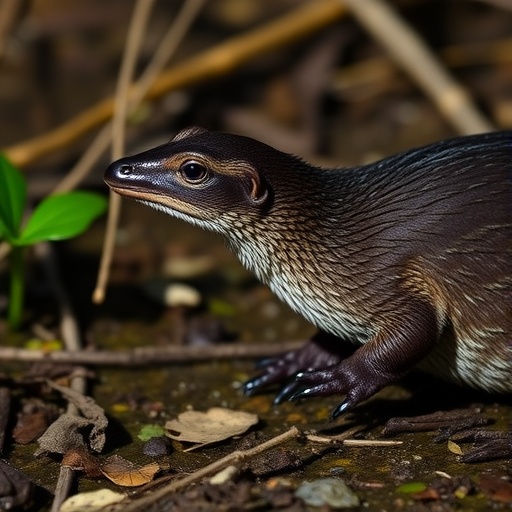
The platypus, one of nature’s most enigmatic and evolutionarily distinctive mammals, inhabits the freshwater ecosystems along the east coast of mainland Australia and throughout Tasmania. Despite its iconic status and deep evolutionary history, this semi-aquatic species remains surprisingly understudied, largely due to its cryptic, nocturnal behavior and elusive nature. Recently, researchers have begun to unravel the complexities of platypus population genetics, revealing surprising insights into how this peculiar mammal responds to both natural forces and anthropogenic disturbances in its habitat. A groundbreaking genomic study focusing on platypus populations in Melbourne’s catchments sheds important light on genetic diversity, migration dynamics, and human impacts — or the lack thereof — across these freshwater systems.
The study, based on comprehensive genomic data from over five hundred individuals sampled across five distinct river catchments in Melbourne, Victoria, presents an unprecedented view of platypus genetic structure within a metropolitan landscape. Using more than 2,700 single-nucleotide polymorphisms (SNPs), the researchers characterized the fine-scale genetic variance among populations, a feat previously unattainable with traditional methods. This dataset not only improves our understanding of how platypus populations are genetically organized but also provides a window into the past demographic processes and contemporary environmental pressures shaping their evolutionary trajectory.
One of the remarkable findings is the detection of relatively consistent levels of genetic diversity across the different catchments, indicating that despite urban encroachment and habitat alteration, platypus populations in these freshwater ecosystems maintain a degree of genetic robustness. This genetic diversity is vital for the adaptability and long-term survival of the species, given the rapid ecological changes and increased fragmentation of habitats due to urban development. Such resilience in genetic variability may provide a buffer against extinction risks, but this dynamic is complex and requires deeper contextual analysis.
.adsslot_Unz9FCQ5ls{ width:728px !important; height:90px !important; }
@media (max-width:1199px) { .adsslot_Unz9FCQ5ls{ width:468px !important; height:60px !important; } }
@media (max-width:767px) { .adsslot_Unz9FCQ5ls{ width:320px !important; height:50px !important; } }
ADVERTISEMENT
Migration within and between catchments emerges as a crucial factor underpinning the genetic patterns observed. The study documents moderate levels of migration within catchments, demonstrating that platypuses are capable of moving along river systems to maintain gene flow on local scales. This connectivity is essential in freshwater species, where isolated populations often suffer from inbreeding depression and reduced adaptive potential. However, the researchers note that while migration within catchments is evident, differentiation between catchments remains significant, highlighting some degree of isolation that shapes unique population substructures.
The interplay between isolation and environmental heterogeneity stands out as a key driver of the observed genetic structuring. The researchers identify two principal mechanisms: isolation-by-river-distance and isolation-by-environment. Isolation-by-river-distance reflects the intuitive pattern whereby platypus populations become more genetically differentiated as the geographic distance along waterways increases. In parallel, isolation-by-environment refers to variations in habitat conditions — such as water quality, flow regimes, and vegetation — which further restrict gene flow and create genetic divergence even over relatively short distances. Together, these mechanisms demonstrate the nuanced ways in which both physical geography and ecological variation influence population dynamics.
Adding further complexity to this pattern, the study provides evidence for sex-biased dispersal within catchments on short spatial scales. Specifically, one sex appears more prone to disperse than the other, a behavior that can have profound implications for the spatial distribution of genetic diversity and the maintenance of population structure. While the precise mechanisms driving sex-biased dispersal in platypuses remain to be elucidated, such findings corroborate growing evidence from other vertebrates where males or females disperse preferentially to reduce inbreeding and enhance genetic mixing.
Crucially, the study interrogates the role of anthropogenic barriers such as dams, which are common across Melbourne’s catchments, to determine their impact on platypus migration and genetic connectivity. Surprisingly, the results suggest that these human-made obstacles have not yet measurably disrupted gene flow among platypus populations. This finding is particularly striking given the documented effects of dams on other freshwater species globally, where barriers often fragment populations and reduce migration. The apparent insignificance of dams in affecting platypus migration might reflect the species’ ecological flexibility or potentially a lag in genetic signals responding to recent habitat changes.
The concept of temporal lag becomes a central theme in interpreting these data. The authors suggest that contemporary genetic patterns in platypus populations largely reflect historical demographic events rather than immediate environmental alterations. This lag implies that genetic structure does not always keep pace with rapid anthropogenic changes, offering a cautionary note for conservationists relying solely on genetic data for real-time assessments. The platypus genetic landscape, therefore, provides a snapshot shaped by past connectivity and demographic stability, which may obscure emerging threats from ongoing habitat modification.
Understanding these evolutionary and ecological dynamics is not merely academic; it informs conservation strategies critical to the platypus’s future. As a species categorized as Vulnerable in Victoria and Near Threatened globally, the platypus faces multifaceted challenges including habitat destruction, climate change, water pollution, and invasive species. The maintenance of genetic diversity and connectivity is paramount to bolster adaptive potential in the face of such threats, and the insights from this study pinpoint the spatial scales and environmental contexts where conservation efforts might be most effectively targeted.
The findings underscore the importance of preserving riverine corridors and minimizing habitat disruption to maintain the natural migration behaviors essential for sustaining genetic health. While anthropogenic barriers have not had a strong detectable impact to date, this situation could change with increasing urban development, warranting continuous monitoring. Further studies focusing on long-term genetic trends, coupled with ecological assessments, are necessary to anticipate the thresholds beyond which gene flow might become critically impaired.
In addition to ecological insights, the study advances the methodological frontier in population genomics of elusive species. Large-scale SNP genotyping provides high-resolution data that enable decoding the subtle genetic patterns shaped by complex ecological and evolutionary processes. This approach serves as a model framework for other researchers aiming to investigate cryptic species in fragmented landscapes, bridging gaps between molecular biology, ecology, and conservation management.
Moreover, this research illustrates the potential of meta-population frameworks in understanding species distributed across heterogeneous environments. The platypus populations studied function as a meta-population, where subpopulations are interconnected by dispersal but subject to local environmental pressures. This perspective is crucial for predicting responses to future environmental changes, particularly in human-modified landscapes where habitat fragmentation is inevitable.
The study amplifies the narrative that conservation genetics must incorporate temporal scales and ecological nuances to fully grasp species persistence. The platypus’s evolutionary resilience demonstrated through stable genetic diversity contrasts with the emerging risks posed by ongoing environmental changes — a duality that exemplifies the intricate balance of life in modern ecosystems. By revealing this genetic lag in response to contemporary drivers, it encourages a precautionary approach that pre-empts irreversible declines.
Collectively, these findings represent a milestone in platypus research, transforming our understanding from anecdotal knowledge to robust, genome-informed insights. The integration of population genetics, spatial ecology, and anthropogenic impact assessment provides a holistic picture that supports both theoretical exploration and practical conservation. As urbanization and climate change accelerate, such comprehensive studies are vital to safeguarding Australia’s emblematic and evolutionarily unique platypus for generations to come.
This research not only enhances our grasp of platypus biology but also resonates more broadly in conservation biology and evolutionary ecology. It highlights how species with complex life histories and cryptic behaviors can be studied effectively through genomics, and how these insights can inform adaptive management in a changing world. The platypus, long a symbol of Australia’s natural heritage, emerges from genetic inquiry as a sentinel species representing the evolutionary challenges faced by aquatic mammals globally.
Subject of Research: Genetic diversity, population structure, and the effects of environmental and anthropogenic factors on platypus populations in Melbourne’s freshwater catchments.
Article Title: Genetic diversity and structure lag the effects of contemporary environmental changes in a platypus meta-population.
Article References:
Ahrens, C.W., Griffiths, J., Danger, A. et al. Genetic diversity and structure lag the effects of contemporary environmental changes in a platypus meta-population. Heredity (2025). https://doi.org/10.1038/s41437-025-00774-w
Image Credits: AI Generated
DOI: https://doi.org/10.1038/s41437-025-00774-w
Tags: anthropogenic impacts on wildlifeconservation of unique speciesenvironmental changes affecting platypusevolutionary history of the platypusfreshwater ecosystems in Australiagenetic diversity in mammalsgenomic study of platypusMelbourne river catchments studymigration dynamics of platypusplatypus population geneticssemi-aquatic mammals evolutionsingle-nucleotide polymorphisms in wildlife