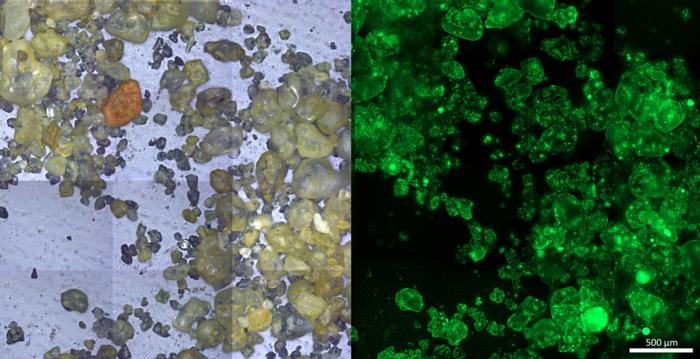

In the vast and intricate world beneath our feet lies an extraordinary microbial landscape that profoundly influences Earth’s nitrogen cycle. Recent groundbreaking research led by scientists at the Max Planck Institute for Marine Microbiology in Bremen, Germany, reveals how microscopic colonies of microorganisms inhabiting individual sand grains play an outsized role in nitrogen removal from coastal sediments. These tiny environments, long hidden from conventional observation, create oxygen-depleted microhabitats that enable crucial anaerobic processes in otherwise oxygen-rich surroundings.
For decades, our understanding of nitrogen removal in coastal marine sediments has centered on the process of denitrification—an anaerobic reaction that converts reactive nitrogen compounds back into inert nitrogen gas, effectively regulating excessive nitrogen input from human activities like agriculture. However, the presence of oxygen typically inhibits this process, posing a puzzling question as to how denitrification occurs in seemingly well-oxygenated permeable sands that dominate many continental shelf environments around the globe.
The team at the Max Planck Institute employed advanced microfluidic imaging techniques, allowing them to analyze sand grains at microscopic resolutions not previously achievable. This sophisticated approach unveiled the heterogeneous distribution of microbial colonies across individual sand grain surfaces, each colony exhibiting distinct metabolic activity in oxygen consumption and production. Intriguingly, clusters of microbes rapidly depleted localized oxygen, establishing anoxic niches no larger than a few micrometers, imperceptible to traditional sensing technologies.
.adsslot_3TYxImKzX2{width:728px !important;height:90px !important;}
@media(max-width:1199px){ .adsslot_3TYxImKzX2{width:468px !important;height:60px !important;}
}
@media(max-width:767px){ .adsslot_3TYxImKzX2{width:320px !important;height:50px !important;}
}
ADVERTISEMENT
These minuscule anoxic microenvironments serve as sanctuaries where anaerobic denitrification flourishes, despite the oxygenated milieu bathing the sediment. Through precise measurements and modelling, the researchers demonstrated that the oxygen consumption rate of microbial colonies can outpace oxygen diffusion into these micro-pockets, perpetuating zones devoid of oxygen. This refined understanding overturns previous assumptions regarding the spatial scale of redox processes within granular marine sediments.
Quantitative model simulations anchored in empirical observations suggest that these anoxic microhabitats contribute significantly—up to one third—of total nitrogen loss via denitrification in oxygenated coastal sands. Given that permeable sands account for approximately half of all continental shelf areas worldwide, this revelation has considerable implications for global biogeochemical cycles and our understanding of how marine ecosystems mitigate anthropogenic nitrogen loading.
The researchers highlight the synergistic interplay between microbial spatial distribution and metabolic activity in shaping sedimentary nitrogen fluxes. “Tens of thousands of microorganisms colonize a single sand grain, with oxygen-consuming and oxygen-producing groups packed within micrometers,” explains lead scientist Farooq Moin Jalaluddin. This delicate micro-scale arrangement dictates localized oxygen gradients, fostering conditions necessary for nitrogen-transforming anaerobic processes even in oxic environments.
Importantly, the implications of these findings extend beyond mechanistic insights into microbial ecology. Human-induced nitrogen inputs into coastal waters have escalated dramatically, primarily due to fertilizer runoff and sewage discharge. Excess nitrogen fuels eutrophication, harmful algal blooms, and hypoxic zones detrimental to marine biodiversity. Understanding how natural microbial communities mitigate these inputs through enhanced nitrogen removal pathways provides critical data for coastal management and environmental protection strategies.
The study’s co-author, Soeren Ahmerkamp, now at the Leibniz Institute for Baltic Sea Research Warnemünde, emphasizes the global environmental significance: “Our calculations indicate that micro-scale anoxic zones on individual sand grains act as a substantial sink for anthropogenic nitrogen entering the oceans. This recognition is vital for accurate global nitrogen budgeting and in predicting ecosystem responses to ongoing human pressures.”
Technological advances, such as microfluidic imaging, coupled with integrative modeling frameworks, have allowed researchers to bridge the gap between microscale processes and their macroscale ecological effects. This study sets a new paradigm in sediment biogeochemistry by advocating for consideration of microhabitat heterogeneity in biogeochemical modeling, a factor often oversimplified or neglected.
Moreover, this research opens new avenues for exploring how microbial consortia adapt to fluctuating environmental conditions to maintain biogeochemical functions. The dynamic interplay of oxygen consumption and production, spatial heterogeneity, and communal microbial behavior within tiny sand grain surfaces underscores the complexity and resilience of sediment microbiomes.
Future investigations will likely delve deeper into how varying environmental parameters such as temperature, organic matter input, and hydrodynamic conditions influence the formation and persistence of these anoxic microenvironments. Understanding these controls could further enhance predictive models of nitrogen cycling under changing climate and anthropogenic impacts.
In essence, this research not only elucidates fundamental microbial ecology but also highlights the understated power of minuscule biological structures in governing large-scale environmental processes. It challenges longstanding paradigms and rekindles appreciation for the intricate microscale worlds that profoundly shape planetary health.
By unveiling the mechanisms through which microorganisms engineer their habitats on sand grain surfaces, this pioneering work enriches our understanding of coastal nitrogen dynamics. It provides a compelling example of how cutting-edge technology can transform microbiological discoveries into globally relevant ecological insights, ultimately informing sustainable environmental stewardship.
Subject of Research: Microbial microenvironments on sand grains and their role in nitrogen removal through denitrification in oxygenated coastal sediments.
Article Title: Microenvironments on individual sand grains enhance nitrogen loss in coastal sediments
News Publication Date: 11-May-2025
Web References:
10.1038/s41598-025-00755-3
Image Credits: Farooq Moin Jalaluddin / Max Planck Institute for Marine Microbiology
Keywords
Denitrification, Coastal sediments, Microbial microenvironments, Oxygen microgradients, Nitrogen cycling, Sand grain microbiome, Anaerobic metabolism, Marine biogeochemistry, Anthropogenic nitrogen, Permeable sands, Microfluidic imaging, Nitrogen removal
Tags: anaerobic environments in sedimentscoastal marine microbiologydenitrification in sandy shoresenvironmental impact of nitrogen inputsMax Planck Institute researchmicrobial activity and nitrogen lossmicrobial coloniesmicrobial landscapes in sandy sedimentsmicrofluidic imaging techniquesnitrogen cycle and coastal ecosystemsnitrogen removal processesoxygen-depleted microhabitats