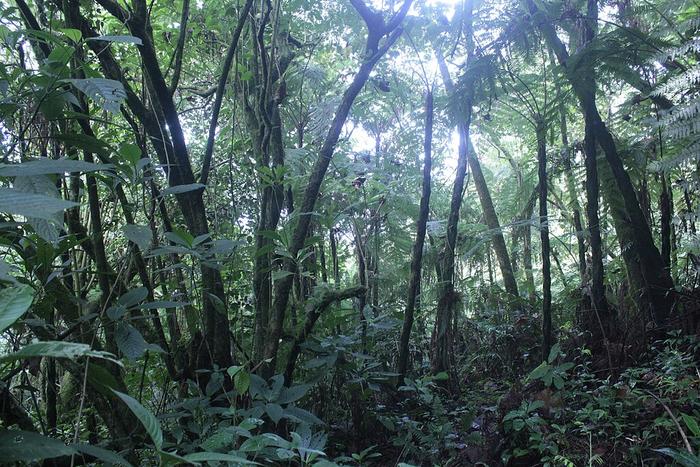
In the global quest to mitigate climate change, forest restoration has long been hailed as a vital tool for sequestering carbon and cooling the Earth’s atmosphere. Yet, until recently, conventional climate models primarily quantified this impact through carbon uptake alone, neglecting critical atmospheric chemical interactions. A groundbreaking study led by researchers at the University of California, Riverside, reshapes this paradigm by incorporating complex atmospheric chemistry, revealing that large-scale tree restoration could play a far more pronounced role in climate mitigation than previously appreciated, especially in tropical regions.
This recent modeling study, published in Communications Earth & Environment, leverages advanced Earth system modeling to assess the climatic effects of restoring forests to their preindustrial spatial extent. Their findings indicate that reforestation covering approximately 12 million square kilometers—equivalent to roughly 135% of the area of the United States—could cool global average surface temperatures by 0.34°C. This cooling effect corresponds to nearly a quarter of the warming experienced since the mid-19th century industrialization, highlighting forest restoration’s substantial but partial role in offsetting anthropogenic climate change.
Crucially, this study integrates previously overlooked atmospheric processes involving biogenic volatile organic compounds (BVOCs) emitted by trees. BVOCs interact with atmospheric oxidants to form secondary organic aerosols and cloud condensation nuclei. These particles enhance cloud albedo and increase sunlight scattering, amplifying the net cooling beyond carbon sequestration alone. The inclusion of these chemical effects, which most climate models omit, reveals that the radiative forcing benefits of tree restoration are underestimated when considering carbon uptake in isolation.
.adsslot_8MVDqr6WKZ{ width:728px !important; height:90px !important; }
@media (max-width:1199px) { .adsslot_8MVDqr6WKZ{ width:468px !important; height:60px !important; } }
@media (max-width:767px) { .adsslot_8MVDqr6WKZ{ width:320px !important; height:50px !important; } }
ADVERTISEMENT
Tropical forests emerge as pivotal hotspots for these cooling dynamics. Trees in tropical ecosystems exhibit both higher carbon sequestration efficiency and robust BVOC emissions compared to mid- or high-latitude forests. Moreover, tropical vegetation imposes less surface albedo reduction—a factor that, when changed, can potentially offset cooling by increasing solar absorption in boreal or temperate regions. As such, the net climate benefit of reforestation is geographically heterogeneous, underscoring the importance of prioritizing tropical areas for restoration efforts to maximize climatic impact.
The implications of reforestation further extend to atmospheric composition and regional air quality. Under the modeled restoration scenario, the northern hemisphere could experience a 2.5% reduction in airborne dust, a significant change with potential health and climate feedback effects. However, in the tropics, increased BVOC emissions present a nuanced air quality picture: while elevated particulate matter linked to aerosol formation might degrade local air quality, ozone concentrations—which have their own health and climatic implications—tend to improve, suggesting complex trade-offs that must be carefully considered in policy planning.
Despite these promising findings, the study’s authors emphasize that forest restoration is not a panacea for global warming. Even the highly ambitious scenario of restoring all lost tree cover since the mid-19th century does not negate the necessity for immediate and substantial reductions in fossil fuel emissions. Land use constraints, food security concerns, and ongoing deforestation particularly in tropical regions represent formidable challenges. The potential to reclaim forested landscapes competes with agricultural, urban, and infrastructural land demands, complicating the feasibility of achieving maximal restoration coverage.
Nevertheless, localized reforestation endeavors, even if modest in scale, can wield tangible influence on regional climates and ecosystems. The research underscores that restoration efforts do not require planetary scale implementation simultaneously to generate meaningful benefits. Incremental progress can cumulatively aggregate, positively impacting both atmospheric chemistry and microclimates. This adaptive strategy offers a pragmatic pathway for policymakers and conservationists aiming to harmonize ecological benefits with socio-economic realities.
The study also highlights inspiring case studies exemplifying how conservation and economic incentives can intersect beneficially. Rwanda, for example, has fostered a model in which forest protection fuels a robust tourism industry, redistributing economic gains to local communities and creating vested interests in forest preservation. Such integrated approaches incentivize sustainable land stewardship and offer blueprints for reconciling environmental goals with human development imperatives.
Methodologically, the research originated as a graduate coursework project before expanding into a full-fledged interdisciplinary collaboration, integrating satellite land-use data and sophisticated Earth system models. This academic-to-impact trajectory epitomizes innovative scientific education paired with real-world applicability, reflecting the crucial role of emerging scientists in addressing global environmental challenges. The blend of climatology, atmospheric chemistry, and land-use science represented in this work embodies the multifaceted approach necessary for understanding and confronting climate change.
In summary, this comprehensive study provides a refined and more optimistic assessment of tree restoration’s climate mitigation potential by factoring in essential atmospheric chemistry processes. While not a silver bullet, reforestation emerges as an indispensable pillar in the broader climate stabilization framework. It underscores the imperative for a dual strategy: aggressive decarbonization of global energy systems coupled with targeted, scientifically-informed reforestation. As humanity confronts the escalating climate crisis, harnessing the full spectrum of nature’s cooling mechanisms is critical, with tropical forest restoration at the forefront.
The words of UCR’s Bob Allen, the study’s lead author, encapsulate the sentiment: “Reforestation is a powerful strategy, but it has to be paired with serious emissions reductions.” Likewise, graduate co-author Antony Thomas reminds us that “every step toward restoration, no matter the scale, helps,” reinforcing the urgency for action tailored both to scale and locale in mitigating climate change.
Subject of Research: Climate mitigation potential of large-scale tree restoration incorporating atmospheric chemistry effects.
Article Title: Atmospheric chemistry enhances the climate mitigation potential of tree restoration.
News Publication Date: 13-May-2025
Web References:
https://www.nature.com/articles/s43247-025-02343-9#Sec8
http://dx.doi.org/10.1038/s43247-025-02343-9
Image Credits: Atabong Armstrong
Keywords
Climate change, Anthropogenic climate change, Climate change adaptation, Climate change mitigation, Climatology, Environmental sciences, Environmental chemistry, Plants, Trees, Mangroves, Ecology, Plant biochemistry
Tags: anthropogenic climate change and forest solutionsatmospheric chemistry and climate modelsbiogenic volatile organic compounds in climatecomplex interactions in climate systemscooling effects of large-scale tree restorationEarth system modeling for climate solutionsecological benefits of restoring forestsforest restoration impact on climateglobal temperature reduction through reforestationrole of aerosols in climate mitigationtree planting and carbon sequestrationtropical reforestation benefits