Recent advances at the intersection of nanotechnology and biomimicry have unlocked revolutionary pathways for designing intelligent micro- and nanomotors capable of autonomous operation within complex environments. A team of researchers from the University of Science and Technology Beijing has announced an innovative two-stage micro@nanomotor system inspired by the unique biological interaction between suckerfishes and sharks. This cutting-edge development harnesses near-infrared (NIR) light propulsion combined with a weak acid-triggered release mechanism to enable precise and responsive cargo delivery at the microscale, potentially transforming drug delivery and environmental remediation technologies.
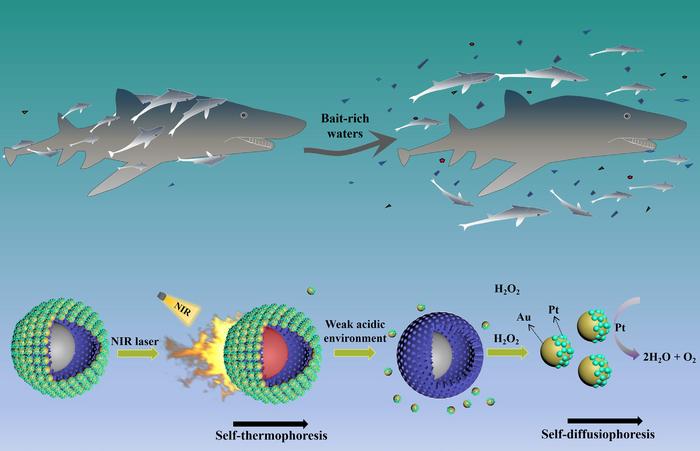
Natural organisms have evolved highly specialized morphologies and behaviors to adapt to their intricately changing habitats. By translating these biological inspirations into artificial designs, scientists have sought to replicate the remarkable efficiency and versatility observed in nature. The suckerfish-shark relationship serves as a compelling model: suckerfishes cling to sharks or boats during transit but detach upon arrival in prey-rich waters to forage independently. Mimicking this dynamic behavior, the researchers engineered a core-satellite micro@nanomotor system that operates through two distinct stages—a large micromotor host carrying numerous small nanomotor satellites, which release selectively in response to environmental pH changes.
At the heart of this system is a yolk-shell structured micromotor composed of polydopamine-mesoporous silica (PDA-MS), which acts as the “host.” This core is functionalized with many Janus gold-platinum (Au-Pt) nanomotors—analogous to the “suckerfish” satellites—that are capable of autonomous propulsion driven by hydrogen peroxide (H₂O₂) decomposition. The coordinated bonding between the nanomotors and the PDA-MS surface is sensitive to weakly acidic conditions, allowing the nanomotors to detach precisely when the micro@nanomotor encounters specific chemical cues.
.adsslot_JjfTsK5iF0{width:728px !important;height:90px !important;}
@media(max-width:1199px){ .adsslot_JjfTsK5iF0{width:468px !important;height:60px !important;}
}
@media(max-width:767px){ .adsslot_JjfTsK5iF0{width:320px !important;height:50px !important;}
}
ADVERTISEMENT
The micro@nanomotor achieves directional motion by exploiting self-thermophoresis when illuminated with low-power NIR light. This photothermal effect generates a localized temperature gradient, propelling the micromotor host along a predetermined path. Upon encountering a weakly acidic microenvironment, similar to tumor extracellular spaces, the coordinated bonds weaken, triggering the release of the active nanomotors. Once released, these smaller nanomotors engage in self-diffusiophoretic movement fueled by the low concentrations of hydrogen peroxide present, enabling independent navigation and enhanced coverage at the target site.
This innovative two-stage propulsion mechanism represents a profound leap in micro/nanorobotics, combining remote light actuation with environmentally responsive release. The bionic design strategy addresses a long-standing challenge in the field: developing flexible micro/nanomotors capable of adapting to and functioning within the diverse, complex biological milieus encountered in vivo. Such responsiveness is critical for performing sophisticated tasks such as targeted drug delivery, biosensing, and environmental detoxification, where precise control over motor behavior and cargo release is paramount.
Moreover, the core-satellite architecture allows for a high payload capacity of functional nanomotors loaded onto a single micromotor platform. This hierarchical system maximizes efficiency by enabling the controlled liberation of numerous Janus nanomotors at the site of interest, vastly improving the potential for targeted therapeutic applications. In particular, the researchers propose that this system could be adapted for theranostic functions within tumor microenvironments, where the mild acidity acts as a natural trigger for motor deployment and therapeutic payload release.
The research, supported by major funding bodies including China’s Fundamental Research Funds for the Central Universities and the Natural Science Foundation of Jiangsu Province, represents a significant milestone in artificial micro/nanomotor engineering. It also highlights the synergy between biomimetic design principles and advanced materials chemistry in constructing functional devices with high intelligence and autonomy. Such advancements pave the way for next-generation smart nanomachines that intelligently interact with biological systems for applications spanning precision medicine, diagnostics, and beyond.
The prospects for this two-stage micro@nanomotor extend beyond medical applications. Environmental remediation stands to benefit from the autonomous release of numerous catalytic nanomotors capable of degrading pollutants, enhancing water treatment technologies, and monitoring environmental variables in situ. The responsive release mechanism enables a dynamic adaptation to contaminants, triggering motor deployment only when necessary, thus conserving fuel and avoiding unintended dispersal.
In the broader context, this breakthrough underscores the importance of investigating natural cooperative behaviors and translating them into engineered microsystems. By imitating the cooperative locomotive and release behaviors of marine species, researchers can overcome existing design challenges associated with control, fuel efficiency, and environmental adaptability in micro/nanomotors. This bench-to-nature approach signifies a new paradigm in the design of intelligent nanomachines and multifunctional therapeutic platforms.
As nanotechnology continues to push the frontiers of miniaturization and autonomy, such smart biomimetic micro@nanomotors herald a future where artificial systems not only coexist harmoniously within biological niches but actively respond and adapt to microenvironmental cues. The dynamic interplay between NIR light propulsion and chemical stimuli response in this system offers a versatile framework potentially extensible to other stimuli-responsive materials including enzymatic, magnetic, and acoustic modulation.
Ultimately, the core-satellite PDA-MS@Au-Pt micro@nanomotor system crafted by this research team represents a compelling synthesis of materials engineering, catalytic propulsion chemistry, and biomimetic design. It exemplifies the transformative impact of biologically inspired mechanisms powered by intelligent materials to realize multifunctional, adaptable, and controllable micro/nanomachines. As such, it opens new vistas for soft robotic devices capable of performing complex biological tasks with precision and minimal invasiveness.
Subject of Research: Biomimetic micro/nanomotors inspired by suckerfish-shark interaction for intelligent, two-stage propulsion and weak acid-triggered release of nanomotors.
Article Title: Biomimetic two-stage micro@nanomotor with weak acid-triggered release of nanomotors
News Publication Date: 7-Apr-2025
Web References: http://dx.doi.org/10.26599/NR.2025.94907309
Image Credits: Nano Research, Tsinghua University Press
Keywords
Biomimetic micro/nanomotors, two-stage propulsion, Janus nanomotors, near-infrared light propulsion, weak acid-triggered release, hydrogen peroxide decomposition, polydopamine-mesoporous silica, tumor microenvironment, smart nanomachines, self-thermophoresis, self-diffusiophoresis, active cargo delivery
Tags: autonomous operation in complex environmentsbiological inspiration in engineeringbiomimetic nanomotor technologycore-satellite nanomotor designdrug delivery innovationsenvironmental remediation technologiesintelligent micro-nanotechnology applicationsnear-infrared light propulsionpolydopamine mesoporous silica micromotorsuckerfish shark relationship inspirationtwo-stage micro nanomotor systemweak acid-triggered release mechanism