

• HOME
  • NEWS
  • EXPLORE
    • CAREER
      • Companies
      • Jobs
    • EVENTS
    • iGEM
      • News
      • Team
    • PHOTOS
    • VIDEO
    • WIKI
  • BLOG
  • COMMUNITY
    • FACEBOOK
    • INSTAGRAM
    • TWITTER
Saturday, February 7, 2026
BIOENGINEER.ORG
No Result
View All Result
  • Login
  • HOME
  • NEWS
  • EXPLORE
    • CAREER
      • Companies
      • Jobs
        • Lecturer
        • PhD Studentship
        • Postdoc
        • Research Assistant
    • EVENTS
    • iGEM
      • News
      • Team
    • PHOTOS
    • VIDEO
    • WIKI
  • BLOG
  • COMMUNITY
    • FACEBOOK
    • INSTAGRAM
    • TWITTER
  • HOME
  • NEWS
  • EXPLORE
    • CAREER
      • Companies
      • Jobs
        • Lecturer
        • PhD Studentship
        • Postdoc
        • Research Assistant
    • EVENTS
    • iGEM
      • News
      • Team
    • PHOTOS
    • VIDEO
    • WIKI
  • BLOG
  • COMMUNITY
    • FACEBOOK
    • INSTAGRAM
    • TWITTER
No Result
View All Result
Bioengineer.org
No Result
View All Result
Home NEWS Science News Health

Archaeopteryx Reveals Origins of Bird Structure

Bioengineer by Bioengineer
September 6, 2025
in Health
Reading Time: 2 mins read
0
Archaeopteryx Reveals Origins of Bird Structure
Share on FacebookShare on TwitterShare on LinkedinShare on RedditShare on Telegram

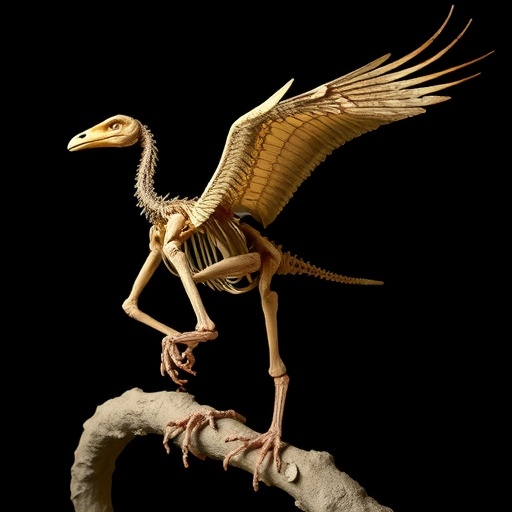
Extending from this, the specimen’s vertebral column comes into astonishing detail, revealing paired proatlases — small accessory bones associated with the skull’s articulation — that were previously unknown in Archaeopteryx. Also noteworthy is the recognition that its tail was considerably longer than earlier fossil interpretations suggested. This elongated tail would have had significant biomechanical implications, potentially affecting balance and flight dynamics, and painting a more nuanced picture of the locomotive strategies employed by these early birds.

Another intriguing anatomical revelation centers on the morphology of the foot pads. Detailed impressions suggest that Archaeopteryx was adapted for terrestrial locomotion rather than raptorial predation. The padded structure of the foot implies a gait suited for walking on firm ground, contrasting with the pedal specializations seen in modern birds of prey. Such an ecological insight helps refine previous conjectures about the lifestyle of Archaeopteryx, indicating a more ground-oriented existence alongside its aerial capabilities.

The discovery of humeral tertials being absent in near relatives but present in Archaeopteryx underscores an important evolutionary milestone: a mosaic emergence of flight adaptations rather than a sudden, single-step shift. The evolutionary narrative that arises is one of gradual transformation where skeletal and feather features co-evolved to form the sophisticated flying apparatus characteristic of modern birds.

The study sets a new standard for the application of modern imaging techniques to fossils, demonstrating how micro-CT driven preparation can reveal concealed morphological data without destructive intervention. This approach exemplifies the power of technological advancement in paleontology, allowing researchers to push back the limits of what can be discerned from fossils and reconstruct the evolutionary past with ever-increasing precision.

Subject of Research: Early evolution of the avian bauplan based on a new nearly complete Archaeopteryx specimen.

Article Title: Chicago Archaeopteryx informs on the early evolution of the avian bauplan.

Article References:
O’Connor, J., Clark, A., Kuo, PC. et al. Chicago Archaeopteryx informs on the early evolution of the avian bauplan. Nature (2025). https://doi.org/10.1038/s41586-025-08912-4

Image Credits: AI Generated

Tags: adaptations for flight in vertebratesadvanced imaging in scientific researchArchaeopteryx fossil discoveryavian evolution insightscranial morphology of Archaeopteryxfeather evolution in birdsmicro-computed tomography in paleontologynon-avian dinosaur connectionspaleontological techniques and methodssignificance of complete fossilsskeletal morphology of birdstransitional forms in evolution


Share14Tweet9Share2ShareShareShare2

Related Posts

Evaluating Pediatric Emergency Care Quality in Ethiopia

February 7, 2026

TPMT Expression Predictions Linked to Azathioprine Side Effects

February 7, 2026

Improving Dementia Care with Enhanced Activity Kits

February 7, 2026

Decoding Prostate Cancer Origins via snFLARE-seq, mxFRIZNGRND

February 7, 2026

POPULAR NEWS

  • Robotic Ureteral Reconstruction: A Novel Approach

    Robotic Ureteral Reconstruction: A Novel Approach

    82 shares
    Share 33 Tweet 21
  • Digital Privacy: Health Data Control in Incarceration

    63 shares
    Share 25 Tweet 16
  • Study Reveals Lipid Accumulation in ME/CFS Cells

    57 shares
    Share 23 Tweet 14
  • Breakthrough in RNA Research Accelerates Medical Innovations Timeline

    53 shares
    Share 21 Tweet 13

About

We bring you the latest biotechnology news from best research centers and universities around the world. Check our website.

Follow us

Recent News

Evaluating Pediatric Emergency Care Quality in Ethiopia

TPMT Expression Predictions Linked to Azathioprine Side Effects

Improving Dementia Care with Enhanced Activity Kits

Subscribe to Blog via Email

Enter your email address to subscribe to this blog and receive notifications of new posts by email.

Join 73 other subscribers
  • Contact Us

Bioengineer.org © Copyright 2023 All Rights Reserved.

Welcome Back!

Login to your account below

Forgotten Password?

Retrieve your password

Please enter your username or email address to reset your password.

Log In
No Result
View All Result
  • Homepages
    • Home Page 1
    • Home Page 2
  • News
  • National
  • Business
  • Health
  • Lifestyle
  • Science

Bioengineer.org © Copyright 2023 All Rights Reserved.
