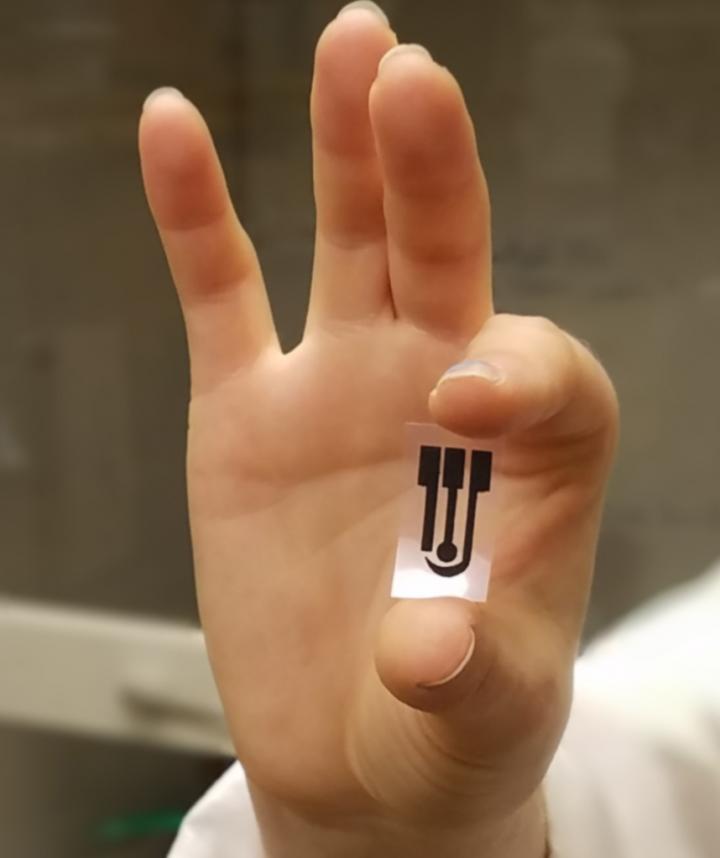
Credit: Charles S. Henry, Ph.D.
Food poisoning is a scourge. Yet preventing it is far from foolproof. But in a new study in Analytical Chemistry, scientists report that they are closing in on a way to use a combination of color-changing paper and electrochemical analysis — on plastic transparency sheets or simple paper — to quickly, cheaply and more accurately detect bacterial contamination of fruits and vegetables in the field before they reach grocery stores, restaurants and household pantries.
Of all the contaminants found in food and water, bacteria cause the most hospitalizations and deaths in the United States. Nearly half of these incidents are attributed to spinach, cabbage, lettuce and other leafy greens, which are sometimes irrigated with unsafe water containing fecal material. Federal regulations require frequent testing of fruits and vegetable for bacterial contamination. But traditional lab cultures take up to 48 hours to produce results, and other techniques such as DNA amplification and immunoassays are costly and are prone to false results. Recently, Charles S. Henry and colleagues developed a paper-based method to detect Salmonella, Listeria and E. coli in food and water samples. In their latest study, Henry's team wanted to see if it would be feasible to use this paper-based technique in conjunction with electrochemical analysis to produce more refined results.
To simulate contaminated food, the researchers exposed clean alfalfa sprouts to E.coli and Enterococcus faecalis bacteria. They also collected unfiltered water from a nearby lagoon. For colorimetric detection, the team built a simple light box, which served as a substitute for a laboratory plate reader. Then they used a smartphone to take a series of images of the 84 paper-based well plates over time. For the electrochemical portion of the experiment, they used a series of electrodes printed onto plastic transparency sheets. Both approaches used the same assays to successfully detect harmful bacteria in the samples within 4 to 12 hours, and both produced complementary findings. They conclude that combining their paper-based technique with electrochemistry could lead to a simpler, yet more comprehensive way to detect bacterial contaminants in food and water.
###
The authors acknowledge funding from the U.S. Department of Agriculture and the National Institutes of Health.
The abstract that accompanies this study is available here.
The American Chemical Society is a nonprofit organization chartered by the U.S. Congress. With nearly 157,000 members, ACS is the world's largest scientific society and a global leader in providing access to chemistry-related research through its multiple databases, peer-reviewed journals and scientific conferences. ACS does not conduct research, but publishes and publicizes peer-reviewed scientific studies. Its main offices are in Washington, D.C., and Columbus, Ohio.
To automatically receive news releases from the American Chemical Society, contact [email protected].
Follow us on Twitter | Facebook
Media Contact
Katie Cottingham
[email protected]
301-775-8455
@ACSpressroom
http://www.acs.org
############
Story Source: Materials provided by Scienmag