• HOME
  • NEWS
  • EXPLORE
    • CAREER
      • Companies
      • Jobs
    • EVENTS
    • iGEM
      • News
      • Team
    • PHOTOS
    • VIDEO
    • WIKI
  • BLOG
  • COMMUNITY
    • FACEBOOK
    • INSTAGRAM
    • TWITTER
Wednesday, April 1, 2026
BIOENGINEER.ORG
No Result
View All Result
  • Login
  • HOME
  • NEWS
  • EXPLORE
    • CAREER
      • Companies
      • Jobs
        • Lecturer
        • PhD Studentship
        • Postdoc
        • Research Assistant
    • EVENTS
    • iGEM
      • News
      • Team
    • PHOTOS
    • VIDEO
    • WIKI
  • BLOG
  • COMMUNITY
    • FACEBOOK
    • INSTAGRAM
    • TWITTER
  • HOME
  • NEWS
  • EXPLORE
    • CAREER
      • Companies
      • Jobs
        • Lecturer
        • PhD Studentship
        • Postdoc
        • Research Assistant
    • EVENTS
    • iGEM
      • News
      • Team
    • PHOTOS
    • VIDEO
    • WIKI
  • BLOG
  • COMMUNITY
    • FACEBOOK
    • INSTAGRAM
    • TWITTER
No Result
View All Result
Bioengineer.org
No Result
View All Result
Home NEWS Science News

Physicists design a device inspired by sonic screwdriver

Bioengineer by Bioengineer
March 8, 2017
in Science News
Reading Time: 2 mins read
0
Share on FacebookShare on TwitterShare on LinkedinShare on RedditShare on Telegram
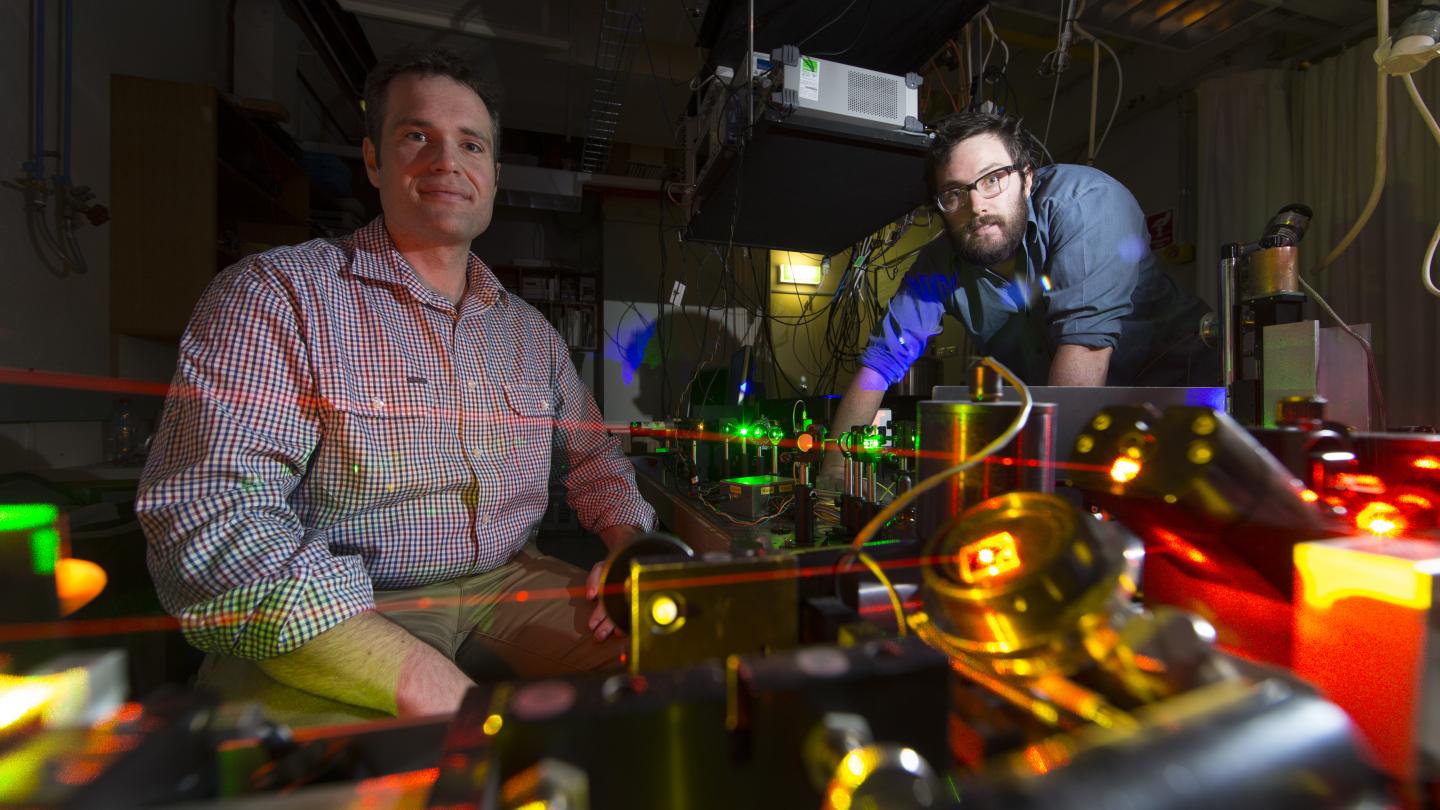
IMAGE

Credit: Stuart Hay, ANU

Physicists have designed a handheld device inspired by the sonic screwdriver in Doctor Who and the tricorder in Star Trek that will use the power of MRI and mass spectrometry to perform a chemical analysis of objects.

The sonic screwdriver is a tool used in Doctor Who to scan and identify matter, among other functions, while the multi-purpose tricorder in Star Trek can provide a detailed analysis of living things.

Lead researcher Dr Marcus Doherty from The Australian National University (ANU) said the team had proven the concept of a diamond-based quantum device to perform similar functions to these science fiction tools and would now develop a prototype.

"Laboratories and hospitals will have the power to do full chemical analyses to solve complex problems with our device that they can afford and move around easily," said Dr Doherty from the ANU Research School of Physics and Engineering (RSPE).

"This device is going to enable many people to use powerful instruments like molecular MRI machines and mass spectrometers much more readily."

Dr Doherty said medical researchers could use the device to weigh and identify complex molecules such as proteins, which drive diseases, such as cancer, and cures for those diseases.

"Every great advance for microscopy has driven scientific revolution," he said.

"Our invention will help to solve many complex problems in a wide range of areas, including medical, environmental and biosecurity research."

Molecular MRI is a form of the common medical imaging technology that is capable of identifying the chemical composition of individual molecules, while mass spectrometers measure the masses within a sample.

Co-researcher Michael Barson said the device would use tiny defects in a diamond to measure the mass and chemical composition of molecules with advanced quantum techniques borrowed from atomic clocks and gravitational wave detectors.

"For the mass spectrometry, when a molecule attaches to the diamond device, its mass changes, which changes the frequency, and we measure the change in frequency using the defects in the diamond," said Mr Barson, a PhD student from RSPE.

"For the MRI, we are looking at how the magnetic fields in the molecule will influence the defects as well."

The research is published in Nano Letters: http://pubs.acs.org/doi/abs/10.1021/acs.nanolett.6b04544

###

For media assistance, contact Will Wright from the ANU Media Team on +612 6125 7979, +61 478 337 740 or [email protected]

Media Contact

Will Wright
[email protected]
61-261-257-979
@ANUmedia

http://www.anu.edu.au/media

############

Story Source: Materials provided by Scienmag

Share12Tweet8Share2ShareShareShare2

Related Posts

NADPH Enzymes Suppress Pancreatic Precancerous Lesions

April 1, 2026

Entorhinal Cortex Maps Remote Tasks Without CA1

April 1, 2026

Chikungunya Virus Lingers in Joint Macrophages, Causes Chronic Disease

April 1, 2026

Recombinant Protein Restores Platelet Function in Mice

April 1, 2026
Please login to join discussion

POPULAR NEWS

  • blank

    Revolutionary AI Model Enhances Precision in Detecting Food Contamination

    96 shares
    Share 38 Tweet 24
  • Imagine a Social Media Feed That Challenges Your Views Instead of Reinforcing Them

    1006 shares
    Share 398 Tweet 249
  • Promising Outcomes from First Clinical Trials of Gene Regulation in Epilepsy

    51 shares
    Share 20 Tweet 13
  • Popular Anti-Aging Compound Linked to Damage in Corpus Callosum, Study Finds

    43 shares
    Share 17 Tweet 11

About

We bring you the latest biotechnology news from best research centers and universities around the world. Check our website.

Follow us

Recent News

NADPH Enzymes Suppress Pancreatic Precancerous Lesions

Entorhinal Cortex Maps Remote Tasks Without CA1

Chikungunya Virus Lingers in Joint Macrophages, Causes Chronic Disease

Subscribe to Blog via Email

Enter your email address to subscribe to this blog and receive notifications of new posts by email.

Join 78 other subscribers
  • Contact Us

Bioengineer.org © Copyright 2023 All Rights Reserved.

Welcome Back!

Login to your account below

Forgotten Password?

Retrieve your password

Please enter your username or email address to reset your password.

Log In
No Result
View All Result
  • Homepages
    • Home Page 1
    • Home Page 2
  • News
  • National
  • Business
  • Health
  • Lifestyle
  • Science

Bioengineer.org © Copyright 2023 All Rights Reserved.