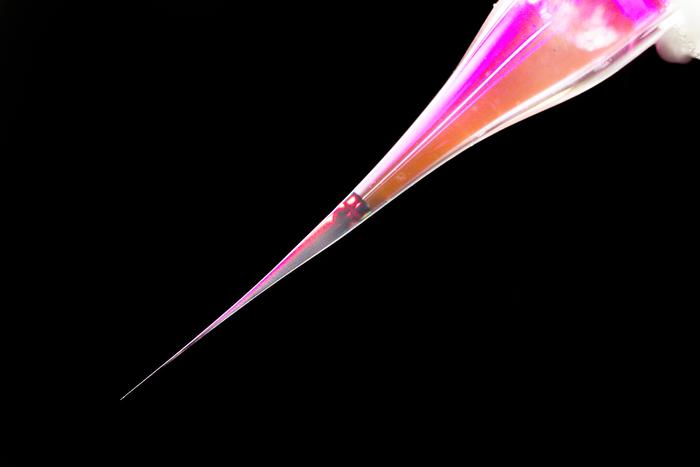
Researchers at Linköping University have made a groundbreaking advancement in neurobiology with the introduction of a novel iontronic micropipette designed to deliver ions precisely to individual neurons while maintaining the integrity of the surrounding extracellular environment. This innovation offers scientists a revolutionary tool for exploring the intricacies of brain function, enabling them to manipulate ion concentrations and better understand cellular communication within the brain. By focusing on the delicate balance maintained in the extracellular milieu, which is essential for neuronal operation, the new pipette provides a pathway for insights that previous methods were unable to achieve.
Traditionally, changes in the extracellular environment, achieved through liquid infusion, have disrupted the biochemical equilibrium, complicating the interpretation of experimental results. The researchers aimed to circumvent this issue by developing an innovative micropipette measuring merely 2 micrometers in diameter—significantly smaller than a human hair and even smaller than the neurons it targets. This unprecedented design allows for localized alterations in ion concentrations while preserving the existing physiological conditions, thereby enabling a clearer understanding of neuronal activity and intercellular dynamics.
One of the primary advantages of this iontronic micropipette is its capability to introduce specific ions, such as potassium and sodium, into the extracellular space without altering the surrounding fluid dynamics or pressure. This targeted approach allows researchers to investigate how these ions influence neuronal and glial cell activity independently. Past research has typically neglected the role of glial cells in brain function, largely because they are non-responsive to electrical stimulation, which limited the scope of neurophysiological studies.
Daniel Simon, a professor at Linköping University, emphasizes the potential of this technology in the realm of treating neurological diseases such as epilepsy. Indeed, the ability to deliver ions with precision could lead to new therapeutic strategies that target specific abnormal neurochemical states. By modulating the local ion concentrations with extreme accuracy, researchers could theoretically restore normal cellular function, pointing towards a future where ion-based therapies could address complex neurological disorders.
The significance of glial cells cannot be underestimated, especially when considering their diverse roles in supporting and regulating neuronal function. Glial cells outnumber neurons in the human brain, participating actively in neurotransmitter recycling and ion homeostasis. By employing the iontronic micropipette to manipulate glial cell activity, researchers may unlock new understandings of their contributions to neural circuitry and overall brain health.
In preliminary studies using hippocampal tissue slices from mice, researchers observed intriguing dynamics between neurons and astrocytes, a type of glial cell. Initial expectations regarding the responsiveness of neurons to changes in ion concentration proved overly optimistic. Surprisingly, it was the astrocytes that displayed rapid and significant reactions to the added ions, whereas neuronal activation occurred only after astrocytic saturation. This unexpected outcome underscores the nuanced interplay between different cell types in the brain, revealing a more complex picture of neurophysiology than previously understood.
The details of the pipette’s construction are just as fascinating as its applications. The micropipette is produced by heating and pulling a glass tube to create a delicate, tapered tip. This manufacturing process is reminiscent of traditional micropipette fabrication used in neuroscience, ensuring that the new tool remains compatible with existing methodologies. As Daniel Simon notes, the familiarity that researchers have with micropipettes enhances the likelihood of swift adoption, potentially accelerating advances in neuroscience research.
Looking forward, the team at Linköping University envisions expanding their research to encompass further chemical signaling investigations in both healthy and diseased brain tissues. Utilizing the iontronic micropipette to assess how health-related changes in ionic concentrations impact both neurons and glial cells will pave the way for an enhanced understanding of the molecular basis of neurological diseases. Moreover, there are plans to explore the delivery of therapeutic agents through this new tool, which could ultimately lead to more effective treatments for conditions such as epilepsy, where precise chemical modulation is crucial.
Furthermore, by refining methods for ionic modulation, this research provides a template for future studies exploring the broader implications of ion concentration variations in multiple brain regions. Such studies may yield significant insights not only into healthy brain function but also into the pathological changes that characterize various neurological diseases. Enhanced knowledge in these areas could ultimately lead to the development of new pharmacological therapies that are more targeted and effective.
In conclusion, the development of the iontronic micropipette represents a significant step forward in neuroscience, allowing for precise control over the local ionic environment within the brain. As research progresses, the potential applications of this technology in both fundamental neuroscience and clinical contexts could reshape our understanding of brain function and the treatment of neurological diseases, providing hope for advancements that improve patient outcomes.
Subject of Research: Animal tissue samples
Article Title: Miniaturized Iontronic Micropipettes for Precise and Dynamic Ionic Modulation of Neuronal and Astrocytic Activity
News Publication Date: 10-Mar-2025
Web References: DOI link
References: Not provided
Image Credits: Credit: Thor Balkhed
Keywords
neuroscience, iontronic micropipette, glial cells, neuronal activity, neurological treatments, ion concentration, brain signaling, cellular communication, therapeutics, epilepsy, experimental research, Linköping University
Tags: brain function exploration toolscellular communication and ion dynamicsexperimental methods in neuroscienceextracellular environment integritygroundbreaking neuroscience innovationsiontronic micropipette technologyLinköping University research contributionslocalized ion concentration manipulationmicropipette design in neurobiologyneurobiology research advancementsneuronal communication study toolsprecision ion delivery to neurons