Credit: Oliver Dietze
Together with the German Aerospace Center (DLR), computer scientists from Saarland University have now developed a new system that listens in to these conversations and engages with the controllers. The scientists are presenting their prototype at the Cebit computer fair in Hannover, Germany (Hall 6, Stand E28).
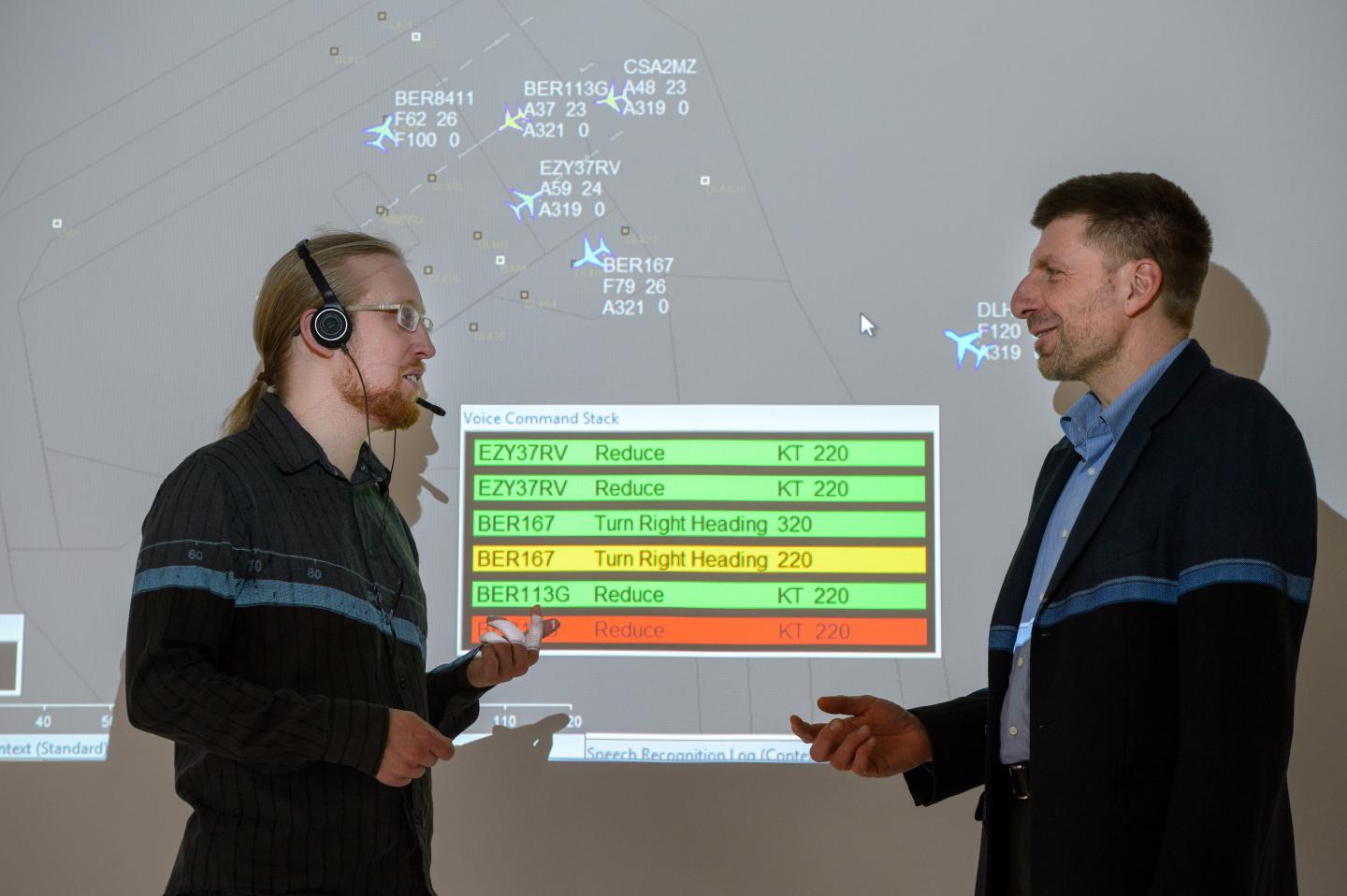
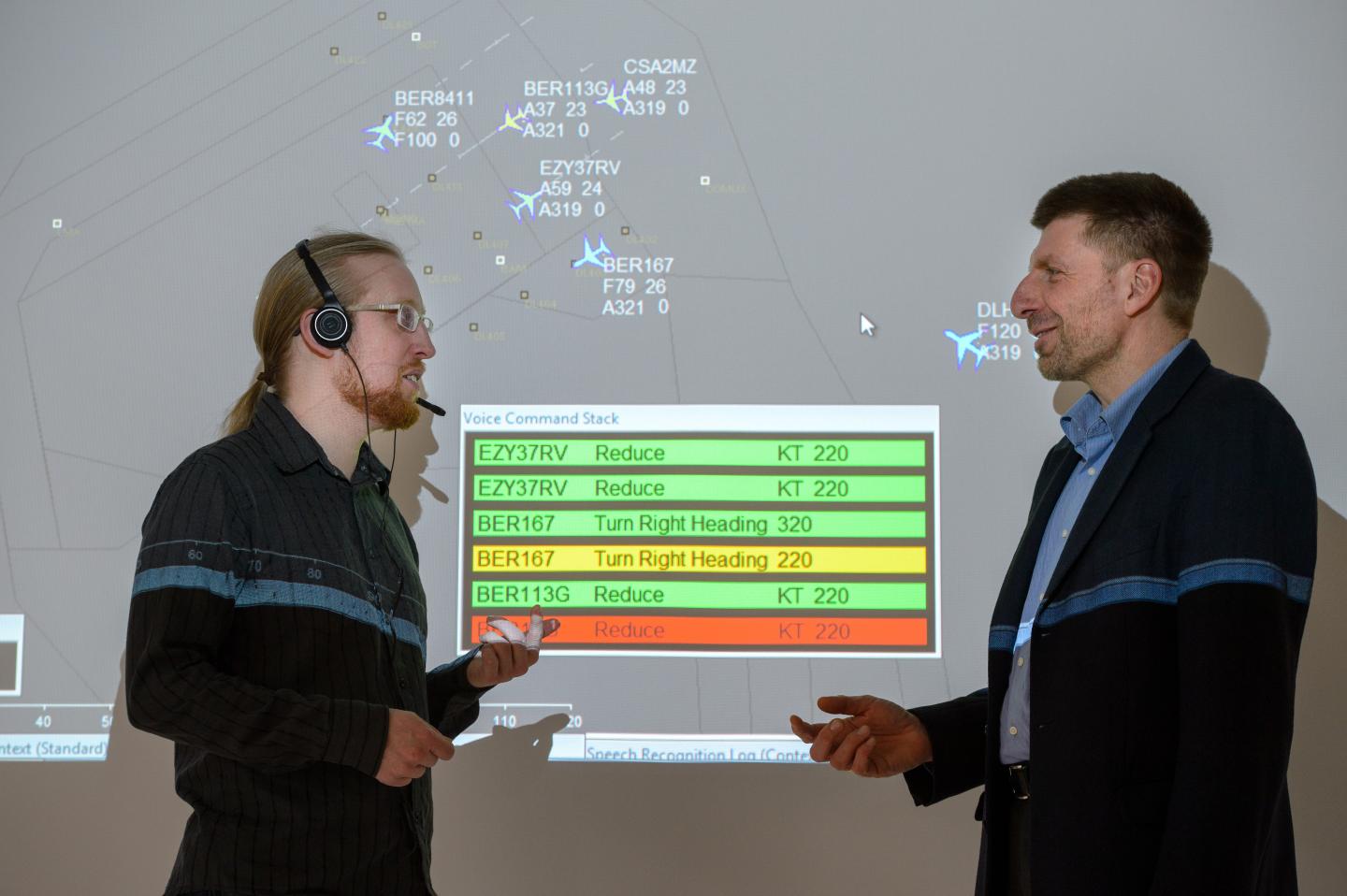
Air traffic controllers are responsible for keeping aircraft at a safe distance to one other in the air and on runways and airstrips. Their most important tool is the radar, which uses radio waves to pinpoint the positions of the airplanes and measure their relative distances. The so-called system aid that air traffic controllers use for planning proposes an optimal order for the airplanes in that particular airspace. These automated suggestions are based on radar data. The controller then radios in with the individual pilots to communicate the correct order. So far, the system aid has been excluded from these short and often terse dialogues between controller and pilot. This lowers the quality of the system aid's automated suggestions, which is particularly dangerous in critical situations. "The more stressful the situation is, the less you can rely on the system aid," Youssef Oualil points out. Oualil is a researcher in the Department of Language Science and Technology at Saarland University. Together with his colleague Marc Schulder, the professor of Spoken Language Systems at Saarland University, Dietrich Klakow, as well as Hartmut Helmke from the German Aerospace Center DLR, Oualil developed a software system named "AcListant", which listens in to air controllers' radio conversations and makes more informed suggestions for their current situation.
The researchers relied entirely on automatic speech recognition, so that controllers do not have to enter any new commands themselves by keyboard or mouse. As the speech recognition system is supposed to filter nonsensical or unsuitable commands out immediately, the computer scientists incorporated additional information from the system aid, so that the controllers' display will only include commands that actually match the current situation. The software system only filters such basic information that is actually relevant to controllers. "This means that verbal padding like Hello or Good morning will be edited out, but identification numbers, altitudes and commands stay in," Marc Schulder explains. The system also performs a kind of reality check in which it incorporates current information from the radar. Data from the radar is used to generate probable word sequences, and then only such pieces of information that are most similar to the generated phrases are subsequently forwarded to the system aid. The flight controller is then shown these filtered items as suggested instructions for the pilot.
The researchers have already tested their prototype in various simulations for major airports at the DLR Research Airport in Braunschweig. "With AcListant, we have not just reduced the number of incorrect commands that are processed by a factor of four, compared to less sophisticated systems. The flight controllers are also able to communicate a lot better with pilots who talk very fast or with an accent," says Dietrich Klakow. The German Aerospace Center is now trying to promote the commercialization of the system.
AcListant is not the only research project that Klakow and his colleagues are working on. One focus of their work is teaching computers to understand ambiguous statements, and learning to recognize the dominant sentiment – in future even in ambiguous expressions like "damn good" or "pretty bad". Users will be able to ask their computer intuitive questions, and receive answers like from a human respondent. The Saarbruecken scientists also developed a special software for the computer game "Sonar Silence", which automatically understands in-game questions of players of different nationalities, and responds with the according information in the appropriate language. The core elements of this technology can be used both in medicine, for instance for the early diagnosis and detection of depressive episodes, and in online retail, for instance for automatic responses to customer requests.
###
Further Information
Project website: http://www.aclistant.de
Media Inquiries
Dietrich Klakow
Professor of Spoken Language Systems
Saarland University
Phone: +49 681 302-58122
E-Mail: [email protected]
Editor
Gordon Bolduan
Competence Center Computer Science Saarland
Saarland Informatics Campus E1.7
Saarland University
Phone: +49 681 302-70741
E-Mail: [email protected]
Media Contact
Gordon Bolduan
[email protected]
49-681-302-70741
@Saar_Uni
http://www.uni-saarland.de
############
Story Source: Materials provided by Scienmag