Credit: C) HZDR / 3Dkosmos
Chile is one of the most important suppliers of copper to German industry. Within the framework of the scientific and technological cooperation between the two countries, research is now being pursued into how Chilean copper ores can be extracted in a more environmentally sustainable way. Bioactive substances derived from bacteria may replace or reduce chemicals. A further aim is to increase metal yield while extracting metals that are traditionally difficult to separate out, in particular the molybdenum content. The joint project between Helmholtz Institute Freiberg for Resource Technology (HIF) – part of Helmholtz-Zentrum Dresden-Rossendorf (HZDR) – and the Advanced Mining and Technology Center at the Universidad de Chile in Santiago de Chile began in February.
The researchers have set themselves a three-year deadline to prove that it is possible to separate metals from ores using biotechnology. The principle could have long-term significance for the processing of complex raw materials and recycled materials. Such resources are becoming ever more economically valuable, but they are not yet technologically viable. The research project is funded by the German Federal Ministry for Education and Research (BMBF).
Copper is an important bulk metal for German industry. The demand is partly covered by recycling, but the rest has to be imported either in the form of metal concentrates or crude ore. In addition to world market leader Chile, other important suppliers for Germany are Peru and Brazil. Copper is mainly used in the cable and electrical industry, but also in the construction and automotive sectors and in mechanical engineering.
Bacteria from the sea
"Chile has an obvious interest in making its own mining production of copper more efficient and environmentally responsible," explains Dr Martin Rudolph, Head of the Processing Division at HIF. In the Pacific coastal state, salt water is used instead of fresh water to recover the valuable metal. However, this involves an increased use of chemicals. Furthermore, it leads to the loss of the molybdenum contained in the ore, an important rare metal used for steel alloys, lubricants and electronic components.
Bacteria could be a promising way forward. "They have to be adapted to saline conditions, which means taken from the sea," says Rudolph's colleague Dr Katrin Pollmann, who heads the biotechnological working group. "We do not need living microbes as such, but only those active substances that are specifically able to alter mineral surfaces. These can be bacterial cells, cell components, metabolic products or biomolecules."
As yet unexplored possibilities: Bioflotation
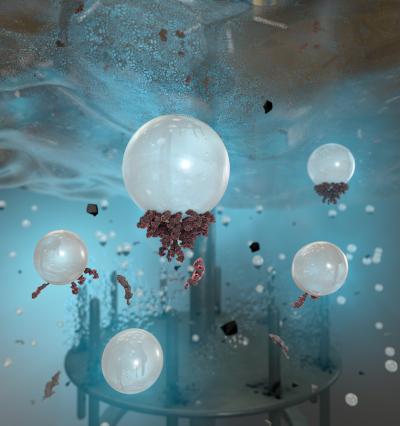
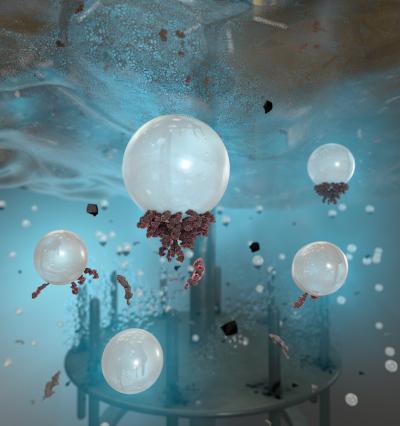
The process of flotation has been used in industry for the past 150 years in the processing of raw materials. The copper content of crude ore is thus enriched from around one percent to approximately 30 percent. During flotation, the finely ground ore is mixed with water. The addition of chemicals makes the ore particles differentially wettable; valuable substances are extracted while worthless particles are left behind. In the future, bioactive substances instead of chemical reagents will be added to the ore minerals. The minerals containing copper and molybdenum will be filtered out, while the useless iron mineral pyrite will be deposited as waste.
The fact that bacteria need the iron mineral pyrite for their metabolism is already exploited in the industrial extraction of copper by bioleaching. Now the researchers want to open the door to bioflotation – an area that is still largely unexplored. Once suitable bacteria have been identified and the bioactive substances isolated, the aim is to analyze the interactions with the mineral surfaces down to the level of individual molecules. Dr Rudolph considers the long-term prospects: "We assume that bioflotation can be readily integrated into classic processing routes. A further advantage is that bioactive substances degrade naturally in the environment. How they behave there is a matter for further research."
###
For more information:
Dr. Martin Rudolph | Head Processing Division
Helmholtz Institute Freiberg for Resource Technology at HZDR
Tel: +45 351 260-4410 | E-Mail: [email protected]
Dr. Katrin Pollmann | Head Biotechnology Group
Helmholtz Institute Freiberg for Resource Technology at HZDR
Tel.: +49 351 260-2946 | E-Mail: [email protected]
Media contact:
Anja Weigl | Press officer
Helmholtz Institute Freiberg for Resource Technology at HZDR
Tel. +49 351 260-4427| E-Mail: [email protected]
The Helmholtz-Zentrum Dresden-Rossendorf (HZDR) conducts research in the sectors energy, health, and matter. The HZDR has been a member of the Helmholtz Association, Germany's largest research organization, since 2011. It has four locations (Dresden, Leipzig, Freiberg, Grenoble) and employs about 1,100 people – approximately 500 of whom are scientists, including 150 doctoral candidates.
The Helmholtz Institute Freiberg for Resource Technology (HIF) pursues the objective of developing innovative technologies for the economy so that mineral and metalliferous raw materials can be made available and used more efficiently and recycled in an environmentally friendly manner. The HIF was founded in 2011, belongs to Helmholtz-Zentrum Dresden-Rossendorf and is cooperating closely with TU Bergakademie Freiberg.
Media Contact
Anja Weigl
[email protected]
49-351-260-4427
@HZDR_Dresden
http://www.hzdr.de/db/Cms?pNid=0
############
Story Source: Materials provided by Scienmag