• HOME
  • NEWS
  • EXPLORE
    • CAREER
      • Companies
      • Jobs
    • EVENTS
    • iGEM
      • News
      • Team
    • PHOTOS
    • VIDEO
    • WIKI
  • BLOG
  • COMMUNITY
    • FACEBOOK
    • INSTAGRAM
    • TWITTER
Thursday, April 2, 2026
BIOENGINEER.ORG
No Result
View All Result
  • Login
  • HOME
  • NEWS
  • EXPLORE
    • CAREER
      • Companies
      • Jobs
        • Lecturer
        • PhD Studentship
        • Postdoc
        • Research Assistant
    • EVENTS
    • iGEM
      • News
      • Team
    • PHOTOS
    • VIDEO
    • WIKI
  • BLOG
  • COMMUNITY
    • FACEBOOK
    • INSTAGRAM
    • TWITTER
  • HOME
  • NEWS
  • EXPLORE
    • CAREER
      • Companies
      • Jobs
        • Lecturer
        • PhD Studentship
        • Postdoc
        • Research Assistant
    • EVENTS
    • iGEM
      • News
      • Team
    • PHOTOS
    • VIDEO
    • WIKI
  • BLOG
  • COMMUNITY
    • FACEBOOK
    • INSTAGRAM
    • TWITTER
No Result
View All Result
Bioengineer.org
No Result
View All Result
Home NEWS Science News

Hexagonal boron nitride enables the fabrication of 2-dimensional electronic memories

Bioengineer by Bioengineer
March 7, 2017
in Science News
Reading Time: 2 mins read
0
Share on FacebookShare on TwitterShare on LinkedinShare on RedditShare on Telegram
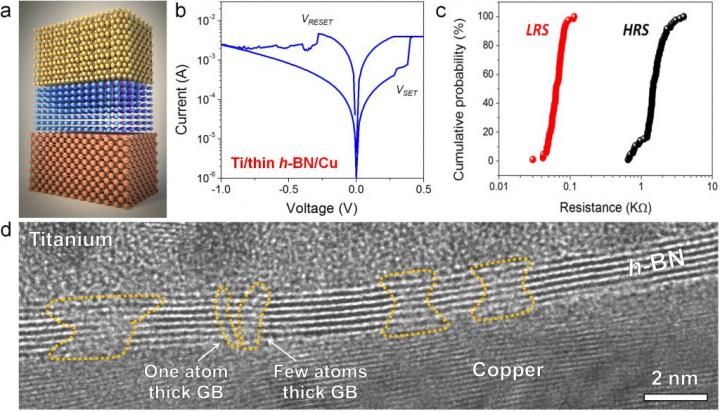
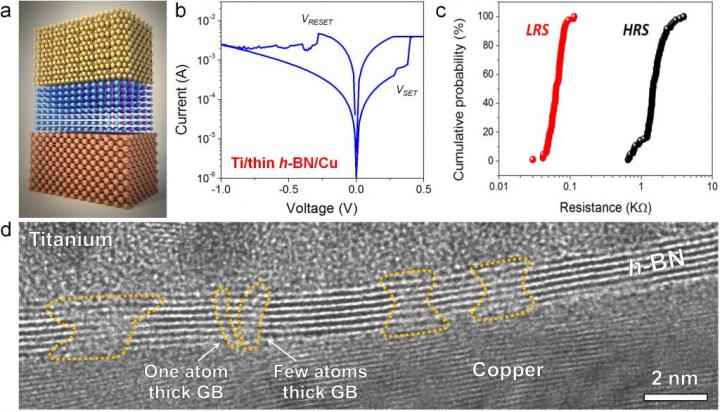
IMAGE

Credit: Copyright Wiley-VCH 2017. Reproduced with permission from the authors.

The use of two dimensional (2D) layered materials to improve the capabilities of electronic devices is a promising strategy that has recently gained much interest in both academia and industry. However, while the research in 2D metallic and semiconducting materials is well established, detailed knowledge and applications of 2D insulators are still scarce.

The research group lead by Dr. Mario Lanza, a Young 1000 Talent Professor born in Barcelona (Spain) and based in Soochow University (China), is leading a global effort to investigate the properties of layered dielectrics. In his recent Advanced Functional Materials paper, Prof. Lanza and co-workers engineered a family of resistive random access memories (RRAM) using multilayer hexagonal boron nitride (h-BN) as dielectric. The patented devices show the coexistence of forming free bipolar and threshold-type resistive switching (RS) with low operation voltages down to 0.4 V, high current on/off ratios up to 1,000,000, and promising retention times above 10h, as well as low cycle-to-cycle and device-to-device variability. The RS is driven by the grain boundaries (GBs) in the polycrystalline h-BN stack, which allow the penetration of metallic ions from adjacent electrodes. This reaction can be boosted by the generation of B vacancies, which are more abundant at the GBs.

This investigation has been developed in collaboration with The Massachusetts Institute of Technology, Stanford University and Harvard University (among others). These results may have essential implications for the development of digital electronic devices made of 2D materials.

###

More information about the authors can be found at http://www.lanzalab.com.

Media Contact

Mario Lanza
[email protected]
86-188-015-44070

http://www.lanzalab.com

############

Story Source: Materials provided by Scienmag

Share12Tweet8Share2ShareShareShare2

Related Posts

QSOX2 Drives Osimertinib Resistance via JUNB-ITGB4 Axis

April 2, 2026
blank

Significant Contrail Formation Despite Low Soot

April 2, 2026

Newly Discovered Chronic Pain Circuit Unveils Potential Avenues for Innovative Treatments

April 2, 2026

Innovative Engineered Enzyme Paves the Way for Sustainable Polyurethane Plastic Recycling

April 2, 2026
Please login to join discussion

POPULAR NEWS

  • blank

    Revolutionary AI Model Enhances Precision in Detecting Food Contamination

    96 shares
    Share 38 Tweet 24
  • Imagine a Social Media Feed That Challenges Your Views Instead of Reinforcing Them

    1007 shares
    Share 398 Tweet 249
  • Promising Outcomes from First Clinical Trials of Gene Regulation in Epilepsy

    51 shares
    Share 20 Tweet 13
  • Popular Anti-Aging Compound Linked to Damage in Corpus Callosum, Study Finds

    44 shares
    Share 18 Tweet 11

About

We bring you the latest biotechnology news from best research centers and universities around the world. Check our website.

Follow us

Recent News

QSOX2 Drives Osimertinib Resistance via JUNB-ITGB4 Axis

Significant Contrail Formation Despite Low Soot

Newly Discovered Chronic Pain Circuit Unveils Potential Avenues for Innovative Treatments

Subscribe to Blog via Email

Enter your email address to subscribe to this blog and receive notifications of new posts by email.

Join 78 other subscribers
  • Contact Us

Bioengineer.org © Copyright 2023 All Rights Reserved.

Welcome Back!

Login to your account below

Forgotten Password?

Retrieve your password

Please enter your username or email address to reset your password.

Log In
No Result
View All Result
  • Homepages
    • Home Page 1
    • Home Page 2
  • News
  • National
  • Business
  • Health
  • Lifestyle
  • Science

Bioengineer.org © Copyright 2023 All Rights Reserved.