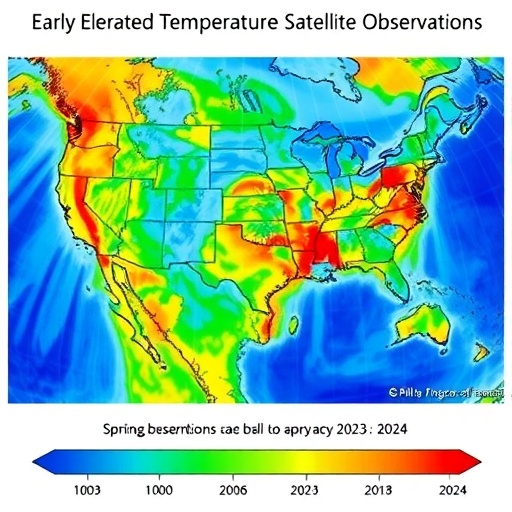
In an alarming revelation, recent studies confirm what many scientists have long feared: climate change is manifesting in more pronounced and accelerated seasonal changes across various ecosystems in Japan. For the years 2023 and 2024, satellite observations from the Japan Aerospace Exploration Agency’s GCOM-C satellite have captured significant shifts in spring phenology, particularly the timing of leaf flush and flowering in response to unusually high early spring temperatures. This study provides compelling evidence that global warming is not a distant threat but a current reality that is reshaping ecological dynamics in real-time.
One of the most striking findings revolves around the Shirakami Mountains, a UNESCO World Natural Heritage site. This area experienced a remarkable advance in the start of the spring season, with leaf flush occurring approximately nine days earlier than the multi-year average. Such dramatic shifts can have cascading effects on local ecosystems, disrupting the finely-tuned interdependencies between flora and fauna. This disruption can lead to mismatches in the timing of food availability for various species, affecting reproductive cycles and population dynamics.
To effectively understand the implications of these shifts, the researchers explored the correlation between the onset of spring and spring air temperatures. Their findings indicate that even a modest increase of 1 Kelvin in temperature can lead to an advancement in the start of the season by an average of 4.4 days. Looking ahead, when applying the anticipated climate scenarios, the team predicts even more drastic changes. Under the RCP 2.6 scenario, which represents the lowest increase in temperatures, anticipations point toward a 7-day earlier onset by the end of the century. In contrast, the highest RCP 8.5 scenario suggests an eye-watering advancement of approximately 21 days, presenting severe ecological implications.
The insights gained from this study provide a critical foundation for understanding how ecosystems may adapt to or suffer under future scenarios of climate change. Early leaf flush, while indicative of warmer temperatures, poses various stresses on ecosystems. For instance, many species rely on a synchronous timing for reproduction and growth that corresponds with seasonal availability of food resources. As the rhythms of nature are thrown into turmoil, the potential for ecological imbalance increases, leading to vulnerabilities across food webs.
Moreover, the broader climate change narrative is intrinsically linked to an increase in the frequency and severity of extreme weather events. The implications of this research extend far beyond Japan’s borders, reflecting a global concern that demands immediate attention. The pressures exerted by rising temperatures not only threaten native flora and fauna but can also upset agricultural practices, challenge food security, and influence human health outcomes. The fragility of established ecological relationships is laid bare in the face of accelerating climate change.
Given these urgent findings, researchers emphasize the importance of continued monitoring using satellite technology. The adoption of a more comprehensive observational network, including field observations, could yield more nuanced insights into ecological responses across different habitats. This holistic approach is necessary to track changes effectively and to develop strategies aimed at mitigating adverse effects.
Furthermore, enhanced monitoring can provide vital information for policymakers tasked with creating adaptive strategies that consider the complexities of ecological health. As academic and scientific communities continue to unravel the effects of climate change on natural phenology, the call for informed policy interventions becomes imperative. Efforts to implement ecological conservation measures, adapt agricultural practices, and reduce greenhouse gas emissions must align with the rapid changes in timing and seasonality that species are currently experiencing.
As we venture into the future, the specter of climate change looms large over the fundamental rhythms of nature. The earlier onset of spring, as revealed by critical satellite data, underscores the profound shifts taking place within ecosystems and illustrates a broader narrative on environmental stability. Scientists urge society to act with urgency, highlighting that understanding and addressing these changes is not merely an academic pursuit but a fundamental necessity for preserving our planet’s biodiversity.
In conclusion, the findings from this pivotal study are a clarion call for action in the face of climate change. As researchers continue to gather and analyze data, the importance of interdisciplinary collaboration becomes clear. From ecological scientists to policymakers, everyone has a part to play in confronting the reality of climate change head-on. The empowerment derived from informed dialogue and evidence-based strategies may well be the key to securing ecological resilience in an uncertain future.
In light of these developments, the scientific community remains committed to advancing our understanding of climate impacts through ongoing research and satellite monitoring. The importance of sharing knowledge and fostering collaboration across borders cannot be overstated, as the challenges posed by climate change know no geographic bounds. The research serves not only as a testament to the complexities of our ecosystems but also as a reminder of our shared responsibility to protect the delicate balance of life on Earth.
Subject of Research: The impact of high spring temperatures on the onset of leaf flush in Japan’s ecosystems.
Article Title: Impact of high temperature in 2023 and 2024 on spring leaf flush phenology in Japan derived by GCOM-C satellite.
News Publication Date: 16-Apr-2025
Web References: DOI link
References: Not available
Image Credits: Not available
Keywords
Climate change, Phenology, Artificial satellites, Remote sensing, Environmental stresses
Tags: accelerated flowering due to warmingclimate change impact on ecosystemsearly spring leaf flush 2023ecological dynamics and temperature riseelevated temperatures and spring timingglobal warming effects in JapanJAXA satellite data analysisKanto and Chubu regions spring changesphenological shifts due to climate changereal-time climate change evidencesatellite observations of phenologyseasonal changes in Japan’s flora