Credit: UC Riverside
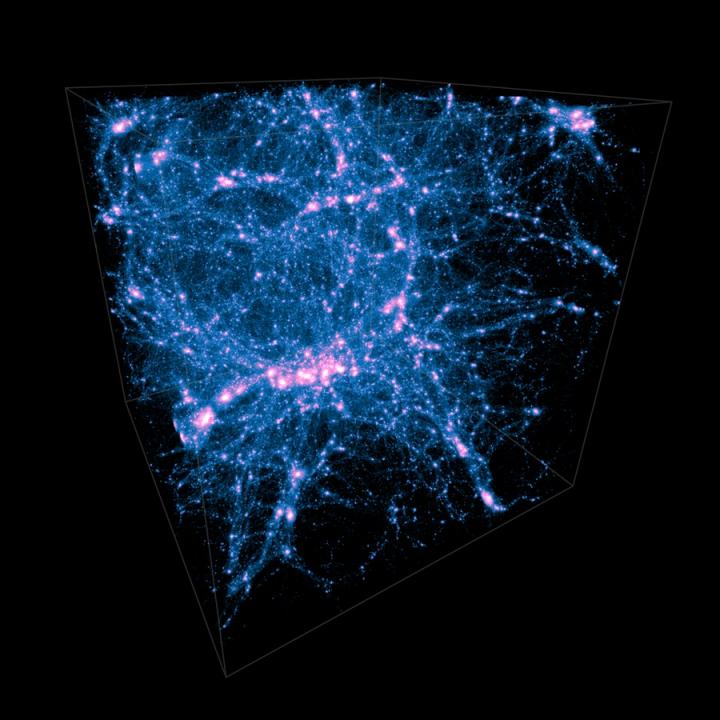
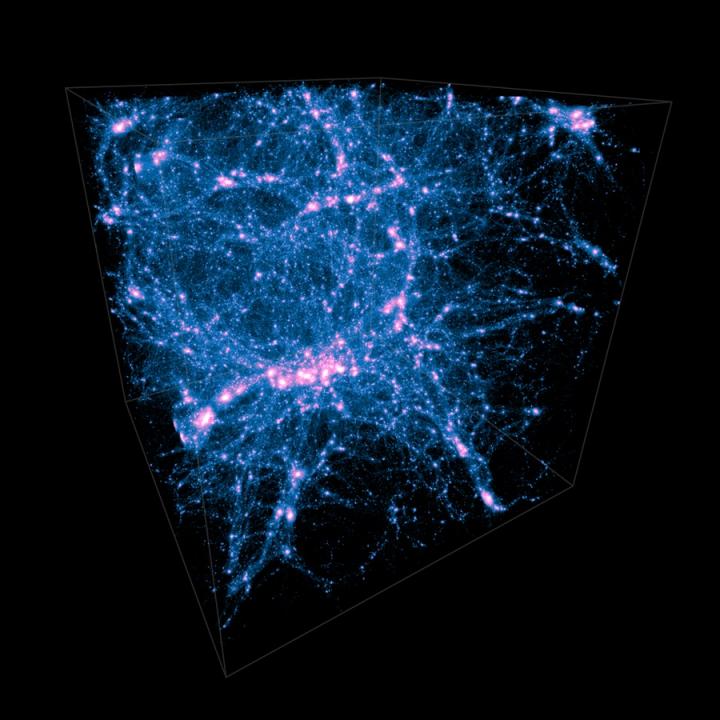
RIVERSIDE, Calif. — The scaffolding that holds the large-scale structure of the universe constitutes galaxies, dark matter and gas (from which stars are forming), organized in complex networks known as the cosmic web. This network comprises dense regions known as galaxy clusters and groups that are woven together through thread-like structures known as filaments. These filaments form the backbone of the cosmic web and host a large fraction of the mass in the universe, as well as sites of star formation activity.
While there is ample evidence that environments shape and direct the evolution of galaxies, it is not clear how galaxies behave in the larger, global cosmic web and in particular in the more extended environment of filaments.
In a joint collaboration between the California Institute of Technology and the University of California, Riverside, astronomers have performed an extensive study of the properties of galaxies within filaments formed at different times during the age of the universe.
In a just-published paper, astronomers used a sample of 40,000 galaxies in the COSMOS field, a large and contiguous patch of sky with deep enough data to look at galaxies very far away, and with accurate distance measurements to individual galaxies. The large area covered by COSMOS allowed sampling volumes of different densities within the cosmic web.
Using techniques developed to identify the large-scale structures, they cataloged the cosmic web to its components: clusters, filaments, and sparse regions devoid of any object, extending into the universe as it was 8 billion years ago. The galaxies were then divided into those that are central to their local environment (the center of gravity) and those that roam around in their host environments (satellites).
"What makes this study unique is the observation of thousands of galaxies in different filaments spanning a significant fraction of the age of the Universe" said Behnam Darvish a postdoctoral scholar at Caltech who is the lead author on the paper. "When we consider the distant universe, we look back in time to when the cosmic web and filaments were younger and had not yet fully evolved and therefore, could study the joint evolution of the large scale structures and galaxies associated with them."
The researchers measured the star formation activity in galaxies located in different environments.
"It was reassuring when we found that the average star-formation activity declined from the sparsely populated regions of the cosmic web to mildly populated filaments and dense clusters," said Bahram Mobasher, a professor of physics and astronomy at the University of California, Riverside. "However, the surprising finding was that the decline was especially steep for satellite galaxies."
He emphasized: "The inevitable conclusion from this was that the majority of satellite galaxies stop forming stars relatively fast during the last 5 billion years as they fall to dense environments of clusters by way of the filaments, while this process is much slower for central galaxies."
The fast cessation of star formation experienced by satellite galaxies can be explained by "ram-pressure stripping," which is loss of star-forming gas within a galaxy as it moves within a denser environment, such as a cluster.
"Compared to the central galaxies, it is the smaller gravitational pull of the satellite galaxies produced by their smaller mass, that results in a more efficient loss of gas and hence, a slow-down in star formation activity with respect to the more massive central galaxies" said Chris Martin, a professor of astronomy at Caltech.
This investigation served as a pilot study for future large-volume and relatively deep surveys, which will peer into dimmer and younger galaxies in the Universe, such as LSST, Euclid, and WFIRST.
The paper, "Cosmic Web of Galaxies in the COSMOS Field: Public Catalog and Different Quenching for Centrals and Satellites," was published in Astrophysical Journal.
###
In addition to Darvish, Mobasher and Martin, the authors are: Nick Scoville and Shoubaneh Hemmati of Caltech, David Sobral of Lancaster University in the United Kingdom, Andra Stroe of the European Southern Observatory, and Jeyhan Kartaltepe of the Rochester Institute of Technology.
The research was funded by NASA.
Mario De Leo Winkler, a postdoctoral researcher in the UCR Department of Physics and Astronomy, made significant contributions to this article.
Media Contact
Sean Nealon
[email protected]
951-827-1287
@UCRiverside
http://www.ucr.edu
############
Story Source: Materials provided by Scienmag