• HOME
  • NEWS
  • EXPLORE
    • CAREER
      • Companies
      • Jobs
    • EVENTS
    • iGEM
      • News
      • Team
    • PHOTOS
    • VIDEO
    • WIKI
  • BLOG
  • COMMUNITY
    • FACEBOOK
    • INSTAGRAM
    • TWITTER
Saturday, February 7, 2026
BIOENGINEER.ORG
No Result
View All Result
  • Login
  • HOME
  • NEWS
  • EXPLORE
    • CAREER
      • Companies
      • Jobs
        • Lecturer
        • PhD Studentship
        • Postdoc
        • Research Assistant
    • EVENTS
    • iGEM
      • News
      • Team
    • PHOTOS
    • VIDEO
    • WIKI
  • BLOG
  • COMMUNITY
    • FACEBOOK
    • INSTAGRAM
    • TWITTER
  • HOME
  • NEWS
  • EXPLORE
    • CAREER
      • Companies
      • Jobs
        • Lecturer
        • PhD Studentship
        • Postdoc
        • Research Assistant
    • EVENTS
    • iGEM
      • News
      • Team
    • PHOTOS
    • VIDEO
    • WIKI
  • BLOG
  • COMMUNITY
    • FACEBOOK
    • INSTAGRAM
    • TWITTER
No Result
View All Result
Bioengineer.org
No Result
View All Result
Home NEWS Science News

World-first synthetic receptor mimics how cells ‘talk’ to the world around them

Bioengineer by Bioengineer
March 6, 2017
in Science News
Reading Time: 2 mins read
0
Share on FacebookShare on TwitterShare on LinkedinShare on RedditShare on Telegram
IMAGE

Credit: University of Bristol

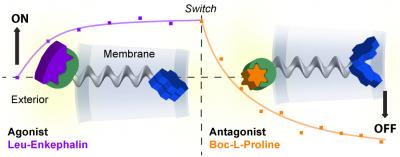
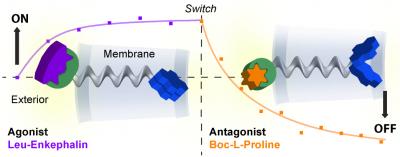
Researchers from the University of Bristol have found a way to mimic the way cells in living organisms 'talk' to the world around them by creating a world-first synthetic receptor which can respond to chemical signals just like its natural equivalent.

The breakthrough research, published in the journal Nature Chemistry, paves the way for further advances in biotechnology and in the future could be used in the treatment of medical conditions caused by faulty cellular communication. The research was supported by the European Research Council and the Engineering and Physical Science Research Council (EPSRC).

Professor Jonathan Clayden from the University of Bristol's School of Chemistry explains: "Cells in living organisms find out what is happening in the world around them by using receptor molecules embedded in their outer membranes. These respond to chemical messages, such as hormones, by changing shape, which sets off a cascade of chemical events inside the cell.

"Working with collaborators in Manchester, we have now designed and synthesised the first artificial mimic of one of these receptors."

The synthetic receptor embeds itself into the membrane of simple cellular structures known as vesicles, and just like its natural equivalent, changes its molecular shape in response to chemical signals.

The researchers were able to get the receptor mimic to respond to the natural hormone Leu-enkephalin (an "agonist"), which in humans is involved in pain relief, and were able to use another chemical messenger (an "antagonist") to switch this response off again.

"The discovery that artificial molecules can respond to chemical signals in this way raises the possibility that the natural communication pathways used by cells could be added to or bypassed," said Professor Clayden.

"Ultimately, we could see artificial cells being used to produce valuable materials or medicines under the control of receptors in their membranes, or the use of artificial receptors to treat medical conditions caused by faulty cellular communications."

###

Media Contact

Shona East
[email protected]
44-011-792-88086
@BristolUni

http://www.bristol.ac.uk

############

Story Source: Materials provided by Scienmag

Share13Tweet8Share2ShareShareShare2

Related Posts

Evaluating Pediatric Emergency Care Quality in Ethiopia

February 7, 2026

TPMT Expression Predictions Linked to Azathioprine Side Effects

February 7, 2026

Improving Dementia Care with Enhanced Activity Kits

February 7, 2026

Decoding Prostate Cancer Origins via snFLARE-seq, mxFRIZNGRND

February 7, 2026
Please login to join discussion

POPULAR NEWS

  • Robotic Ureteral Reconstruction: A Novel Approach

    Robotic Ureteral Reconstruction: A Novel Approach

    82 shares
    Share 33 Tweet 21
  • Digital Privacy: Health Data Control in Incarceration

    63 shares
    Share 25 Tweet 16
  • Study Reveals Lipid Accumulation in ME/CFS Cells

    57 shares
    Share 23 Tweet 14
  • Breakthrough in RNA Research Accelerates Medical Innovations Timeline

    53 shares
    Share 21 Tweet 13

About

We bring you the latest biotechnology news from best research centers and universities around the world. Check our website.

Follow us

Recent News

Evaluating Pediatric Emergency Care Quality in Ethiopia

TPMT Expression Predictions Linked to Azathioprine Side Effects

Improving Dementia Care with Enhanced Activity Kits

Subscribe to Blog via Email

Success! An email was just sent to confirm your subscription. Please find the email now and click 'Confirm' to start subscribing.

Join 73 other subscribers
  • Contact Us

Bioengineer.org © Copyright 2023 All Rights Reserved.

Welcome Back!

Login to your account below

Forgotten Password?

Retrieve your password

Please enter your username or email address to reset your password.

Log In
No Result
View All Result
  • Homepages
    • Home Page 1
    • Home Page 2
  • News
  • National
  • Business
  • Health
  • Lifestyle
  • Science

Bioengineer.org © Copyright 2023 All Rights Reserved.