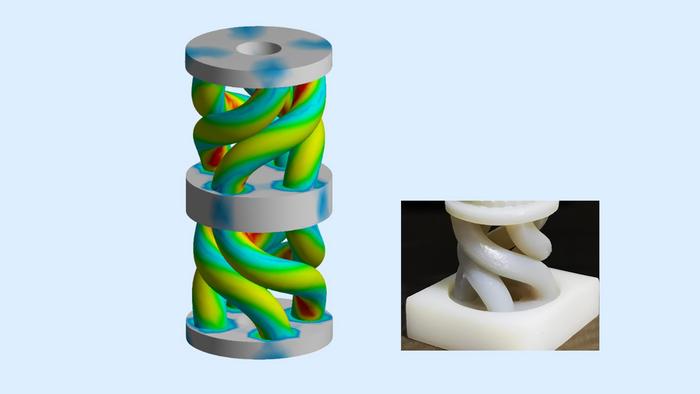

In the realm of material science, a groundbreaking advancement is emerging, centering on the development of mechanical metamaterials that exhibit extraordinary properties for energy storage and management. Researchers at the Karlsruhe Institute of Technology (KIT), led by Professor Peter Gumbsch, have made significant strides in crafting metamaterials that allow for the storage of substantial mechanical energy without structural failure. This innovation could change how we approach energy efficiency in various applications, from robotics to industrial machinery.
The fundamental principle underlying this advancement lies in the concept of enthalpy, which refers to the maximum energy density that a material can store and subsequently release. Conventional materials often encounter challenges when balancing stiffness, strength, and recoverable strain, leading to limitations in energy storage capacity. Gumbsch points out the necessity of merging these conflicting attributes to create a new category of materials that can better withstand mechanical loads while maintaining flexibility.
The research team has focused on the helical deformation mechanism found in specifically arranged rods. By manipulating this configuration, they developed a novel type of metamaterial that effectively captures and retains elastic energy. This arrangement differs significantly from traditional bending springs, which tend to suffer from high tensile and compressive stresses leading to potential failure. By utilizing the twisting motion inherent to the helical structure, the researchers reduced internal stress levels, ensuring that the material can endure greater loads without permanent deformation.
In experimental settings, Gumbsch and his colleagues conducted simulations that demonstrated the unique resilience of this new metamaterial under uniaxial loads. Their findings revealed that the enthalpy of their material could reach levels two to 160 times higher than that of existing metamaterials. Such a leap in performance is a significant working advantage for engineers and designers looking to enhance energy efficiency in their applications.
Through rigorous testing, the researchers validated their theoretical models, demonstrating that their metamaterials could absorb large forces while retaining impressive elastic energy storage capabilities. This advancement opens the door to a plethora of applications, including energy-efficient machinery, robotics, and shock absorption systems, all of which could significantly benefit from enhanced mechanical properties combined with efficient energy storage.
In practical terms, this metamaterial could serve as a superior alternative to conventional springs and shock absorbers. Its unique structural properties could allow for more compact designs while still providing maximum flexibility and resilience, allowing engineers to rethink product designs across multiple industries. The potential for using this type of metamaterial in robotics is especially exciting, as it could lead to the creation of more agile and responsive robotic systems that exploit these advanced mechanical efficiencies.
Furthermore, the researchers envision using the internal twists and turns of these metamaterials to create entirely new mechanical joints that can operate elastically, eliminating the need for traditional hinges and connectors. Such innovations could revolutionize how we approach mechanical assemblies in both small and large-scale applications, enhancing performance while reducing material waste.
However, the journey toward practical applications is arduous and requires extensive further research and development. The scientists continue to explore not only the mechanical properties of these metamaterials but also their long-term stability and performance under varied environmental conditions. Understanding how these materials behave over time, particularly in real-world scenarios, is critical to bringing these innovations to market.
As they move forward, the research team emphasizes the need for interdisciplinary collaboration to fully harness the potential of their discoveries. Combining insights from mechanics, materials science, and engineering will be vital in addressing the complex challenges associated with deploying such advanced materials practically. The hope is that by uniting expertise across different fields, they can accelerate the commercialization of these promising materials.
The implications of this research extend beyond mere material advancements; they touch upon the larger environmental and economic issues of sustainability and resource efficiency. As society increasingly seeks solutions to reduce energy consumption and improve efficiency, breakthrough technologies like these metamaterials represent a crucial step forward. They not only promise to enhance existing technologies but also pave the way for entirely new paradigms in energy storage and mechanical engineering.
In summary, the creation of high-capacity mechanical metamaterials is set to dramatically reshape our understanding and utilization of energy in various sectors. The potential applications, from robotics to energy-efficient machinery, signify a leap toward more sustainable practices that align with contemporary scientific and industrial challenges. As the research unfolds, it carries the promise of not only transforming technology but also contributing meaningfully to our collective goals of sustainability and innovation.
Subject of Research: Not applicable
Article Title: Large recoverable elastic energy in chiral metamaterials via twist buckling
News Publication Date: 12-Mar-2025
Web References: KIT Materials
References: DOI: 10.1038/s41586-025-08658-z
Image Credits: Illustrations: IAM, KIT / Collage: Anja Sefrin, KIT
Keywords
Mechanical metamaterials, energy storage, enthalpy, robotics, mechanical engineering, energy efficiency, materials science.
Tags: advanced mechanical propertiesenergy density storageenergy efficiency in roboticsenergy management innovationsenthalpy in material scienceflexibility in materialshelical deformation mechanismKarlsruhe Institute of Technology researchmechanical energy storagenovel metamaterial designrevolutionary metamaterialsstructural failure prevention