Credit: The University of Manchester
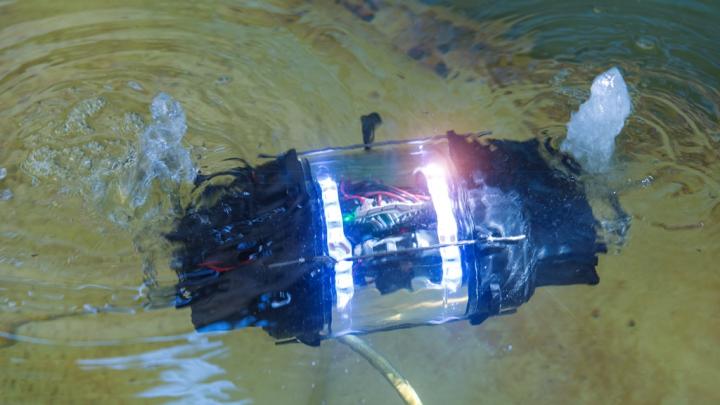
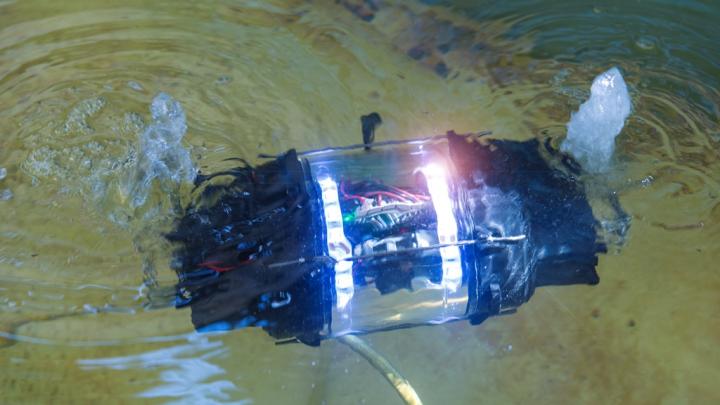
University of Manchester scientists are leading a team which is to comprehensively map some of the world's most radioactive sites using sensing technology mounted on an advanced robotic vehicle.
The world is home to a large number of sites which are contaminated with radioactive waste and require clean-up and analysis. Currently, the options to map and assess these sites are extremely expensive and time consuming – involving either removing samples for lab analysis or sending in remote sensors which only give part of the necessary picture.
The team, led by The University of Manchester, has been awarded a £1.6 million grant by the Engineering and Physical Sciences Research Council to form a group which will develop a new robotic system with the ability to use a wider range of sensors than ever before to map nuclear sites.
Featuring optical spectroscopic techniques, advanced radiation detection methods and modern sensor technologies on remotely-operated vehicle platforms, each sensing technology will provide a piece of the 'total characterisation' jigsaw, together with 3D mapping of the material within the environment.
It will feature advanced robotics and control technologies, such as those used in NASA's Curiosity Rover, to form the flexible platform necessary for trials in nuclear environments ranging from Sellafield in the UK, to Fukushima in Japan.
Principal Investigator, Dr Phil Martin from The University of Manchester's School of Chemical Engineering and Analytical Science, said: "This is an exciting project bringing together a multi-disciplinary team of scientists and engineers to develop a really innovative system for remote characterisation of a range of nuclear environments which should lead to big improvements in the decommissioning process."
The Consortium, known as TORONE (TOtal characterisation by Remote Observation in Nuclear Environments), is also made up of scientists from Lancaster and Aston Universities, the National Nuclear Laboratory and the UK Atomic Energy Authority. The project is for three years' duration and starts on 1st March 2017.
The TORONE group will be working with Sellafield, and Sellafield Ltd Robotics and Autonomous Systems Lead, Dr Paul Mort, said: "Characterisation of materials is of critical importance on the Sellafield site. Improved understanding of what materials are and where they are in our facilities offers considerable benefits when we are planning and carrying out decommissioning activities.
"A technology that is cheap and able to be remotely deployed simply and quickly to inspect materials in-situ, will make it safer for humans and give an opportunity to get better data to make more informed decisions. This technology would have far reaching applications on site and has the potential to improve productivity, thereby reducing decommissioning timescales and costs."
Professor Francis Livens, Director of The University of Manchester's Dalton Nuclear Institute, said: "As we decommission nuclear facilities around the world, it has become very clear that we have to be smarter, because that allows us to be quicker, cheaper and safer. New ideas, such as these, are vital if we are to do this."
Lancaster University Co-Investigator Professor Malcolm Joyce said: "This is an exciting opportunity to integrate the state of the art in radiation detection and robotics."
TORONE is led by UoM Principal Investigator Dr Philip Martin (School of Chemical Engineering and Analytical Sciences). Co-Investigators at UoM comprise Prof. Barry Lennox (School of Electrical and Electronic Engineering) and Prof Nick Smith (Royal Society Industry Fellow, Schools of Earth and Environmental Sciences and Mechanical, Aerospace and Civil Engineering, seconded from NNL); Lancaster University Co-Investigator Prof. Malcolm Joyce (School of Engineering) and Aston University Co-Investigator Dr Michael Aspinall (School of Life and Health Sciences).
Funding of £1.6 million is from the EPSRC through its Remote Sensing in Extreme Environments call.
###
Media Contact
Jamie Brown
[email protected]
44-161-275-8383
@UoMNews
http://www.manchester.ac.uk
############
Story Source: Materials provided by Scienmag