
The Indian monsoon, a vital source of rainfall for millions of residents, has traditionally been understood as a reliable atmospheric phenomenon that propagates northward from the equator, driven by the dynamics of atmospheric oscillations such as the Boreal Summer Intraseasonal Oscillation (BSISO). Recent research from the Indian Institute of Science (IISc) challenges this established narrative, suggesting a more nuanced relationship between the strength of cloud bands and their northward movement. This revelation comes at a critical time when climate change is altering weather patterns worldwide.
Monsoon rains provide around 80% of India’s annual rainfall, primarily falling between June and September. This indispensable source of water sustains agriculture, drinking supplies, and livelihoods across the subcontinent. However, the intensity and duration of these rains can vary significantly from year to year, influenced by various factors including the strength and structure of monsoon cloud bands. Previous scientific understanding had posited that disturbances in the equatorial region consistently result in a northward propagation of these cloud bands. However, the findings from the IISc team highlighted a critical insight: the propulsion of cloud bands northward is intricately linked to their initial strength.
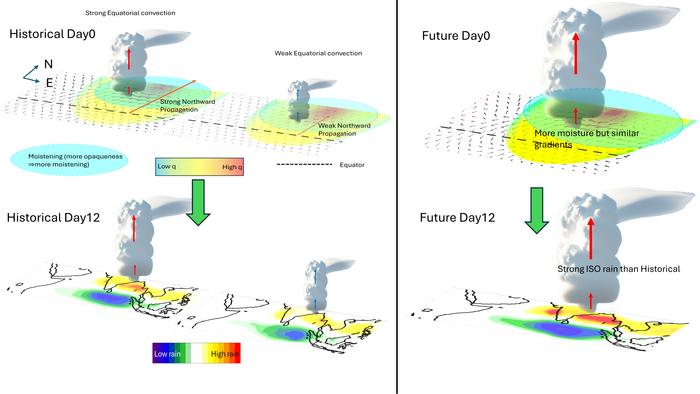
The research undertaken by a group led by PhD student Aditya Kottapalli has redefined the dynamics of the BSISO. Contrary to the historical belief that even minimal equatorial disturbances would lead to a consistent northward thrust, the study reveals that if the cloud bands at the equator are weak, their movement northward is not guaranteed. This key finding could have significant implications for future climate prediction models that rely on the prevailing understanding of monsoon dynamics.
The IISc researchers meticulously analyzed various climate models to identify the triggers behind the BSISO’s behavior. Their meticulous effort involved examining existing gaps in predictions and integrating projections from various robust models to effectively comprehend factors influencing the movement of rainfall patterns across India. They established that only when the cloud band is strong does a reliable northward propagation occur, enhancing moisture levels over the Indian subcontinent and thereby reinforcing the atmospheric conditions required for successful northward movement.
PN Vinayachandran, Chair of the Centre for Atmospheric and Oceanic Sciences at IISc, has highlighted the crucial role that air-sea interactions in the equatorial Indian Ocean play in this process. With the potential for future atmospheric changes resulting from global warming, Vinayachandran warns of an increase in the baseline levels of moisture before monsoonal rains begin. This scenario indicates that upcoming wet spells could be considerably more intense than those experienced in the recent past.
The researchers project that as general atmospheric trends change due to climate shifts, we may see a drastic increase in rainfall—between 42% to 63% during these future wet spells over India and its adjoining seas. Such an increase could have sweeping implications for water management, agriculture, and disaster preparedness in a region where the economy leans heavily on the monsoon season.
The improved understanding of these intricate processes can enhance current climate forecasting models, providing better predictions of weather patterns crucial for agriculture and water resource management. Particularly when aligned with the impending challenges posed by climate change, accurate forecasting becomes paramount. This fresh perspective ignites hope for enhanced agricultural resilience and better preparation for flood risks associated with heavier rainfalls.
In addition to climate modeling, this research paves the way for scientists and policymakers to formulate targeted strategies for adapting to the evolving dynamics of monsoon patterns. Enhancing our understanding of rainfall behavior not only fosters agricultural sustainability but also aids in developing effective water management systems in the face of potential climate adversities.
The implications of this research extend beyond India; a clearer understanding of monsoon systems contributes to global climate science, fostering an interconnected approach to meteorological phenomena common in many regions of the world. Recognizing the broader impacts of the Indian monsoon and similar systems worldwide could herald a new era of cooperative climate research.
As researchers and climate scientists continue to delve into this newly established dynamic, the emphasis will likely shift towards better predictions and actionable insights that can guide practical responses at local, national, and global levels. The urgency of such actions cannot be overstated, given the potential for devastating impacts stemming from climate-induced shifts in monsoon patterns.
In essence, this research serves as a clarion call for the meteorological and scientific communities to re-evaluate existing paradigms about monsoon systems. As climate change continues to reshape weather patterns globally, understanding the variability of cloud band movements could mean the difference between effective preparation and disastrous outcomes for millions reliant on monsoon rains.
As we stand on the cusp of significant climatic changes, studies like this offer a beacon of hope for the future of monsoon-dependent regions, underlining the importance of adaptability and foresight in managing our planet’s changing climate.
Subject of Research: The impact of equatorial convection on boreal summer intraseasonal oscillations in monsoon systems
Article Title: Equatorial convection controls boreal summer intraseasonal oscillations in the present and future climates
News Publication Date: 28-Feb-2025
Web References: npj climate and atmospheric science
References: DOI link: 10.1038/s41612-025-00959-4
Image Credits: Aditya Kottapalli
Keywords
Climate Change, Monsoon Patterns, Intraseasonal Oscillation, Meteorology, Rainfall Prediction, Climate Models, Weather Patterns, Atmospheric Science, Air-Sea Interaction.
Tags: agricultural dependence on monsoonatmospheric oscillations and weather patternsBoreal Summer Intraseasonal Oscillationcloud band dynamicsIISc research on climate dynamicsimpact of climate change on monsoonIndian monsoon variabilitymonsoon rainfall predictionnorthward movement of cloud bandsrelationship between cloud strength and monsoonsignificance of monsoon rainfall in Indiavariability of monsoon wet spells