
Scientists at the University of Texas at Dallas are making significant strides in uncovering the properties and potential applications of rhombohedral graphene, a unique structure derived from the familiar material graphene. Graphene, known for its remarkable conductivity and structural features, has captured the attention of physicists and engineers alike since its isolation in 2004, a groundbreaking achievement that led to a Nobel Prize in Physics. The ongoing research conducted by Dr. Fan Zhang and his team focuses on the behavior of multi-layered graphene and how its distinct stacking arrangements affect its electronic properties, with implications for advanced semiconductor technology.
Graphene consists of a single layer of carbon atoms arranged in a hexagonal lattice, with each vertex of the hexagons occupied by a carbon atom. When multiple layers of graphene are stacked, the orientation and arrangement of these layers critically influence the material’s overall properties. This is particularly evident when comparing hexagonal stacking, where layers are aligned and rotated by 60 degrees, to rhombohedral stacking, which exhibits a chiral arrangement that can significantly enhance the correlations among electrons within the material. This similarity to chirality highlights how structural nuances can lead to different electronic behaviors, a crucial factor for semiconductors intended for applications in electronics and materials science.
Dr. Zhang has dedicated over fifteen years to studying the unique electronic phenomena that arise from such stacking arrangements. One of his primary research interests has been in understanding how chiral stacking alters the band gap characteristics and electron densities in rhombohedral graphene. His insights into these properties reveal how external influences, such as electric fields, allow continuous tuning of electronic behavior, a finding that addresses longstanding challenges in semiconductor technology where modifying material properties typically requires extensive synthesis and fabrication efforts.
The implications of this work extend beyond academic curiosity; the ability to manipulate the electron density and band gap of rhombohedral graphene opens new avenues for reconfigurable or adaptable semiconductor devices. In contrast to traditional semiconductors, where adjustments require synthesizing new materials or altering chemical compositions, Zhang’s research indicates that electric gates can easily modify the properties of a single sample of rhombohedral graphene. This offers unprecedented flexibility and efficiency, potentially leading to a new era of dynamic electronic systems.
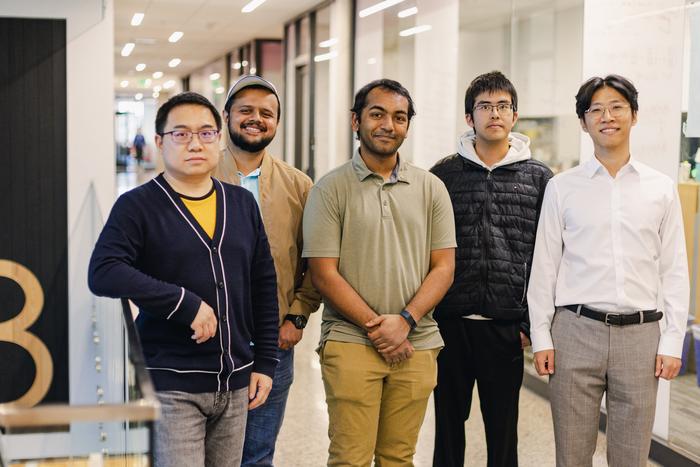
Zhang’s collaborator, doctoral student Tianyi Xu, emphasized the importance of distinguishing between the stacking orders of graphene layers, particularly since structures found in nature, like graphite, often contain both hexagonal and rhombohedral stacking. This distinction is crucial not just for understanding the material properties but also for practical applications where differing electron behaviors may be utilized. As they delve deeper into the complexities of these materials, Zhang’s team is corroborated by a tight-knit group of researchers, including doctoral students like Praveen Pai and Ninad Dongre, who are at the forefront of this innovative field.
In their recent publications in esteemed journals such as Science and Nature Physics, the team reported findings indicating that rhombohedral graphene exhibits unique properties, such as superconductivity and novel magnetic characteristics when subjected to specific electric gating conditions. These attributes, typically not seen in conventional semiconductors, suggest that rhombohedral graphene could allow the simultaneous exhibition of multiple electronic phenomena within the same device. As Pai noted, the ability to switch between different electronic states within a single material adds exciting possibilities for future electronic devices, including those that leverage the quantum anomalous Hall effect.
One of the major hurdles in studying rhombohedral graphene lies in the fabrication of isolated samples. As Dr. Chiho Yoon, another pivotal member of the research group, pointed out, samples often consist of mixed stacking orders, making it crucial to effectively isolate regions that exhibit the desired rhombohedral characteristics. This process of isolating the ABC stacking regions from the AB stacking areas is a challenging yet vital step for detailed analysis and application of the material in device fabrication. The ability to accurately identify and manipulate these structures is being supported by cutting-edge nanotechnologies in collaboration with experimental physicists at research institutions.
Zhang’s recent achievements, including his selection for the prestigious Humboldt Research Award, further highlight the significant impact of his work in the field of condensed matter physics. This accolade is not merely a recognition of past accomplishments but also an acknowledgment of Zhang’s potential to contribute further groundbreaking insights into the realm of two-dimensional materials. His dedication to advancing our understanding of the electronic properties of layered materials is inspiring a new generation of scientists who aim to unravel the complexities of material behavior at the nanoscale.
The area of layered two-dimensional materials remains vibrant and contentious, as researchers strive to push the boundaries of our understanding and capabilities. The ability to dynamically tune the properties of rhombohedral graphene suggests profound implications not only for fundamental research but also for practical applications across a spectrum of technologies, including quantum computing and next-generation electronic devices. With ongoing funding from the National Science Foundation, Zhang and his team are at the forefront of this exciting research landscape, which promises to revolutionize our approach to materials science and engineering.
In summary, the research being conducted on rhombohedral graphene at the University of Texas at Dallas holds immense promise for the future of electronics and materials science. As insights into the unique electronic properties of stacked graphene layers accumulate, they will undoubtedly inspire further investigations and innovations in the industry. Understanding how to manipulate and optimize the behavior of these materials is a critical step toward realizing their full potential in advanced applications. The evolution of this research continues to garner attention, and the excitement around it is palpable as scientists and students alike contribute to the unfolding story of graphene.
As the field progresses, the concept of reconfigurable electronics powered by the unique properties of materials like rhombohedral graphene may redefine our understanding of semiconductor technology. The prospects of superconductivity, magnetic phenomena, and enhanced electronic behavior in a single device encapsulate a transformative journey that has only just begun.
Through their perseverance and collaborative spirit, the team led by Dr. Zhang is helping to write the future of electronics and materials science. Their work exemplifies the potential lying within advanced research, where insights into complex materials can pave the way for groundbreaking innovations that can shape the technologies of tomorrow. By continuing to investigate how graphene layers behave when stacked and manipulated, scientists will undoubtedly uncover further secrets of this remarkable material.
Subject of Research: Rhombohedral graphene and its electronic properties
Article Title: Scientists Tune In to Rhombohedral Graphene’s Potential
News Publication Date: October 2023
Web References: 1, 2, 3, 4, 5, 6, 7, 8
References: Articles by Dr. Fan Zhang and his research group in Science and Nature Physics
Image Credits: University of Texas at Dallas
Keywords
Graphene, Two-dimensional materials, Semiconductors, Quantum physics, Materials science, Rhombohedral stacking, Electronic properties, Superconductivity, Nanotechnology.
Tags: advanced materials researchbreakthroughs in graphene technologycarbon-based materials innovationchiral stacking arrangementselectronic properties of graphenegraphene conductivity and structuregraphene semiconductor applicationsimplications of graphene stackingmulti-layered graphene researchphysicists and engineers graphene studiesrhombohedral graphene propertiesUniversity of Texas at Dallas scientists