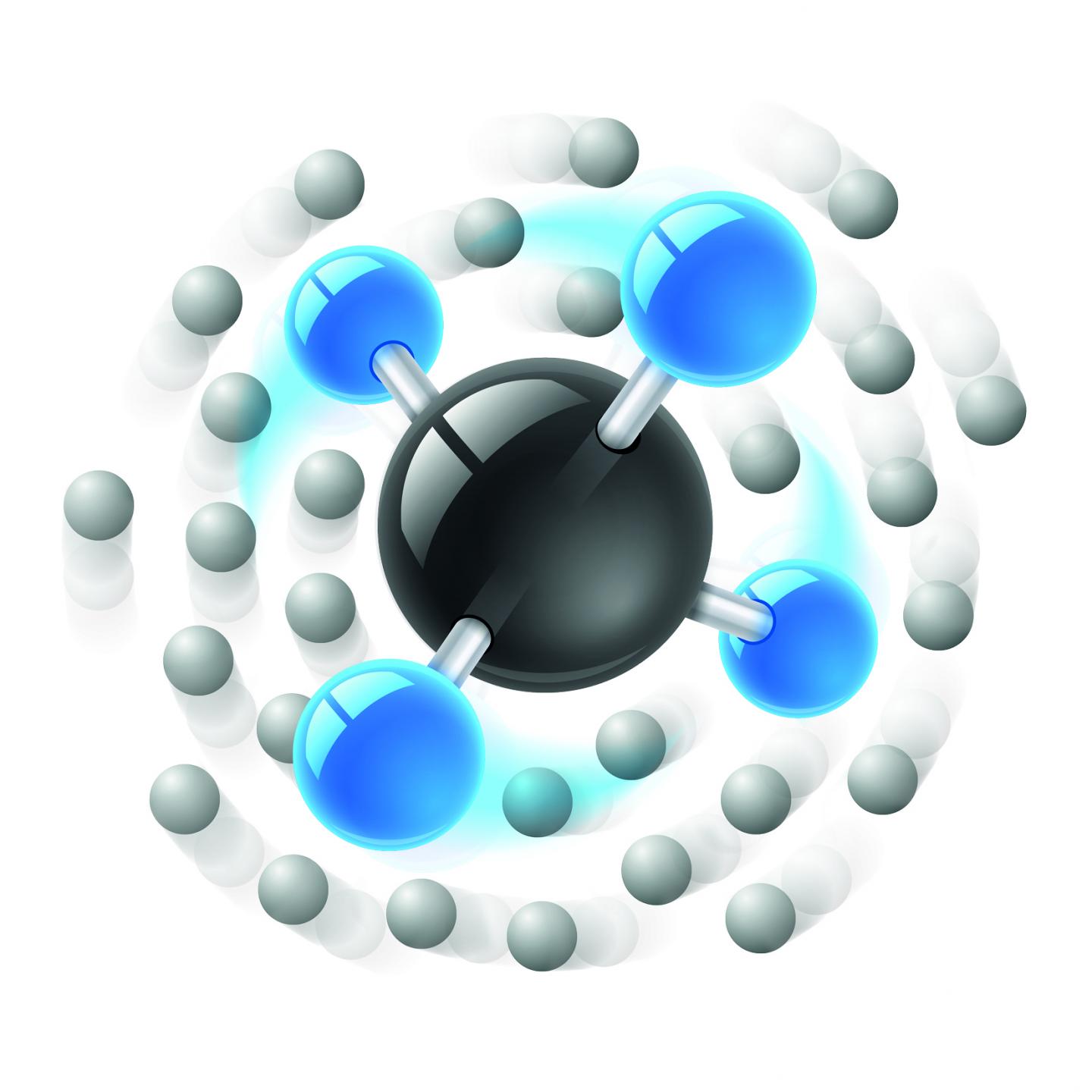
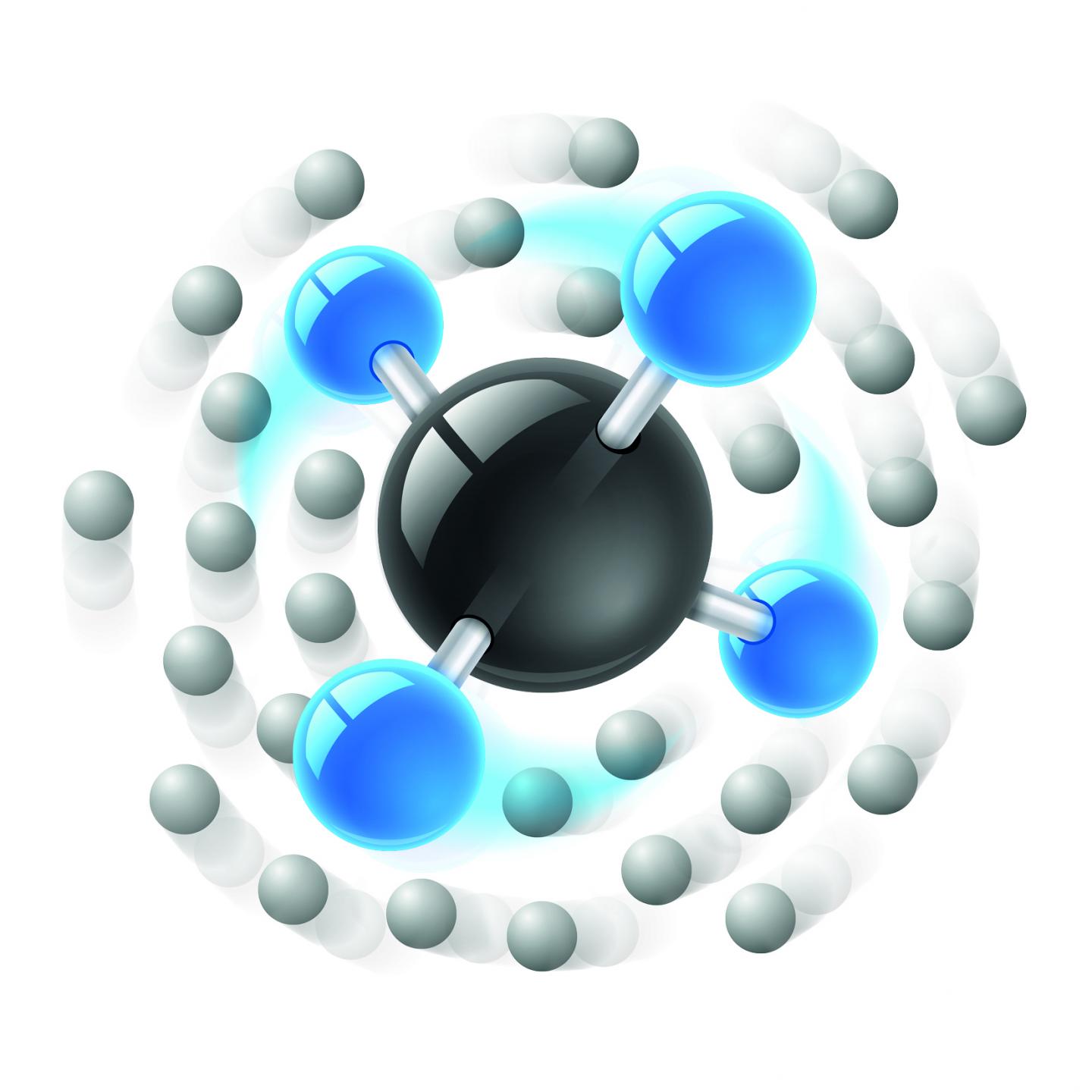
Credit: IST Austria
How do molecules rotate in a solvent? Answering this question is a complicated task since the molecular rotation is perturbed by a very large number of surrounding atoms. For a long time, large-scale computer simulations have been the main approach to model molecule-solvent interactions. However, they are extremely time consuming and sometimes completely infeasible. Now, Mikhail Lemeshko from the Institute of Science and Technology Austria (IST Austria) has proven that angulons — a certain type of quasiparticle he proposed two years ago – do in fact form when a molecule is immersed in superfluid helium. This offers a quick and simple description for rotation of molecules in solvents.
In physics, the concept of quasiparticles is used as a technique to simplify the description of many-particle systems. Namely, instead of modeling strong interactions between trillions of individual particles, one identifies building blocks of the system that are interacting with one another only weakly. These building blocks are called quasiparticles and might consist of groups of particles. For example, to describe air bubbles rising up in water from first principles, one would need to solve an enormous set of equations describing the position and momentum of each water molecule. On the other hand, one could notice that the bubbles themselves can be treated as individual particles — or quasiparticles — which drastically simplifies the description of the system. As another example, consider a running horse engulfed in a cloud of dust. One can think of it as a quasiparticle consisting of the horse itself and the dust cloud moving along with it. Understanding what is going on in terms of such a 'quasi-horse' is substantially easier compared to treating every dust grain, as well as the horse, separately in a complicated simulation.
The latter example is similar to what Mikhail Lemeshko did in his study. Instead of treating the rotating molecule and all the atoms of the surrounding material separately, he used angulons to look at the problem from a different perspective. Angulon quasiparticles, which form when a rotating object interacts with a surrounding environment, were predicted theoretically two years ago by Lemeshko and Schmidt. Until now, however, they were considered only theoretically and their actual existence was still to be demonstrated. Lemeshko's study, which was published today in Physical Review Letters, is based on experimental data collected by several laboratories over the last two decades. All the experiments had one thing in common: molecules of different types were observed to rotate inside tiny droplets of superfluid helium. As Lemeshko has shown, independent of which molecule was studied, be it heavy or light species, methane, water, carbon dioxide or ammonia, the outcome of the angulon theory was always in good agreement with the measurements. This indicates that the angulon quasiparticles indeed form inside helium droplets.
"In our first study we proposed angulons as a possibility for describing rotation of molecules in solvents. Now we have provided strong evidence that angulons actually exist," says Lemeshko. This substantially simplifies existing many-particle theories and could lead to applications in molecular physics, theoretical chemistry, and even biology.
A first application of the angulon theory was already found by Enderalp Yakaboylu, a postdoc in Lemeshko's group. The authors predicted that even a medium that is non-polarizable can shield an immersed impurity from an external electromagnetic field. This effect, which seems to contradict intuition, is called "anomalous screening" and is caused by an exchange of angular momentum on quantum level. The discovery, which the authors also publish in Physical Review Letters, was made possible by describing the charged particle and the interacting surroundings as angulon quasiparticle. Future measurements will show if the prediction can be proven experimentally.
###
Mikhail Lemeshko joined IST Austria in 2014 after having spent three years as an independent postdoctoral fellow at Harvard University. His research group entitled "Theoretical Atomic, Molecular, and Optical Physics" currently includes three postdocs and one PhD student. The main focus of study is the physics of quantum impurities possessing orbital angular momentum. He was recently awarded a standalone grant by the Austrian Science Fund (FWF) to continue his work on angulons. Enderalp Yakaboylu is a postdoc in IST Austria's ISTFELLOW program which is partially funded by the European Union.
Media Contact
Elisabeth Guggenberger
[email protected]
43-022-439-000-1199
@istaustria
http://Www.ist.ac.at
############
Story Source: Materials provided by Scienmag