• HOME
  • NEWS
  • EXPLORE
    • CAREER
      • Companies
      • Jobs
    • EVENTS
    • iGEM
      • News
      • Team
    • PHOTOS
    • VIDEO
    • WIKI
  • BLOG
  • COMMUNITY
    • FACEBOOK
    • INSTAGRAM
    • TWITTER
Wednesday, April 1, 2026
BIOENGINEER.ORG
No Result
View All Result
  • Login
  • HOME
  • NEWS
  • EXPLORE
    • CAREER
      • Companies
      • Jobs
        • Lecturer
        • PhD Studentship
        • Postdoc
        • Research Assistant
    • EVENTS
    • iGEM
      • News
      • Team
    • PHOTOS
    • VIDEO
    • WIKI
  • BLOG
  • COMMUNITY
    • FACEBOOK
    • INSTAGRAM
    • TWITTER
  • HOME
  • NEWS
  • EXPLORE
    • CAREER
      • Companies
      • Jobs
        • Lecturer
        • PhD Studentship
        • Postdoc
        • Research Assistant
    • EVENTS
    • iGEM
      • News
      • Team
    • PHOTOS
    • VIDEO
    • WIKI
  • BLOG
  • COMMUNITY
    • FACEBOOK
    • INSTAGRAM
    • TWITTER
No Result
View All Result
Bioengineer.org
No Result
View All Result
Home NEWS Science News

Chemoselective acetalization by a bifuncional cerium phosphate catalyst

Bioengineer by Bioengineer
February 28, 2017
in Science News
Reading Time: 2 mins read
0
Share on FacebookShare on TwitterShare on LinkedinShare on RedditShare on Telegram
IMAGE

Credit: Tokyo Institute of Technology

Acid-base bifunctional catalysts exhibit wide applicability for atom-efficient functional group transformation, tandem reactions, and asymmetric synthesis. In heterogeneous catalysis, the acid-base properties of metal-oxide-based materials have been extensively studied. Nevertheless, it is difficult to construct uniform acid-base sites with controlled electrical and structural properties, which in turn restrains the fine-tuning and reactivity of catalysts. Although oxide surfaces can be readily modified with organic acids or bases, organic functional groups are susceptible to oxidation or thermal degradation, limiting the utility of such catalysts. Thus, it is imperative to design novel high-performance inorganic heterogeneous acid-base catalysts, especially for the manufacture of high value-added products from renewable biomass as a sustainable feedstock.

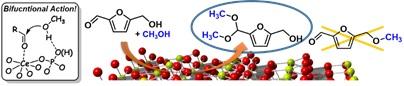
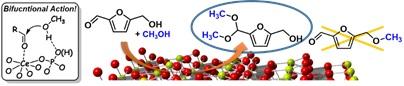
In this regard, a team of scientists led by Michikazu Hara (Tokyo Institute of Technology) has reported the highly chemoselective acetalization of biomass-derived 5-hydroxymethylfurfural (HMF) with alcohols using a monoclinic CePO4. CePO4, corresponding to rare earth (RE) orthophosphates, are expected to be suitable bifunctional acid-base catalysts, where the synergistic promotion of electrophilicity and nucleophilicity in reactive partners could be achieved.

Mechanistic studies indicated that CePO4 most probably serves as a bifunctional catalyst via the interaction of uniform Lewis acid and weak base sites with HMF and alcohol molecules, respectively, leading to high catalytic performance. Activation of HMF and methanol by CePO4 facilitates the nucleophilic attack of OH in methanol on the carbon atom of C=O, affording the hemiacetal derivative. Next, the reaction between the derivative and methanol by the assistance of CePO4 leads to the acetal. The effectiveness of the bifunctional properties of CePO4 was evidenced by the wide applicability to various acetals including industrially important solketal.

This study discusses a promising strategy employing highly efficient heterogeneous catalysts via the non-dissociative activation of electrophiles and nucleophiles under extremely mild conditions.

###

Media Contact

Emiko Kawaguchi
[email protected]
81-357-342-975

http://www.titech.ac.jp/english/index.html

############

Story Source: Materials provided by Scienmag

Share12Tweet8Share2ShareShareShare2

Related Posts

Scientists Unveil Innovative Catalyst Boosting Syngas-to-Light Olefins Conversion Efficiency

Scientists Unveil Innovative Catalyst Boosting Syngas-to-Light Olefins Conversion Efficiency

April 1, 2026
UCLA Researchers Highlight the ‘Body Gap’ in AI: Why Lacking Human Experience Could Impact Safety

UCLA Researchers Highlight the ‘Body Gap’ in AI: Why Lacking Human Experience Could Impact Safety

April 1, 2026

NIH Scientists Develop Pain-Relief Drug with Low Addiction Risk

April 1, 2026

New UBC Study Reveals Aquaculture Trends Moving Toward Less Sustainable Species

April 1, 2026
Please login to join discussion

POPULAR NEWS

  • blank

    Revolutionary AI Model Enhances Precision in Detecting Food Contamination

    96 shares
    Share 38 Tweet 24
  • Imagine a Social Media Feed That Challenges Your Views Instead of Reinforcing Them

    1006 shares
    Share 398 Tweet 249
  • Promising Outcomes from First Clinical Trials of Gene Regulation in Epilepsy

    51 shares
    Share 20 Tweet 13
  • Popular Anti-Aging Compound Linked to Damage in Corpus Callosum, Study Finds

    43 shares
    Share 17 Tweet 11

About

We bring you the latest biotechnology news from best research centers and universities around the world. Check our website.

Follow us

Recent News

Scientists Unveil Innovative Catalyst Boosting Syngas-to-Light Olefins Conversion Efficiency

UCLA Researchers Highlight the ‘Body Gap’ in AI: Why Lacking Human Experience Could Impact Safety

NIH Scientists Develop Pain-Relief Drug with Low Addiction Risk

Subscribe to Blog via Email

Enter your email address to subscribe to this blog and receive notifications of new posts by email.

Join 78 other subscribers
  • Contact Us

Bioengineer.org © Copyright 2023 All Rights Reserved.

Welcome Back!

Login to your account below

Forgotten Password?

Retrieve your password

Please enter your username or email address to reset your password.

Log In
No Result
View All Result
  • Homepages
    • Home Page 1
    • Home Page 2
  • News
  • National
  • Business
  • Health
  • Lifestyle
  • Science

Bioengineer.org © Copyright 2023 All Rights Reserved.