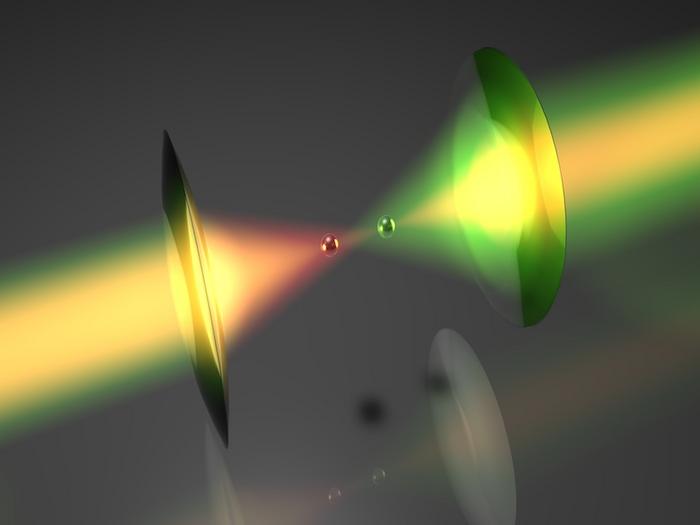

A groundbreaking study published in the esteemed journal Optica introduces a novel experimental instrument poised to transform our understanding of the intricate boundary between classical and quantum physics. This innovative apparatus has been developed through collaborative efforts in Florence, uniting several prestigious institutions including the National Quantum Science and Technology Institute (NQSTI), the Department of Physics and Astronomy at the University of Florence, the National Institute of Optics (CNR-INO), along with contributions from the European Laboratory for Nonlinear Spectroscopy (LENS) and the Florence branch of the National Institute for Nuclear Physics (INFN).
As we venture deeper into the microscopic realm, the behavior of matter becomes increasingly enigmatic, often leading to phenomena that defy our classical intuitions. The research team, led by the esteemed physicist Francesco Marin, has harnessed this complexity to develop an instrument that allows simultaneous observation of phenomena influenced by both classical and quantum principles. By bridging these two worlds, researchers hope to illuminate the mechanisms that govern the behavior of matter at both macroscopic and microscopic scales.
This groundbreaking device capitalizes on the physics of optical trapping, a phenomenon first documented in the 1980s, which allows for the manipulation of individual particles using focused laser beams. This technique was notably advanced by Arthur Ashkin, whose pioneering work earned him the Nobel Prize in Physics in 2018. The current research team has taken this concept a step further, utilizing dual-colored beams of light to trap and study glass nanospheres, enabling the observation of oscillatory behaviors inherent to both classical dynamics and quantum mechanics.
Within this sophisticated optical setup, the trapped nanospheres exhibit frequencies of oscillation that provide insights into their interactions, revealing how they respond to one another under various conditions. This experimental approach enables researchers to explore the rich dynamics of coupled nanosystems, where the intricacies of classical and quantum interactions can be meticulously examined. Such studies could potentially shed light on the fundamental processes governing collective behavior in nanoscale systems.
The innovative aspects of this study extend beyond the mere trapping of particles; they delve into the heart of the quantum-classical divide. According to Marin, the system allows scientists to manipulate electrically charged nanospheres, which interact with one another, making it possible to study their trajectories and collective dynamics in a highly controlled environment. This interplay between the macroscopic and microscopic realms could unveil new dimensions of physics that have remained largely uncharted.
Furthermore, this research has been supported by significant funding from the European Union as part of the #NextGenerationEU initiative, specifically through the National Recovery and Resilience Plan (PNRR). This backing highlights the growing recognition of quantum sciences and photonics as vital fields for future technological advancements and scientific discovery. By establishing a strong research infrastructure, the project not only aims to advance fundamental science but also seeks to inspire a new generation of quantum technologies.
The potential applications of this research span a multitude of fields, including quantum computing, advanced materials science, and nanoscale sensors. As the boundaries of our understanding expand, so does the potential for transformative breakthroughs that could redefine technologies as we know them. By delving into the quantum effects of collective behaviors, scientists may unlock new avenues for developing next-generation devices with unprecedented capabilities.
As research continues to probe the quantum realm’s complexities, the hope is to achieve a more comprehensive understanding of how classical and quantum behaviors intertwine. This study marks a significant step toward reconciling our classical intuitions with the counterintuitive nature of quantum mechanics. It raises exciting questions about the behavior of matter, challenging conventional wisdom and offering a tantalizing glimpse into the future of interdisciplinary research at the intersection of physics and technology.
In summary, this pioneering instrument developed by the Florence research team stands as a testament to the power of scientific collaboration. By blending traditional practices with innovative techniques, researchers are setting the stage for groundbreaking discoveries that may ultimately unlock the true nature of our universe. As this field of study progresses, it may not only enhance our fundamental understanding but also inspire new applications that harness the principles of both classical and quantum physics for technological advancements.
The ramifications of this research extend far beyond the confines of the laboratory. Understanding the nuances of how classical and quantum systems interact could have profound implications for various industries. From data processing techniques in quantum computing to advancements in precision measurement systems, the impact of this work could lead to revolutionary changes across multiple domains.
Ultimately, as researchers continue to explore the delicate dance between classical and quantum realms, we may soon witness a paradigm shift in our grasp of the fundamental principles governing the universe. The interplay of these two modes of thought is not merely an academic pursuit; it represents the frontier of scientific exploration, where the very fabric of reality may be reevaluated and redefined.
Subject of Research: Not applicable
Article Title: Coulomb coupling between two nanospheres trapped in a bichromatic optical tweezer
News Publication Date: 20-Dec-2024
Web References: Not available
References: Not available
Image Credits: Marco Bellini (Cnr-Ino)
Keywords
Quantum physics, Classical physics, Optical trapping, Nanospheres, Experimental study, Quantum mechanics, Interdisciplinary research, National Quantum Science and Technology Institute, CNR-INO, Florence, Coulomb coupling, Bichromatic optical tweezer.
Tags: advancements in quantum scienceclassical vs quantum physicscollaborative scientific efforts in FlorenceFrancesco Marin’s contributionsinnovative experimental instrumentsinterdisciplinary research in physicsmechanisms of matter behaviorNano-oscillator developmentNational Quantum Science and Technology Institutenonlinear spectroscopy applicationsoptical trapping technologyUniversity of Florence physics research