In recent years, the fight against cancer has taken center stage in the medical community, as researchers strive to improve diagnostic techniques and patient outcomes. According to the World Health Organization, cancer was responsible for nearly 10 million deaths globally in 2020, accounting for about one in every six fatalities. This sobering statistic emphasizes the urgency for advancements in early detection methods, which could potentially save countless lives. One promising avenue of research that has garnered attention is the detection of circulating tumor cells (CTCs) found in peripheral blood, which serve as valuable non-invasive biomarkers for cancer diagnosis.
The challenge of accurately separating and diagnosing these rare CTCs is daunting, given traditional methods often require complex sample preparations, significant amounts of equipment, and large sample volumes. Even then, the efficiency of the separation process remains a critical issue. Fortunately, new methodologies are emerging that promise to revolutionize the way we approach cancer diagnostics. A groundbreaking study published in the journal Physics of Fluids by researchers Afshin Kouhkord and Naser Naserifar from K. N. Toosi University of Technology aims to address these challenges by introducing a novel microfluidic system that utilizes standing surface acoustic waves for CTC separation.
Kouhkord and Naserifar’s research focuses on integrating advanced computational modeling, experimental analysis, and artificial intelligence algorithms to create an innovative system that separates CTCs from red blood cells with unprecedented efficiency. Their work leverages the power of machine learning to optimize the parameters necessary for effective cell separation. The use of AI not only enhances the accuracy of cell recognition and extraction but also has the potential to greatly reduce energy consumption associated with the separation process.
At the heart of their research lies the concept of acoustofluidics, which combines acoustics and fluid dynamics in micro-scale applications. This technology harnesses high-frequency sound waves to manipulate particle movement within fluid, allowing for a non-invasive and biocompatible method of isolating CTCs. The precision of this approach can lead to a more effective separation process, which is pivotal for achieving reliable test results in cancer diagnostics. Traditionally, CTCs have been exceptionally difficult to isolate due to their rarity, meaning that even slight enhancements in technology can yield significant improvements in the sensitivity and specificity of cancer detection methods.
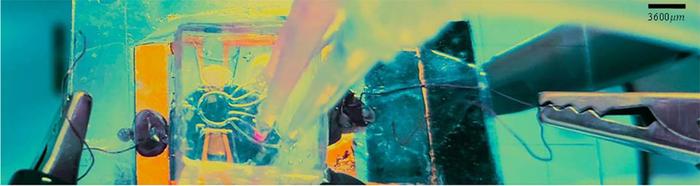
The researchers employed a particularly innovative technique involving dualized pressure acoustic fields, which essentially doubles the mechanical effect on target cells. By strategically positioning these acoustic fields at critical locations within the channel geometry on a lithium niobate substrate, they were able to optimize the interaction between the sound waves and the cellular structures. This setup allows for the generation of reliable datasets that offer insights into the trajectories and interaction times of cancer cells as they move through the microfluidic system. The implications of such a design are immense, as understanding these parameters could enable more accurate predictions regarding tumor cell migration and behavior.
Kouhkord articulated the significance of this advanced lab-on-chip platform, emphasizing its potential for real-time operation. The capability for rapid, energy-efficient, and highly accurate cell separation represents a meaningful stride toward earlier cancer diagnosis. By refining the process of capturing CTCs, this technology not only enhances diagnostic windows but lays the groundwork for personalized medicine approaches. With the ability to analyze a patient’s specific cancer profile based on the presence and characteristics of CTCs, clinicians could tailor treatment plans that respond effectively to individual tumor dynamics.
The potential impact of this research on the field of cancer diagnostics cannot be overstated. The concepts explored within this study may catalyze further developments across various areas, such as targeted therapies and real-time monitoring of treatment progress. The interplay between microengineering, artificial intelligence, and clinical applications is becoming increasingly relevant, as healthcare disciplines seek innovative solutions to age-old problems. By effectively isolating and analyzing CTC populations, there’s hope for more informed treatment options, potentially leading to reduced morbidity and mortality rates associated with cancer.
In conclusion, Kouhkord and Naserifar’s research serves as an inspiring testament to the promise of interdisciplinary collaboration and technological advancement in the fight against cancer. As they prepare for the article’s publication in Physics of Fluids, anticipation grows within the scientific community regarding the real-world applications that may arise from their findings. It reflects a larger movement toward harnessing the power of technology to enhance healthcare outcomes, particularly in oncology.
Such advancements not only pave the way for enhanced research methodologies but also directly translate into improved patient care and outcomes. As this work continues to evolve, it will be exciting to witness how these innovative techniques can reshape the landscape of cancer diagnostics and treatment.
Through ongoing efforts, the goal remains to forge a path toward earlier detection and improved patient management, ultimately curbing the global impact of cancer and saving lives.
Subject of Research: Ultrasound-assisted microfluidic cell separation for enhanced cancer diagnosis
Article Title: Ultrasound-assisted microfluidic cell separation – A study on microparticles for enhanced cancer diagnosis
News Publication Date: 28-Jan-2025
Web References: Physics of Fluids Journal
References: DOI: 10.1063/5.0243667
Image Credits: Afshin Kouhkord and Naserifar Naser
Keywords
Cancer research, Separation methods, Applied acoustics, Medical diagnosis, Target cells, Microfluidics
Tags: cancer diagnostics advancementschallenges in cancer cell separationcirculating tumor cells detectioncomplex sample preparation for diagnosticsearly detection methods for cancerimproving patient outcomes in oncologyinnovative cancer research techniqueslab-on-chip technologymicrofluidic systems for diagnosticsnon-invasive cancer biomarkersrevolutionary medical technologies for cancerstanding surface acoustic waves in medicine